
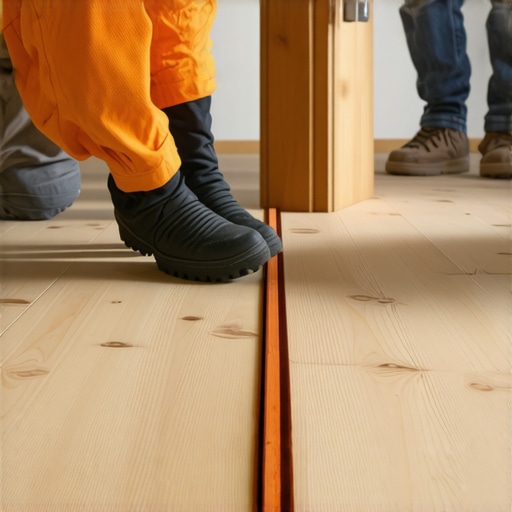
The Magnet Trick for Finding Floor Joists Under Hardwood
Most guys skip the leveling compound. They think the underlayment will hide the dip. It won’t. I spent three days grinding concrete on a job last month just so the floor wouldn’t click like a castanet. The homeowner had bought a high-end French Oak, but the slab looked like the surface of the moon. If I hadn’t spent those seventy-two hours with a seven-inch diamond cup wheel and a HEPA vacuum, that floor would have failed in six months. The locking mechanisms would have snapped. The client would have sued. That is the reality of the trade. You cannot build a monument on a swamp. Flooring is a structural engineering challenge. It is not a cosmetic choice. If you do not understand what is happening beneath the surface, you are just a salesman with a hammer.
The steel signal hidden in the grain
The magnet trick for finding floor joists under hardwood involves using a high-powered Neodymium magnet to locate the steel fasteners that secure the subfloor to the joists. This method is the most reliable way to map the structural skeleton of a room without drilling pilot holes or using expensive, often inaccurate electronic stud finders. By sliding a rare earth magnet across the finished surface, you can pinpoint the exact location of the floor cleats or staples. These fasteners are driven directly into the center of the joists during the initial subfloor installation. Once you find a line of these fasteners, you have found your joist. This is vital for projects where you need to anchor a heavy kitchen island or install a new partition wall directly into the framing. The physics of magnetism allows the flux lines to penetrate three-quarters of an inch of solid oak or maple to find the carbon steel screw or nail below. Standard refrigerator magnets lack the coercive force to detect these small targets through dense wood fibers. You need an N52 grade Neodymium magnet. These magnets have a high remanence and energy product, which means they can pull toward a fastener even through thick wear layers and subfloor material. When the magnet sticks, you mark the spot with a piece of blue painter tape. Repeat this every few feet and you will see a clear line forming. That line is your structural support.
“A floor is only as good as the subfloor beneath it; deflection is the enemy of every joint.” – Master Flooring Axiom
Why your subfloor is lying to you
Subfloor flatness is the single most ignored variable in modern flooring installations, leading to premature failure of locking systems and persistent squeaks. You might look at a plywood sheet and think it is flat. It is not. Plywood and OSB are organic products that react to the ambient relative humidity of the home. When a subfloor is fastened to the joists, it can develop slight undulations between the spans. These dips and crowns are magnified when you lay down hardwood floors or laminate. A dip of just three-sixteenths of an inch over a ten-foot span can cause the floor to bounce when you walk on it. This bounce creates a vacuum effect. It sucks air and dust through the joints. Over time, the constant movement grinds the tongues and grooves of your planks into sawdust. This is why mapping the joists is so important. If you know where the joists are, you can add structural screws to pull the subfloor tighter to the framing, eliminating the gap that causes the noise. In many cases, the squeak isn’t the hardwood itself. It is the subfloor rubbing against a nail that has pulled loose from the joist. By finding the joist with your magnet, you can drive a new screw and kill the squeak forever. This level of detail is what separates a master installer from a handyman. You have to listen to the house. You have to feel the vibration of the subfloor under your boots. If it feels soft, it is wrong. There is no middle ground in structural integrity.
The 1/8 inch that ruins everything
Adherence to the National Wood Flooring Association standards requires a subfloor to be flat within one-eighth of an inch over a six-foot radius. If you exceed this tolerance, you are asking for trouble. When we talk about hardwood floors, we are talking about a material that wants to move. Wood is hygroscopic. It breathes. It expands and contracts with the seasons. If the floor is pinned down or if it sits over a hollow spot, those forces have nowhere to go. They will find the weakest point. Usually, that is the joint. In laminate installations, the situation is even more dire. Laminate relies on a click-lock system that is often made of high-density fiberboard. If the floor deflects too much, those thin plastic or fiberboard tabs will simply snap. Once they snap, the boards separate. Now you have a gap that collects dirt and moisture. You can’t fix a broken locking tab. You have to rip out the floor. This is why I preach the gospel of the level and the magnet. You map the joists. You check the flatness. You grind the high spots. You fill the low spots. It is a tedious process. It is dusty. It is loud. But it is the only way to ensure that the floor will last for fifty years instead of five. Most people want the job done fast. I want the job done once.
| Floor Type | Acclimation Time | Deflection Limit | Moisture Content Max |
|---|---|---|---|
| Solid Hardwood | 7 to 14 days | L/360 | 6% to 9% |
| Engineered Wood | 3 to 5 days | L/360 | 7% to 10% |
| Laminate | 48 hours | L/240 | N/A |
| Ceramic Tile | N/A | L/720 | Slab must be dry |
The ghost in the expansion gap
An expansion gap is a mandatory space left around the perimeter of a room to allow the flooring material to move without buckling. Wood expands across the grain significantly more than it does along the length of the board. For a typical solid oak floor, you need at least a half-inch gap at every wall. If you run the wood tight to the drywall, the floor will eventually crown. In the humid months, the wood cells soak up water vapor and swell. If they hit a wall, they have no choice but to push upward. This creates a hump in the middle of the room. I have seen entire floors lift three inches off the subfloor because the installer didn’t leave a gap. People think the baseboard will hide the mistake. It won’t. The baseboard should sit on top of the floor, not pin it down. This same logic applies to showers and tile work. While tile doesn’t expand like wood, the house itself moves. If you don’t use a flexible grout or a silicone caulk at the change of plane in a shower, the grout will crack. It is inevitable. The intersection of two walls or a wall and a floor is a pivot point. The house breathes. The wood frame shifts. If your grout is rigid, it will crumble. This is why we use 100% silicone in the corners of showers. It can stretch. It can compress. It is a technical solution to a physical reality. If you ignore the physics, you are just painting the floor with wood and stone. You aren’t building anything.
Comparing hardwood floors and laminate
Hardwood floors offer a structural and aesthetic longevity that laminate cannot match, although laminate provides a cost-effective alternative for low-moisture environments. Solid hardwood is 3/4 inch of pure timber. It can be sanded and refinished five or six times. It adds actual value to the home. Laminate is a photograph of wood glued to a core of compressed sawdust and resin. It is a floating floor. It is not attached to the subfloor. This means it can feel hollow underfoot. To mitigate this, people often buy the thickest underlayment they can find. This is a mistake. Too much cushion under a laminate floor allows for too much vertical movement. This movement puts stress on the locking joints. I recommend a high-density rubber or felt underlayment that is no thicker than 3mm. You want support, not a mattress. Furthermore, hardwood requires acclimation. You cannot just bring the wood from the warehouse and nail it down. It needs to sit in the room for at least a week. The moisture content of the wood must be within 2% of the moisture content of the subfloor. If you skip this, the floor will shrink or swell immediately after installation. Laminate also needs 48 hours to adjust to the temperature, but it is far less sensitive to humidity than solid oak or walnut. Each material has its place, but neither will perform if the joists aren’t mapped and the subfloor isn’t prepped.
Moisture and the chemistry of failure
The chemical bond of adhesives and the structural integrity of wood fibers are both compromised by excessive moisture vapor transmission through the subfloor. If you are installing over a concrete slab, you must perform a calcium chloride test or use an in-situ probe to measure the relative humidity. A slab might look dry, but it is a sponge. It is constantly pulling moisture from the earth. If you trap that moisture under a layer of plastic or wood, it will build up. This leads to mold, odors, and the delamination of engineered wood. In showers, the grout acts as the first line of defense, but it is not waterproof. Water passes through grout. This is why the waterproofing membrane behind the tile is the most important part of the build. Whether you use a liquid-applied membrane or a sheet-bonded system like Kerdi, it must be continuous. The same goes for the vapor retarder under hardwood. We use 15-pound felt paper or a specialized synthetic barrier. This doesn’t stop moisture; it slows it down. It allows the wood to adjust gradually. If you use a total vapor barrier on a wood subfloor over a crawlspace, you can actually rot the subfloor from the bottom up. The moisture gets trapped in the plywood. You have to let the assembly breathe. It is a delicate balance of chemistry and physics. You have to know when to seal and when to vent. If you don’t, you are just waiting for the phone to ring with a complaint. And I hate those calls.
“Deflection is not just a number on a chart; it is the sound of a floor dying.” – NWFA Technical Manual
- Verify subfloor thickness is at least 3/4 inch for joists spaced 16 inches on center.
- Use a Neodymium magnet to map the joist paths across the entire room.
- Check the moisture content of the subfloor at twenty different points per 1,000 square feet.
- Ensure the environment is atThe Magnet Trick for Finding Floor Joists Under Hardwood