
Most guys skip the leveling compound. They think the underlayment will hide the dip. It won’t. I spent three days grinding concrete on a job last month just so the floor wouldn’t click like a castanet. I smell like WD-40 and oak dust most days, and my knees are shot, but my floors do not move. If you are looking for a cosmetic fix, you are in the wrong place. We are talking about the structural integrity of hardwood floors and the precise engineering required to handle vertical obstructions like radiator pipes and plumbing stacks. A floor is a performance surface that must withstand thermal expansion, moisture migration, and the relentless pull of gravity. When you encounter a pipe, you are not just making a hole. You are creating a relief valve for the entire installation.
The margin of error in a mechanical room
Hardwood installation around pipes requires a contour gauge to capture the specific diameter and offset of the plumbing. Most failures in flooring occur because the installer treated the plank as a static object. Wood is hygroscopic. It is a bundle of cellulose tubes that expand and contract with the relative humidity of the room. When you cut a hole for a pipe, you must account for the expansion gap required by NWFA standards. This gap is usually one quarter of an inch. If you cut the hole too tight, the wood will eventually press against the copper or iron pipe, causing the board to cup or the joint to fail. I have seen entire living rooms buckle because one single plank was pinned against a steam pipe.
“A floor is only as good as the subfloor beneath it; deflection is the enemy of every joint.” – Master Flooring Axiom
Why your subfloor is lying to you
Subfloor flatness is the primary requirement for any successful flooring project involving laminate or hardwood. You might look at your plywood and think it is level, but the contour gauge will reveal the truth when you try to seat a plank around a fixed point. If the subfloor has a dip near the pipe, the plank will bounce every time someone walks past it. This movement creates a mechanical stress on the cut area. Over time, the wood will splinter. You must use a self-leveling underlayment or Portland-based patch to ensure the surface is within three sixteenths of an inch over a ten foot span. Without this, your expensive white oak is just expensive firewood.
The physics of the steel pin contour gauge
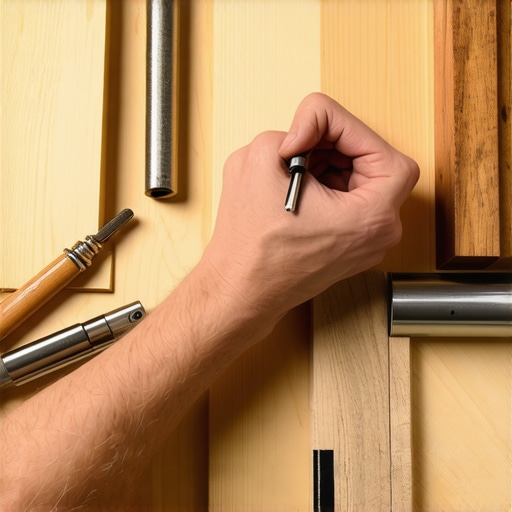
Contour gauges work by independent pin movement to replicate complex shapes onto a workpiece. I prefer the steel pin versions over the plastic ones. The steel pins are thinner and allow for a more granular capture of the pipe’s radius. You press the tool against the pipe, and the pins slide back to create a perfect negative. You then lock the gauge and transfer that shape to your hardwood plank. You are not just drawing a circle. You are drawing the exact intersection of a cylinder and a plane. The Janka hardness of the wood also matters here. If you are working with Brazilian Cherry, which is incredibly dense, your jigsaw blade will heat up and potentially scorch the finish. You need a carbide-tipped blade with a high tooth count to ensure the cut is clean and does not tear the wood fibers.
Moisture content and the cellular structure of oak
Moisture meters are essential tools for measuring the equilibrium moisture content of hardwood floors before installation. If you are installing hardwood floors in a high-humidity region like New Orleans, that wood is going to grow. If you are in the high desert of Arizona, it will shrink. The cellular structure of the wood contains lignin and cellulose, which react to water vapor in the air. When you make your cut around a pipe, you are exposing the end grain of the wood. This is the most vulnerable part of the plank. I always recommend sealing the inside of the cut with a bit of polyurethane to prevent moisture from the subfloor or the pipe from wicking into the board. This prevents localized swelling that can ruin the aesthetics of your transition.
The 1/8 inch that ruins everything
Precision cutting with a jigsaw requires a stable platform and a sharp blade to maintain a consistent kerf. If your cut is off by even an eighth of an inch, the escutcheon plate or pipe collar might not cover the gap. This leaves a visible hole where grout or caulk might be tempted but should never be used. I have seen guys try to fill these gaps with silicone, and it looks like garbage within six months. The floor moves, the caulk doesn’t, and you end up with a sticky mess that attracts dust. Use the contour gauge. Take your time. Trace the line with a sharp 2H pencil. Use a scroll saw or a jigsaw with the pendulum setting turned off for maximum control.
Transitions near showers and wet areas
Waterproof flooring near showers often involves laminate or LVP, which requires a watertight seal at the perimeter. While the floor itself might be waterproof, the subfloor is not. If you are running laminate up to a shower stall pipe, you must use a 100 percent silicone sealant in the expansion gap. This is the only place where I allow it. This prevents capillary action from drawing water under the floor. If you are using hardwood near a wet area, you are playing with fire. You need a high-quality moisture barrier and a modified thin-set if you are transitioning to grout and tile. The bond between the wood and the tile is a shear point that will crack if there is any deflection in the joists.
| Wood Species | Janka Hardness Rating | Expansion Rate |
|---|---|---|
| White Oak | 1360 | Moderate |
| Hickory | 1820 | High |
| Black Walnut | 1010 | Low |
| Maple | 1450 | High |
Adhesive bonds and the chemistry of stability
Urethane adhesives provide moisture protection and vibration dampening for glue-down hardwood installations. When you are fitting a plank around a pipe, you cannot rely on the tongue and groove alone to hold it in place. You often have to cut the groove side off to slide the board into position. This is where chemical bonding becomes your best friend. I use a high-grab adhesive that allows for some elastomeric movement. This means the wood can shift slightly without breaking the bond to the subfloor. Most homeowners think glue is just glue. It is not. It is an engineered polymer designed to withstand thousands of pounds of lateral pressure as the house settles and the seasons change.
“Wood does not stop being a tree once it is cut into a plank; it remains a living, breathing organic structure subject to the laws of thermodynamics.” – NWFA Field Manual
Laminate versus solid hardwood around vertical obstructions
Floating floors such as laminate require different cutting techniques compared to solid hardwood because they are not attached to the subfloor. A floating floor moves as a single monolithic slab. If you pin a floating floor at a pipe, you are stopping the movement of the entire room. This will lead to joint separation at the other end of the house. You must leave a larger expansion gap around pipes for laminate than you would for solid wood. I usually go with a full half inch and then use a decorative pipe collar to hide the gap. It is a mechanical necessity, not a suggestion.
The toolkit for pipe penetration perfection
- Contour gauge with steel pins for high-resolution shape capture.
- Jigsaw with a downward-cutting blade to prevent chipping the surface.
- Moisture meter to verify the plank and subfloor are within 4 percent of each other.
- Expansion spacers to maintain the perimeter gap during the cut-and-fit process.
- Oscillating multi-tool for fine-tuning the cut once the plank is in place.
- Wood glue for reinforcing the mitered return if the plank is split behind the pipe.
Grout lines and the myth of waterproof transitions
Tile to hardwood transitions must account for differing expansion rates between ceramic and organic materials. You cannot just butt the wood up to the grout line. The wood will expand and crush the grout into powder. You need a T-molding or a threshold that allows both materials to move independently. If you are running wood around a drain pipe that will eventually be tiled, ensure the waterproofing membrane is not compromised by your flooring cuts. I have seen too many showers leak because an installer notched the subfloor too deeply near the drain. Keep your structural members intact. Use your contour gauge to be surgical. Do not be the guy who uses a hammer to make a piece of wood fit. It will buckle. It will squeak. It will fail. Respect the wood, respect the pipe, and most importantly, respect the physics of the room.