
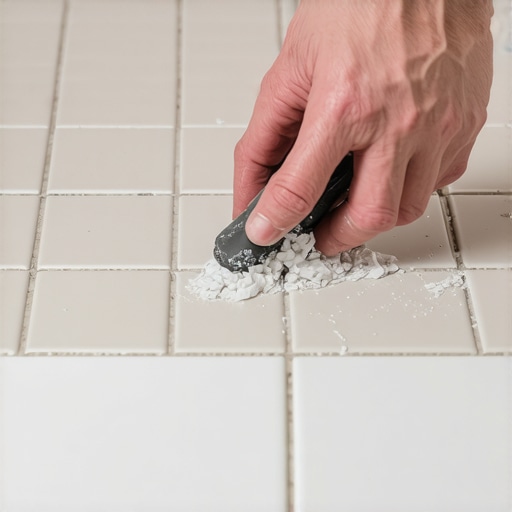
The physics of vibration and the art of the grout joint
I spent three days grinding concrete on a job last month just so the floor wouldn’t click like a castanet. That is the kind of preparation work that makes or breaks an installation. Most guys skip it. They think the underlayment will hide the dip. It won’t. This same philosophy applies to grout removal. People think they can just hack at it with a hammer and a flathead screwdriver, but grout is a structural element. It is the sacrificial buffer that handles the compression and expansion of your entire floor system. If you treat it like a cosmetic detail, you will end up with a pile of chipped ceramic and a ruined substrate. Grout removal is not about brute force. It is about the precise management of mechanical energy and understanding the chemical bond of Portland cement. When you approach a grout line, you are engaging with a material that has a high compressive strength but low tensile strength. This means it is designed to be squeezed, not pulled or vibrated into oblivion. If you don’t respect the glaze on the tile, the tile will punish you by shattering along the edge, leaving you with a repair job that costs four times the original budget.
The geometry of the grout line
Removing grout safely requires understanding the 1/8 inch gap between tiles as a structural channel that protects the edges of the ceramic or porcelain. You must use tools that match the width of this channel to avoid lateral pressure on the tile glaze. Most homeowners fail because they use a tool that is too wide, which causes the blade to skip and bite into the tile surface. The first rule of the Master Flooring Architect is that the tool must always be smaller than the space it occupies. This allows for a shadow gap, a tiny margin of error where the blade can vibrate without touching the tile itself. If you are working with a standard 3/16 inch joint, your blade should be no wider than 1/16 inch. This gives you the clearance needed to move through the cementitious matrix without transferring heat or vibration directly into the fragile edge of the porcelain. If you ignore this margin, the friction will generate enough heat to cause localized thermal expansion, and that is when the chips start flying.
Why your subfloor is lying to you
Subfloor deflection and moisture levels are the hidden causes of grout failure and determine the difficulty of the removal process. If your subfloor was not installed to NWFA or TCNA standards, the floor has likely been flexing for years. This flex creates microscopic cracks in the grout lattice. When you go to remove it, the material may either crumble into dust or behave like a solid rock, depending on how much moisture it has absorbed from the environment. In high-humidity regions like the Gulf Coast, the subfloor plywood often holds a moisture content of 12 percent or higher. This moisture migrates into the grout through capillary action, which can soften the bond over decades but also leads to efflorescence, that white crusty salt that makes the grout harder than the tile itself. You must check the stability of the subfloor before you even touch a tool. If the tiles are moving when you walk on them, the grout isn’t your only problem. You are looking at a structural failure of the underlayment or the joist system itself.
“A floor is only as good as the subfloor beneath it; deflection is the enemy of every joint.” – Master Flooring Axiom
The chemistry of the cured bond
Portland cement grout forms a crystalline lattice of calcium silicates that physically interlocks with the microscopic pores of the tile edge. This is why removing it is so difficult; you are not just scraping paint, you are breaking a molecular bond. Over time, this bond becomes even more stubborn as the grout undergoes carbonation, a process where it absorbs carbon dioxide from the air and turns into something resembling limestone. To break this bond without damaging the tile, you have to understand the Mohs hardness scale. Ceramic tiles typically sit at a 7, while most cement-based grouts are between 3 and 4. Your removal tool must be harder than the grout but used with enough precision that it never makes contact with the harder tile. If you use a diamond-encrusted blade, remember that diamond is a 10 on the scale. It will eat through your tile just as easily as the grout if your hand shakes for even a second. This is why professional installers often prefer carbide tips for standard ceramic and reserve diamonds for the hardest porcelain or natural stone.
| Tool Type | RPM or OPM Range | Risk to Tile | Primary Use Case |
|---|---|---|---|
| Manual Carbide Saw | N/A | Low | Precision and repair work |
| Oscillating Multi-Tool | 10,000 to 20,000 | Medium | Wide joints and speed |
| Rotary Tool | 15,000 to 35,000 | High | Narrow joints and corners |
| Pneumatic Scraper | N/A | Extreme | Commercial demolition only |
Vibrations that shatter ceramic dreams
Oscillating tools are the standard for grout removal because they use high-frequency vibration rather than rotating torque to break the cement bond. This reduces the chance of the tool catching and jumping across the face of the tile. However, the frequency must be tuned to the density of the material. If you run your tool at maximum speed on a soft ceramic tile, you are asking for trouble. The vibration can cause the tile to delaminate from the thin-set mortar if the bond was already weak. I always tell my apprentices to start at a medium speed and let the grit of the blade do the work. Do not push. If you have to push, your blade is dull. A dull blade is the most dangerous tool in the box because it requires the operator to apply the very lateral force that leads to slips and chips. When you feel the tool start to bounce, stop. Change the blade. Your tile is worth more than a five dollar carbide bit. This is especially true when transitioning near hardwood floors or laminate thresholds, where the vibration can rattle the transition strips and break the delicate tongue-and-groove joints of the adjacent flooring.
“The integrity of a tile installation relies on the stability of the bond coat and the compressive strength of the grout joint.” – TCNA Handbook for Ceramic Tile Installation
The shadow gap technique
Professional grout removal relies on creating a relief channel down the center of the joint before attempting to clear the material near the tile edges. This is what I call the shadow gap. By removing the core of the grout first, you relieve the internal tension of the joint. Once the center is gone, the remaining grout on the edges has nowhere to go but inward, toward the empty space you just created. This makes it much easier to scrape away with a manual hand tool. It is the safest way to ensure you don’t chip the glaze. Think of it like a controlled demolition. You wouldn’t blow up the outside of a building first; you start with the core. The same logic applies to your shower floor. In showers, you have the added risk of the waterproofing membrane. If you dive too deep with a power tool, you will puncture the Kerdi or the PVC liner, and then you aren’t just replacing grout, you are rebuilding a shower pan from the studs up.
- Tape the edges of the tiles with blue painter’s tape to provide a sacrificial layer against minor slips.
- Vacuum the joints every three minutes to keep the workspace clear and see exactly where the blade is hitting.
- Wear a P100 respirator because old grout contains silica dust which is a permanent hazard to your lungs.
- Work in sections of no more than two square feet to maintain focus and prevent hand fatigue.
- Check the depth of the joint constantly to avoid hitting the thin-set or the waterproofing layer below.
Moisture dynamics in shower pans
Grout in wet environments like showers behaves differently due to constant saturation and the presence of soap scum and mineral deposits. These contaminants can actually lubricate the grout, making it gum up your blades. In these cases, you might need a specialized grout softener, which is a mild acid that reacts with the calcium in the cement to break it down. But you have to be careful. Acid can etch the surface of natural stone or even some ceramic glazes. Always test a small area first. If you are working in a region with hard water, like Arizona or Nevada, the mineral buildup in the grout can make it nearly as hard as concrete. In those environments, a manual saw is often useless, and you have to move to a diamond-grit oscillating blade. Just remember that once the grout is gone, you must allow the thin-set and the substrate to dry out completely before applying new grout. If you seal moisture into that joint, you will have mold growing under your new work within a month. It is about the physics of evaporation. The floor has to breathe before it can be sealed again. This is a common mistake when people are also installing hardwood floors nearby; they rush the tile work and end up with moisture migration issues that affect the wood.