
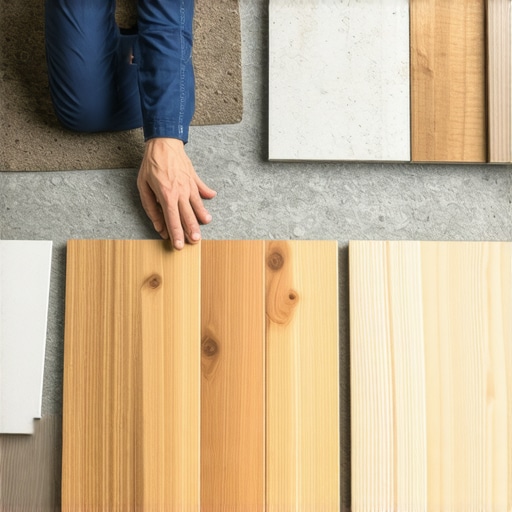
The 1/8 inch that ruins everything
Subfloor preparation is the only way to ensure that laminate floors do not sound like a hollow plastic shell. Most homeowners focus on the wear layer and the plank thickness, but the underlayment and the subfloor flatness determine the structural integrity and acoustic profile of the final installation. If the subfloor is not flat within 1/8 inch over a 10-foot radius, no amount of padding will save your floor.
Most guys skip the leveling compound. They think the underlayment will hide the dip. It won’t. I spent three days grinding concrete on a job last month just so the floor wouldn’t click like a castanet. I have spent 25 years with sawdust under my nails and I can tell you that a floor is only as good as what is under it. I smell like WD-40 and oak dust most days, and I have seen too many people waste thousands on premium planks only to have them bounce and creak because they used cheap 1/16-inch blue foam. You need mass. You need density. You need to understand the physics of deflection.
“A floor is only as good as the subfloor beneath it; deflection is the enemy of every joint.” – Master Flooring Axiom
Why your subfloor is lying to you
Concrete slabs and plywood subfloors are rarely as flat as they appear to the naked eye. Even in high-end homes, settling and curing processes create high spots and valleys that interfere with the locking mechanism of laminate flooring. These deviations cause the floor to flex underfoot, which is the primary cause of the artificial clicking sound.
When you walk across a floor that has a void beneath it, you are essentially hitting a drum. The air pocket trapped between the plank and the subfloor amplifies the sound of your footstep. If you want that solid thud of a 3/4 inch site-finished white oak floor, you have to eliminate that air. This is where the chemistry of your underlayment comes into play. You aren’t just looking for a cushion. You are looking for a material that has the specific gravity to dampen vibration and the compression resistance to stay firm over time. I have seen guys try to double up on underlayment to fix a dip. That is a death sentence for your floor. Too much squish will cause the tongue and groove to snap under the weight of a heavy refrigerator or even a heavy person. You need a stable, flat base. No exceptions.
Density over thickness for a solid step
High-density underlayment made of rubber or recycled felt provides the best acoustic dampening for laminate installations. Unlike standard polyethylene foam, these materials have the mass required to absorb impact sound and mimic the feel of hardwood floors. A 2mm or 3mm high-density product is superior to a 6mm low-density foam in every metric.
Think about the molecular structure. A cheap foam is full of large air bubbles. When you step on it, those bubbles compress and then spring back, creating a bouncy, trampoline-like effect. It feels fake. Now, consider a dense rubber mat or a heavy felt pad. These materials are comprised of tightly packed fibers or polymers. They do not compress easily. They support the locking joints and keep them from moving. This is why the floor feels solid. It doesn’t move. In my shop, I tell people to avoid the thickest pads. They are a trap. You want a pad that feels like a heavy blanket, not a sponge. This is the difference between a floor that lasts 30 years and one that starts separating at the seams in six months.
| Material Type | Density (lb/ft3) | IIC Rating | Thermal R-Value |
|---|---|---|---|
| High-Density Rubber | 50-60 | 68 | 0.40 |
| Recycled Felt | 20-25 | 62 | 0.58 |
| Cross-linked PE Foam | 2-4 | 52 | 0.35 |
| Natural Cork | 10-14 | 58 | 0.50 |
The water rising from your slab
Moisture vapor transmission from a concrete subfloor can destroy the HDF core of a laminate plank if a proper vapor barrier is not used. Even if the surface of the concrete feels dry, capillary action pulls moisture from the ground up through the slab in a constant gaseous state. A 6-mil poly film is the industry standard for protection.
If you live in the swampy humidity of Houston, this is not a suggestion, it is a requirement. I have walked into houses where a $15,000 wide-plank walnut floor was cupping so bad it looked like a potato chip because the installer didn’t check the crawlspace humidity or use a barrier. Laminate is even more sensitive in some ways because the high-density fiberboard core acts like a sponge. Once it absorbs that moisture, the edges swell. We call it peaking. You see it at the seams. No underlayment, no matter how expensive, can fix a floor once the core has blown out. You need to ensure your underlayment has an attached vapor barrier or you need to lay down a dedicated moisture film first. Use a calcium chloride test or a moisture meter. Don’t guess. I have seen guys lose their shirts on warranty claims because they didn’t want to spend fifty bucks on a moisture test kit. It is amateur hour.
“Wood flooring is a hygroscopic material, meaning it gains and loses moisture to reach equilibrium with its environment.” – NWFA Technical Manual
The acoustic lie of the big box store
Sound ratings such as IIC (Impact Insulation Class) and STC (Sound Transmission Class) are often inflated by manufacturers using ideal laboratory conditions that do not reflect real-world installations. To get a floor that truly sounds like real wood, look for the Delta IIC rating, which measures the improvement the underlayment adds to the specific subfloor assembly.
You will see some cheap padding at the big-box retailers claiming an IIC of 72. That is usually tested on an 8-inch concrete slab with a dropped ceiling underneath. It is a fake number for your bedroom. In a standard wood-frame house, that same padding might only give you an IIC of 45. That is why you still hear the click-clack. If you want the floor to be quiet, you need to look at the frequency dampening. High frequencies are the sharp clicks of dog claws or high heels. Low frequencies are the thuds of footsteps. Cheap foam does nothing for the thuds. Dense felt or rubber absorbs the energy of the impact before it can vibrate through the subfloor. It turns kinetic energy into a tiny amount of heat within the material fibers. That is the science of a quiet home. People spend all this money on showers and expensive grout in their bathrooms but then they go cheap on the bedroom floor underlayment. It makes no sense. The bedroom is where you want the most peace and quiet.
A checklist for the perfectionist
Professional installation of laminate underlayment requires more than just rolling out the material and taping the seams. You must ensure the perimeter expansion gaps are maintained and that the underlayment seams do not overlap, which would create a hump in the finished floor. Following a strict protocol ensures the longevity of the locking system.
- Check subfloor flatness using a 10-foot straightedge or laser level.
- Grind down high spots and fill low spots with a high-strength leveling compound.
- Vacuum the subfloor three times to remove every grain of sand or grit.
- Install a 6-mil vapor barrier if installing over concrete or in high-humidity zones.
- Lay underlayment perpendicular to the direction of the laminate planks.
- Butt the edges of the underlayment together without overlapping.
- Use moisture-resistant seam tape to seal the joints of the padding.
- Leave a 1/4 inch gap at the walls to allow for structural expansion.
Thermal resistance and the Kelvin factor
Thermal insulation provided by underlayment is measured by the R-value, which determines how much heat the material will retain or transfer. For homes in cold climates or those with radiant heating systems, choosing an underlayment with the correct R-value is vital for energy efficiency and comfort underfoot.
If you have a heated floor system, you want a low R-value so the heat can actually reach your feet. If you have a cold basement, you want a high R-value to keep the floor from feeling like an ice skating rink in February. In the dry heat of Phoenix, the concern is different. The heat will shrink your baseboards until they show a gap if the humidity isn’t controlled, but the underlayment can help stabilize the temperature of the planks. Laminate expands and contracts based on temperature just as much as moisture. A good underlayment acts as a buffer, slowing down the rate of temperature change in the core of the plank. This reduces the stress on the locking joints. I have seen floors literally pull themselves apart in mountain cabins because the temperature swung 40 degrees in a day and there was no thermal buffer under the floor. It is about more than just sound. It is about protecting the investment. Use your head. Buy the heavy stuff. Your knees and your ears will thank you in ten years.
The final inspection
The difference between a floor that feels like a temporary fix and one that feels like a permanent architectural feature is entirely hidden from view. Once the baseboards are installed, no one will see the rubber or the felt. They will only hear the silence. They will only feel the stability of a step that doesn’t yield. This is the hallmark of a master floor installer. We don’t build for the day of the sale. We build for the next two decades. Do not let a salesperson talk you into a thick, cheap cushion just because it feels soft to the touch in the showroom. Soft in the hand means weak on the floor. Go for the weight. Go for the density. Go for the flat subfloor. That is how you make laminate feel like wood. Anything else is just a floating plastic lie waiting to fail. The job isn’t done until the floor doesn’t make a sound when I walk across it with my boots on. That is the only test that matters. Clean your tools, pack your van, and leave the customer with a floor that stays quiet until the house falls down around it. That is the standard. Stick to it.