
The gritty reality of shower maintenance
Most guys skip the leveling compound. They think the underlayment will hide the dip. It won’t. I spent three days grinding concrete on a job last month just so the floor wouldn’t click like a castanet. That same philosophy applies to your showers. If you are reaching for a toothbrush to scrub those corners, you are dealing with a symptom of a much larger architectural challenge. A toothbrush is a precision tool for a precision job, but it only works if the grout and the subfloor were installed correctly in the first place. You need to understand the physics of water retention and the chemistry of grout before you can master the cleaning process. I have seen 15,000 dollar wide plank walnut floors cup because someone did not check the humidity in the adjacent bathroom.
“A floor is only as good as the subfloor beneath it; deflection is the enemy of every joint.” – Master Flooring Axiom
The anatomy of a failed corner joint
Shower corners represent the most vulnerable intersection in a bathroom because they are where structural movement and hydrostatic pressure collide. When a house settles, it does not do so evenly. The corner where your showers wall meets the floor is a pivot point. If the installer used standard grout instead of a 100 percent silicone caulk in that change of plane, the movement will create micro-fissures. These fissures are where the soap scum and mold take up residence. Using a toothbrush is effective here because the narrow, stiff bristles can penetrate these microscopic gaps that a standard sponge or floor brush will simply skip over. The mechanical action of the bristles agitates the surface tension of the water and cleaning solution, allowing the chemical to break down the bond of the biofilm.
The toothbrush as a surgical tool
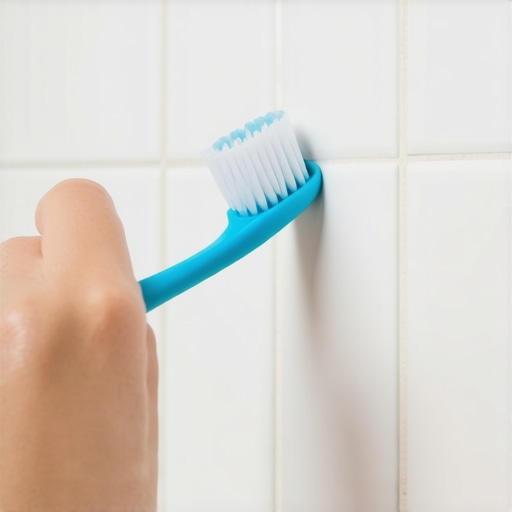
Scrubbing shower corners fast requires a combination of alkaline cleaners and mechanical agitation to remove organic buildup. You want a toothbrush with medium stiffness. Soft bristles will collapse under the pressure required to move calcified deposits, while hard bristles can actually scratch some of the softer grout types or delicate tile glazes. Hold the brush at a 45 degree angle to the corner. This allows the bristles to reach the deepest part of the 90 degree angle. I always say that if you smell floor wax and WD-40, you are doing a real job. In this case, you should be smelling a neutral pH cleaner that does not eat away at your sealer. [image_placeholder]
The technical chemistry of cleaning agents
Grout cleaning is not just about elbow grease; it is about the molecular bonding of the cleaner to the dirt. Most people reach for bleach, but that is a mistake. Bleach is a basic solution that can weaken the cementitious structure of the grout over time. Instead, use an oxygen based cleaner that releases ions to lift the dirt out of the porous grout surface. This is critical for showers because the moisture is constant. If you do not lift the dirt out, you are just pushing it deeper into the slab.
Hardwood floors and the bathroom moisture barrier
Hardwood floors are often installed right up to the bathroom door, creating a moisture transition zone that most installers ignore. If your showers are leaking into the corners, that moisture will travel through capillary action into the hardwood floors in the hallway. I have seen beautiful white oak floors turn black at the edges because the grout in the shower was not maintained. The Janka Hardness Scale tells you how hard the wood is, but it does not tell you how it handles a flood. Moisture meters should be reading between 6 and 9 percent for solid wood, but if your shower corners are failing, you will see those numbers jump to 20 percent in no time.
Why laminate shouldn’t be in the bathroom
Laminate flooring is essentially a photograph glued to a pile of sawdust. In a high moisture environment like a bathroom, it is a ticking time bomb. The wear layer might be a high mil thickness, but the core is vulnerable. If you are scrubbing your showers and water is splashing onto a laminate floor, it will seep into the click-lock joints and cause the edges to swell. Once that happens, the floor is junk. You cannot sand it down and you cannot fix it.
The maintenance schedule for a lifelong floor
Regular maintenance prevents the need for emergency grout repair and keeps your showers structural integrity intact. You should be deep cleaning your corners every two weeks with the toothbrush method to prevent the buildup from becoming a permanent resident.
| Material | Recommended Cleaning Tool | Chemical Type |
|---|---|---|
| Cementitious Grout | Medium Toothbrush | Oxygen Based |
| Epoxy Grout | Stiff Nylon Brush | Neutral pH |
| Silicone Caulk | Soft Cloth | Mild Soap |
| Natural Stone | Soft Toothbrush | Specialty Stone Cleaner |
Information Gain on Underlayment Pressure
While most people want the thickest underlayment, too much cushion actually causes the locking mechanisms on LVP to snap under pressure. This same logic applies to your shower pan. If the mud bed is too soft or has too much air, the grout will crack no matter how clean you keep it.
- Check corner caulk for peeling every 6 months.
- Apply a high quality sealer to grout annually.
- Ensure the shower door sweep is functioning.
- Use a squeegee after every shower to reduce corner moisture.
- Measure the humidity in the bathroom to ensure it stays below 50 percent.
“The TCNA Handbook is clear: any change in plane must be treated as a movement joint.” – Tile Council of North America
The molecular trap of porous surfaces
Grout is essentially a sponge made of sand and cement. When you look at it under a microscope, it is full of valleys and peaks. The toothbrush trick works because the diameter of the bristle is small enough to enter these valleys. If you use a wide brush, you are only cleaning the peaks, leaving the valleys full of bacteria. This is why showers smell even after they look clean. You have to get to the root of the pore.
Structural engineering of a shower pan
The subfloor under your shower must be rigid. If there is even 1/8 inch of deflection, the grout in your corners will fail. This is why I spend so much time on the subfloor prep. I do not care how pretty the tile is if the floor moves like a trampoline. A solid installation means the grout stays intact, and the toothbrush trick becomes a 5 minute maintenance task instead of a 3 hour rescue mission.
The toothbrush technique in detail
Start at the top of the corner and work your way down. Gravity is your friend. Use circular motions to ensure the bristles hit the grout from every possible angle. Do not press too hard; let the chemical and the tip of the bristle do the work. If you are sweating, you are doing it wrong. It is about the frequency of the scrub, not the force.
Why your subfloor is lying to you
Most people think a concrete slab is flat. It is not. It is full of waves and dips. If your shower was built on a dip, the water will pool in the corners, leading to the exact mold issues you are trying to scrub away. This is the subfloor secret that most contractors will not tell you because they do not want to do the grinding work. But as a mechanic who has seen it all, I can tell you that a level floor is the only floor that lasts.