
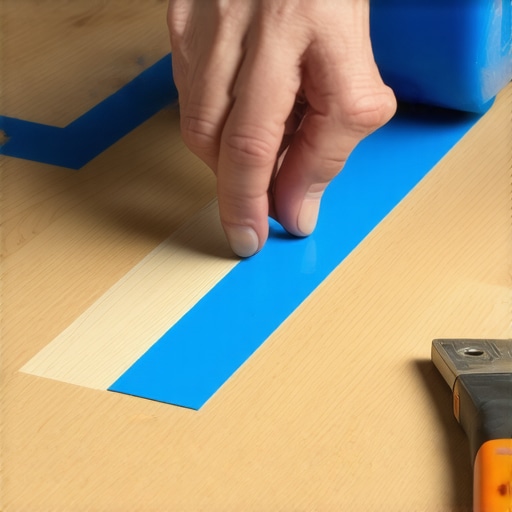
The science of the clean cut
Every laminate floor installation requires a 0.2 mm vapor barrier and a subfloor flatness of 3/16 inch per 10 feet. Using blue painter’s tape on the cut line prevents the carbide blade from chipping the melamine wear layer, ensuring a professional finish. I have spent twenty five years with sawdust under my nails and a level in my hand. Most guys skip the leveling compound. They think the underlayment will hide the dip. It won’t. I spent three days grinding concrete on a job last month just so the floor wouldn’t click like a castanet. That experience taught me that the surface you see is only as good as the substrate you hide. Laminate is essentially a high density fiberboard core wrapped in a decorative image and a protective wear layer. That wear layer is brittle. When a saw blade with an aggressive hook angle strikes the surface, it tends to lift and shatter the melamine edge. By applying a high quality blue painter’s tape directly over your cut line, you provide surface tension that holds those fibers together during the violent impact of the carbide teeth.
The subfloor secret that contractors ignore
A flat subfloor is the absolute foundation of any laminate or hardwood project. If the subfloor has a deviation greater than 3/16 of an inch over a 10 foot span, the locking mechanisms of the planks will eventually fail. When you walk across a floor with a void beneath it, the tongue and groove joints flex. This repetitive motion, known as deflection, causes the thin HDF material to fatigue and snap. I have seen thousand dollar floors ruined in six months because the installer was too lazy to pour a few bags of self leveling underlayment. You have to check the moisture content of your subfloor with a pin meter. For wood subfloors, the moisture should be within 2 percent of the flooring material. For concrete, you need a calcium chloride test or an in situ probe to ensure you are not trapping water under your planks. If that water stays there, it will turn your floor into a moldy mess.
“A floor is only as good as the subfloor beneath it; deflection is the enemy of every joint.” – Master Flooring Axiom
Understanding the Janka scale in hardwood floors
The Janka Hardness Scale measures the resistance of a wood species to denting and wear. While laminate floors use a different rating system called the AC rating, understanding wood density helps you appreciate why certain cuts require specific blade geometries. A high AC rating on laminate means the surface can handle heavy foot traffic, but it also means the material is harder on your tools. The aluminum oxide particles embedded in the top layer are designed to stop scratches, but they will dull a standard steel blade in minutes. You need a blade with at least 60 to 80 teeth for a miter saw. The teeth should have a Triple Chip Grind or an Alternate Top Bevel configuration to slice through the dense core without burning the resin. If you see smoke, you are moving too slow or your blade is shot. Hardwood floors like Brazilian Cherry or White Oak have high Janka ratings, meaning they are dense and heavy. Laminate mimics this density but lacks the cellular structure of real wood, making it more prone to edge shatter during the exit stroke of the saw blade.
Why showers and laminate are dangerous neighbors
Moisture from showers and bathroom grout can migrate through walls and under baseboards to destroy a laminate floor. Even if the product is labeled as waterproof, that usually only refers to the surface. The expansion gap at the perimeter is an open door for water. If a shower pan leaks or if grout lines in a nearby bathroom fail, that water will travel. It wicks into the HDF core of the laminate. Once that fiberboard absorbs water, it swells and never returns to its original size. You get peaking at the seams. I always tell my clients to use a 100 percent silicone sealant in the expansion gaps around wet areas. This doesn’t stop the floor from moving, but it creates a flexible dam that keeps the occasional spill or humidity spike from reaching the core. Hardwood floors are equally sensitive. Wood is hygroscopic, meaning it acts like a sponge. In a humid environment, it expands. In a dry environment, it shrinks. If you don’t leave at least a 1/2 inch gap around the perimeter, the floor will eventually buckle and lift the baseboards right off the wall.
The math of expansion gaps
The coefficient of linear thermal expansion determines how much a laminate floor will grow or shrink with temperature changes. You must leave a perimeter gap of at least 1/4 inch to 1/2 inch depending on the total run of the floor. If the room is longer than 40 feet, you need a transition molding to break up the span. I hate T moldings as much as any minimalist, but physics does not care about your aesthetic. Without that gap, the floor will hit the wall and have nowhere to go but up. This is the ghost in the expansion gap. You hear a pop in the middle of the night, and suddenly your floor has a hump. This is why the blue tape trick is so important for your final cuts. Your perimeter cuts must be precise. If you cut the plank too long and wedge it in, you have killed the floor. If you cut it too short, the baseboard won’t cover the gap. The blue tape allows you to mark your measurements with a fine pencil line that is actually visible, unlike a mark on a dark wood grain pattern.
Tooling and blade geometry comparison
| Tool Type | Blade Spec | Edge Quality | Best Use |
|---|---|---|---|
| Miter Saw | 80T Carbide ATB | High | End cuts and transitions |
| Table Saw | 60T TCG Blade | Medium | Longitudinal rips |
| Jigsaw | Down-cut Wood Blade | Excellent | Notching around door jambs |
| Oscillating Tool | Bimetal Blade | Low | Undercutting door casings |
Pre-cut diagnostic protocol
- Check subfloor for flatness using a 10 foot straight edge.
- Verify moisture levels in both the slab and the flooring planks.
- Apply blue painter’s tape to the finished side of the laminate before marking.
- Set saw blade depth to 1/4 inch deeper than the material thickness.
- Ensure the blade is rotating at full speed before contacting the plank.
- Remove the tape slowly at a 45 degree angle to avoid pulling the melamine.
The chemistry of the laminate core
The HDF core is manufactured using urea-formaldehyde resins or methylenediphenyl diisocyanate to bond wood fibers under immense pressure. This makes the material incredibly stable but also very dusty. When you cut laminate, you are releasing fine particulates of wood and cured resin into the air. Always wear a P100 respirator. The blue tape doesn’t just help with the cut quality, it also helps contain some of that micro dust at the point of impact. I have seen guys develop a nasty cough after just one day of ripping planks without a vacuum. The density of these cores is typically between 800 and 1,000 kg per cubic meter. For comparison, solid oak is around 700 kg per cubic meter. This higher density is why laminate feels so hard underfoot but also why it echoes if you don’t use a high quality rubber or cork underlayment. While most people want the thickest underlayment, too much cushion actually causes the locking mechanisms on LVP and laminate to snap under pressure. You want a high density, low compression underlayment that provides support rather than a marshmallow feel.
“A floor is only as good as the subfloor beneath it; deflection is the enemy of every joint.” – Master Flooring Axiom
The final word on perimeter integrity
Installation is a game of millimeters. The blue tape trick is a hallmark of an installer who cares about the microscopic details. It is the difference between a floor that looks like it was installed by a pro and one that looks like a weekend DIY disaster. Remember that your floor is a living, moving system. It reacts to the humidity of the air and the temperature of the subfloor. If you treat it like a static object, it will fail you. Respect the expansion gaps, prep your subfloor until it is as flat as a pool table, and use the right blades for your cuts. The sawdust under my nails is a testament to the fact that there are no shortcuts. You either do the work to prepare the surface, or you do the work to replace it in three years. Laminate flooring is a structural engineering challenge disguised as a home improvement project. Master the physics of the material, and the beauty will take care of itself. “,