
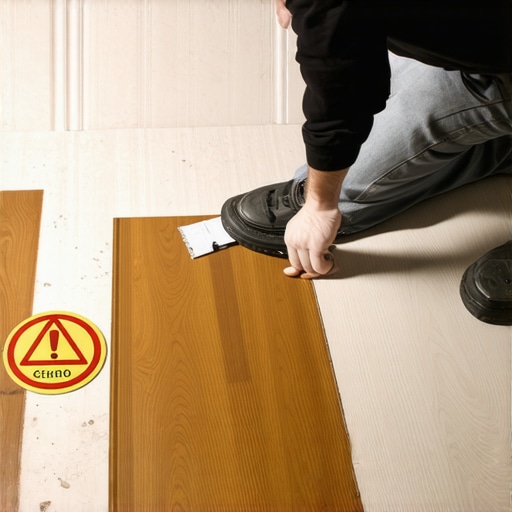
The hidden traps in layering laminate on top of old vinyl
Most guys skip the leveling compound. They think the underlayment will hide the dip. It won’t. I spent three days grinding concrete on a job last month just so the floor wouldn’t click like a castanet. That is the reality of professional floor work. It is dirty, it is loud, and it is governed by the laws of physics, not the pretty pictures on a box of planks. When you decide to throw a new laminate floor over an existing vinyl sheet or tile, you are not just saving time. You are building a sandwich of materials that might not like each other. Most homeowners see a flat surface and assume it is stable. My eyes see a potential disaster area where moisture, chemistry, and mechanical stress intersect to destroy your investment. If you do not respect the subfloor, the subfloor will eventually humiliate you. It does not matter how much you paid for those hardwood floors in the other room or how fancy your new laminate looks. If the foundation is mush, the floor is junk.
The mechanical reality of a failing subfloor
Laminate flooring requires a subfloor flatness of 3/16 inch over a 10-foot radius to prevent joint failure. Old vinyl often hides structural dips or humps that exceed these tolerances, leading to immediate bounce and eventually broken locking tabs. You cannot expect a floating floor to span a canyon. When you walk across a laminate floor that has been installed over a soft, cushioned vinyl, the entire system deflects. This vertical movement puts immense pressure on the tongue and groove. Unlike solid hardwood floors that are nailed down, laminate relies on a thin piece of high-density fiberboard to hold everything together. If that joint moves every time you step on it, the fiberboard will fatigue. It will crack. Once it cracks, the floor starts to separate, and you will see gaps that no amount of tapping will fix. You are essentially asking a rigid product to behave like a liquid, and the physics simply do not support that outcome.
“A floor is only as good as the subfloor beneath it; deflection is the enemy of every joint.” – Master Flooring Axiom
How old vinyl traps moisture against your new planks
Installing laminate over vinyl creates a moisture trap where vapor from the concrete slab or crawlspace becomes stuck between two non-porous layers. This results in the greenhouse effect, which can lead to mold growth and the swelling of the laminate HDF core. Vinyl is an effective vapor retarder. When you put a second layer of laminate and its underlayment on top, you have created a sealed environment. If any moisture rises from the subfloor, it has nowhere to go. It sits against the bottom of your laminate. Most people think their laminate is safe because the top is water-resistant, but the bottom is almost always raw fiberboard. This material is basically a sponge. It will soak up that trapped moisture, causing the edges of the planks to peak. This is known as cupping or peaking, and it is a permanent death sentence for the floor. You cannot sand out a laminate floor. Once the core is blown, the job is over. I have seen floors installed over vinyl in houses near bathrooms and showers where the humidity from the air alone was enough to trigger this reaction because the installer forgot to check the ambient RH levels.
The physics of deflection and joint stress
Deflection refers to the vertical movement of the floor under a load, and excessive deflection is the primary cause of laminate locking mechanism failure. Sheet vinyl with a thick foam backing is too soft to support the rigid requirements of a modern click-lock floor. Think about a diving board. It is designed to flex. Your floor is not. When you install a click-together floor over a ‘cushy’ vinyl, you are building a giant diving board under your feet. Every step compresses the vinyl, which forces the laminate joints to bend. Over time, the friction between the tongue and the groove generates heat and wear. The microscopic fibers of the HDF core begin to break down. Eventually, you will hear a clicking or popping sound. That is the sound of your floor dying. Professionals use a 10-foot straight edge to find these low spots. If the gap under the straight edge is more than 3/16 of an inch, you have to fix it. You cannot just throw more underlayment at the problem. Adding more cushion actually makes the deflection worse. It is a common mistake made by people who want a ‘soft’ walk, but they end up with a broken floor.
Why plasticizer migration destroys your warranty
Plasticizer migration is a chemical reaction where the oils in old vinyl react with the rubber or foam in the new laminate underlayment. This can cause the underlayment to disintegrate or create a sticky, odorous residue that ruins the installation. This is the invisible enemy. You cannot see it happening until it is too late. The chemicals that keep old vinyl flexible are often incompatible with the synthetic materials used in modern underlayments. If you do not use a specific barrier, these chemicals will leach out. I have seen underlayments that turned into a gummy black slime because of this. When that happens, the floor loses its support. The warranty on your new laminate will be voided the second the manufacturer sees that you installed it over a non-approved substrate. They have labs full of scientists who do nothing but look for reasons to deny claims. Don’t give them an easy win. You must verify that the existing vinyl is fully adhered and not ‘loose-laid,’ because a loose-laid vinyl will move under the laminate, causing the whole system to shift and buckle against the walls.
| Subfloor Type | Max Deflection | Moisture Limit | Preparation Needed |
|---|---|---|---|
| Sheet Vinyl | 3/16 inch per 10ft | 75% RH | Full Adhesion Check |
| Luxury Vinyl Plank | 1/8 inch per 10ft | 85% RH | Removal Recommended |
| Concrete Slab | L/360 | 3 lbs per 1000sqft | Grinding and Leveling |
| Plywood Subfloor | 1/64 inch per 1ft | 12% Wood Moisture | Sanding Seams |
The ghost of the old grout line
Textured vinyl or old tile patterns can telegraph through the new laminate surface over time due to the pressure of foot traffic. This creates visible ridges or patterns on the surface of the new floor that mimic the layout of the old floor. People think laminate is thick enough to hide anything. It is not. It is a thin veneer over a wood-based core. If you have old vinyl that looks like stone or tile, those deep grout lines are gaps in the support. Under the weight of a refrigerator or a heavy bookshelf, the laminate will slightly settle into those grooves. In the right light, you will see every single square of the old floor showing through the new one. It looks cheap and it looks amateur. If you are going to leave the vinyl, you must use a floor patch or a ‘feather finish’ to fill in those grout lines and textures. You need a dead-flat plane. I tell my clients that if they can feel a bump with their fingers, they will see it with their eyes in six months. It is the same reason you don’t paint over a dirty wall. The prep work is 90% of the quality.
A roadmap for the cautious builder
Success in flooring is found in the preparation phase rather than the installation phase. Follow a strict protocol to ensure your laminate over vinyl project does not end in a costly tear-out. You need to be methodical. This is not a race. If you rush the subfloor, you are just rushing toward a failure. I always tell guys to keep a moisture meter in their pocket. If you don’t know the numbers, you are just guessing. And guessing is for people who like doing the same job twice for free. Here is the checklist I use for every remodel:
- Strip the baseboards to allow for a true 1/2 inch expansion gap.
- Check the existing vinyl for bubbles or loose edges and glue them down.
- Use a 10-foot straight edge to identify any dips greater than 3/16 inch.
- Fill all textured grout lines in the vinyl with a high-quality cementitious patch.
- Perform a calcium chloride test to check the moisture emission of the slab.
- Verify that the room temperature and humidity are within the manufacturer’s range for 48 hours before starting.
- Ensure the laminate has acclimated to the room’s environment for at least 48 hours.
“Hardwood floors may be the gold standard, but a properly installed laminate is a feat of engineering that requires equal respect for the substrate.” – The Installer’s Manual
Measuring the flatness of the earth under your feet
A subfloor that is out of level is different from a subfloor that is not flat; while a floor can be sloped, it must be a flat plane to support the locking joints of laminate. This is a distinction that trips up a lot of DIYers and even some ‘pro’ builders. You can have a floor that leans toward the kitchen sink, and as long as it is a smooth, flat plane, the laminate will be fine. But the second you have a ‘wave’ or a ‘hump,’ you are in trouble. When the laminate passes over a hump, the joints are pulled apart. When it passes over a dip, they are compressed. Neither is good. I have had to tell homeowners that their beautiful 1950s ranch house has a foundation that looks like the rolling hills of Kentucky. In those cases, you cannot just lay laminate. You have to use self-leveling underlayment. And you can’t always put that over vinyl. Sometimes the only right way to do it is to rip the vinyl out, get down to the wood or concrete, and start fresh. It is a lot of work. It is messy. But it is the only way to sleep at night knowing the floor won’t fail while the customer is hosting Thanksgiving dinner.
The structural reality of locking mechanisms
The click-lock system is a marvel of modern milling, but it is incredibly fragile when subjected to uneven pressure. Most laminate cores are made of HDF which has a limited tensile strength. When you understand the chemistry of the core, you understand why the subfloor matters. HDF is made by compressing wood fibers with resin under high pressure. It is very dense and hard, but it is brittle. It does not have the long-grain strength of solid hardwood floors. If you bend it, it snaps. The tongue of a laminate plank is often only 2 or 3 millimeters thick. That is all that is holding your floor together. If the old vinyl underneath provides an uneven base, that tongue acts like a lever. Eventually, the resin bond fails and the tongue shears off. Now you have a plank that moves every time you walk on it. No amount of glue will fix it properly once that mechanical bond is gone. You are looking at a full replacement. That is why I am so obsessed with the grind. I would rather spend two days with a diamond cup wheel on a grinder than one hour explaining to a customer why their new floor is falling apart. It is about the integrity of the craft. Use your level. Check your moisture. Don’t trust the vinyl just because it looks okay. Underneath that surface, there is a whole world of physics waiting to ruin your day if you let it. { “@context”: “https://schema.org”, “@type”: “Article”, “headline”: “The hidden traps in layering laminate on top of old vinyl”, “author”: { “@type”: “Person”, “name”: “Master Floor Installer” }, “publisher”: { “@type”: “Organization”, “name”: “Flooring Architecture Engine” }, “description”: “Detailed structural analysis of the risks involved in installing laminate flooring over existing vinyl, focusing on moisture traps, deflection, and subfloor prep.” }