
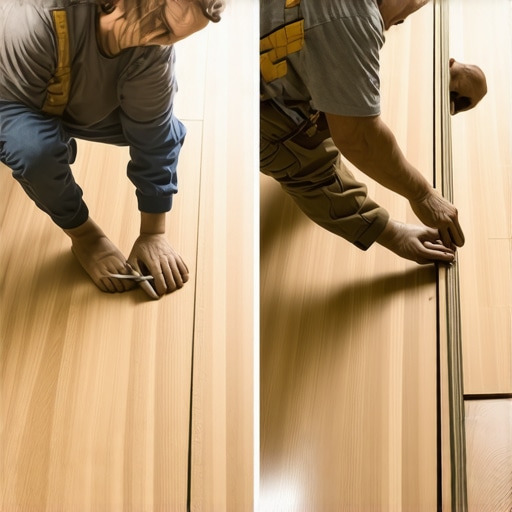
The ghost in the expansion gap
Choosing between glue and click laminate depends on the moisture profile of the slab and the intended foot traffic. Click systems offer speed and easy repair, while glue-down applications provide superior structural stability and sound dampening. Professional installers prioritize subfloor flatness over the installation method itself to prevent joint failure.
Most guys skip the leveling compound. They think the underlayment will hide the dip. It won’t. I spent three days grinding concrete on a job last month just so the floor wouldn’t click like a castanet. I have been doing this for twenty five years. I have seen every shortcut in the book. My knees hurt and my hands smell like WD-40 and oak dust, but I know how a floor behaves when the temperature swings. People think laminate is just a cheap plastic floor. They are wrong. It is a composite engineered product that reacts to the physics of your home. If you treat it like a rug, it will fail you. If you treat it like a structural surface, it will last decades. Most homeowners are obsessed with the color. I am obsessed with the 1/8 inch deviation over 10 feet. That is the difference between a floor that feels solid and a floor that sounds like a bag of potato chips when you walk on it.
Why your subfloor is lying to you
A subfloor must be dry, flat, and structurally sound before any laminate installation begins, regardless of the joining method used. Moisture vapor transmission from a concrete slab can destroy the HDF core of laminate if not properly mitigated with a 6 mil poly film. Flatness remains the primary mechanical requirement.
You walk into a room and it looks flat. It is not. Every concrete slab has waves. Every wooden subfloor has high spots over the joists. When you install a click-lock floor over a dip, the joint becomes a bridge. Every time you step on that bridge, it flexes. That deflection is the silent killer of laminate floors. Over six months, the tongue and groove will fatigue. Eventually, the locking mechanism snaps. Now you have a gap that no amount of kicking will close. When we talk about the chemistry of the bond, we are looking at the hydrostatic pressure of the slab. If you are gluing, that adhesive has to fight against the moisture trying to push its way out of the concrete. I use a calcium chloride test on every single job. I do not care if the builder says the slab is dry. I want to see the numbers. If the vapor emission is over three pounds per 1,000 square feet, we have a problem. You cannot glue to a wet slab. You might as well throw your money into a wood chipper.
“A floor is only as good as the subfloor beneath it; deflection is the enemy of every joint.” – Master Flooring Axiom
The 1/8 inch that ruins everything
Precision in subfloor preparation involves grinding down high spots and filling low spots with a high quality self-leveling underlayment to meet the 3/16 inch over 10 feet industry standard. This tolerance ensures that the click-lock mechanisms do not undergo excessive vertical stress during normal foot traffic.
Laminate is a floating floor system by nature, but it requires a rigid foundation. When you choose the click-lock method, you are relying on the mechanical strength of the High Density Fiberboard. This HDF is essentially sawdust and resin pressed together under extreme heat. It is incredibly dense but brittle. If the subfloor has a crown, the plank will teeter-totter. If it has a valley, the plank will sink. I have spent thousands of dollars on diamond grinding wheels just to flatten out high spots in garage conversions. It is dusty work. It is loud work. But it is the only way. If you skip this, your click joints will start to creak. That creak is the sound of the fibers rubbing together and breaking. Once they break, the floor is junk. You cannot fix a broken click joint with wood glue and a prayer. You have to rip it up back to the wall and start over. This is why I tell people that the floor is just the skin. The subfloor is the skeleton. If the skeleton is deformed, the skin will look terrible.
| Feature | Click-Lock System | Glue-Down Method |
|---|---|---|
| Installation Speed | High | Moderate |
| Joint Strength | Mechanical | Chemical Bond |
| Moisture Resistance | Moderate | Superior (with PVA) |
| Repair Difficulty | Easy | Difficult |
| Sound Dampening | Requires Underlayment | Inherently Quieter |
The chemical reality of modern adhesives
Adhesive applications in laminate flooring utilize specialized PVA glues or high-tack urethanes to create a water-resistant barrier within the joints of the planks. This method is often employed in commercial settings where extreme stability and resistance to liquid penetration are mandatory for long-term performance.
Some people think gluing a laminate floor means gluing it to the subfloor. No. Usually, we are talking about gluing the tongue and groove together while the floor still floats. This is an old-school technique that most DIYers ignore because it is messy and slow. But if you are putting laminate near a kitchen or a powder room, that glue is your insurance policy. It seals the joint. If someone spills a glass of water, the glue prevents the liquid from seeping into the HDF core. Once that core gets wet, it swells. It never goes back down. It is called peaking. You see the edges of the planks standing up like little mountains. It looks awful. In showers or high moisture areas, laminate is usually a bad idea anyway, but if you must do it, you better be using a premium waterproof glue in every single joint. I have seen floors that survived a minor flood because the installer took the time to glue the joints. It is a slow process. You have to wipe the excess glue off the surface before it cures, or you will ruin the finish. It takes a certain kind of patience that most people do not have anymore.
The friction coefficient of floating floors
Floating floors operate on the principle of thermal expansion where the entire floor mass moves as a single unit in response to humidity changes. This requires a 1/2 inch expansion gap around all vertical obstructions to prevent the floor from buckling or crowning during summer months.
Humidity is the enemy of wood. Laminate is mostly wood. Even in a controlled environment, the floor is moving. It is breathing. In the summer, when the air is thick and wet, the planks expand. In the winter, when the heater is running and the air is dry, they shrink. If you click your floor together and push it tight against the baseboards, you have created a ticking time bomb. The floor has nowhere to go. It will find the weakest point and it will pop up in the middle of the room. I have walked into houses where the floor was three inches off the subfloor because there was no expansion gap. You could jump on it like a trampoline. It is funny until you realize you have to take the whole thing apart. This is why we leave that gap. We hide it with shoe molding or baseboards. It is a simple rule but people ignore it. They think it looks sloppy to leave a gap. I think it looks sloppier to have a mountain in your living room.
- Check subfloor moisture with a pinless meter before starting
- Verify subfloor flatness using a 10 foot straightedge
- Acclimate the laminate boxes in the room for at least 48 hours
- Install a 6 mil vapor barrier over all concrete surfaces
- Maintain a consistent expansion gap at every wall and doorway
Why your kitchen island is a floor killer
Heavy permanent fixtures like kitchen islands or heavy cabinetry must be installed before the laminate flooring to allow the planks to move freely underneath the base molding. Pinning a floating floor under a thousand pound island prevents expansion and leads to massive joint failure.
I see this all the time. The homeowner wants the floor to go under the cabinets for a clean look. It is a disaster. You are essentially anchoring the floor in one spot. When the rest of the floor tries to move, it pulls against that anchor. The click joints cannot handle that much tension. They will pull apart. It is physics. You have to install the cabinets first, then bring the floor up to them. Leave the gap and cover it with a toe kick or molding. This allows the floor to slide back and forth as the seasons change. It is the same reason we use T-moldings in large rooms. If a run is longer than 30 feet, the cumulative expansion is too much for the material to handle. You have to break it up. People hate the look of T-moldings. They want a seamless look. I tell them they can have a seamless floor that breaks or a floor with a molding that stays flat. Most people choose the break once they understand the cost of a full replacement. Hardwood floors can sometimes get away with larger runs because they are nailed down, but laminate is a different beast entirely.
“Floating systems require the freedom to move; restriction is the fastest path to a failed installation.” – Master Flooring Axiom
The myth of the waterproof click
Waterproof laminate claims often refer to the top surface and the density of the HDF core rather than the integrity of the locking joints themselves. Without a topical sealant or a glued joint, standing water can still migrate through the click mechanism and cause subfloor mold.
Marketing is a powerful thing. You see these commercials with a puppy spilling a bowl of water and the floor is fine. What they do not show you is the water sitting in the joint for four hours. The top layer of laminate is basically a photograph of wood protected by a wear layer of aluminum oxide. That part is waterproof. The bottom of the plank is often a melamine backing. That is also fairly water resistant. But the edges, where the click happens, that is raw HDF. It is like a sponge. If water gets in there, it is game over. This is why the debate between glue and click is so important. If you want real water protection, you glue those joints. Or you look for the newer systems that have a wax coating on the tongue. That helps, but it is not a submarine. Do not put laminate in a bathroom with a shower. The steam alone will eventually get to it. Use tile or LVP for that. Stick to laminate for living areas and bedrooms where you want that wood feel without the hardwood floors price tag. Just remember that grout belongs on tile and glue belongs in the joints if you are worried about spills.
The final verdict on structural integrity
Final selection between glue and click laminate should be dictated by the specific environment and the skill level of the installer to ensure the longevity of the surface. While click-lock is the industry standard for residential applications, glue-enhanced joints offer a professional grade solution for high traffic zones.
I always tell my clients that I can make a cheap floor look like a million bucks if the subfloor is right. I can also make a twenty dollar a foot floor look like garbage if I am lazy with the prep. If you are doing it yourself, use the click system. It is designed for you. Just buy a tapping block and a pull bar. Do not use a hammer directly on the tongue. You will mushroom the edge and the next plank won’t fit. If you are hiring a pro, ask them about gluing the joints in the high traffic areas. It adds a bit to the labor cost, but the floor will feel more solid underfoot. It stops that hollow clicking sound that people complain about. At the end of the day, I just want to walk away from a job knowing that when the owner has a Christmas party and thirty people are standing on that floor, it isn’t going to move, creak, or fail. I want it to be as solid as the concrete I spent three days grinding. That is the mark of a real installer. We do not just lay floors. We build performance surfaces. If you respect the material and the physics of the house, your laminate will serve you well for a long time.