
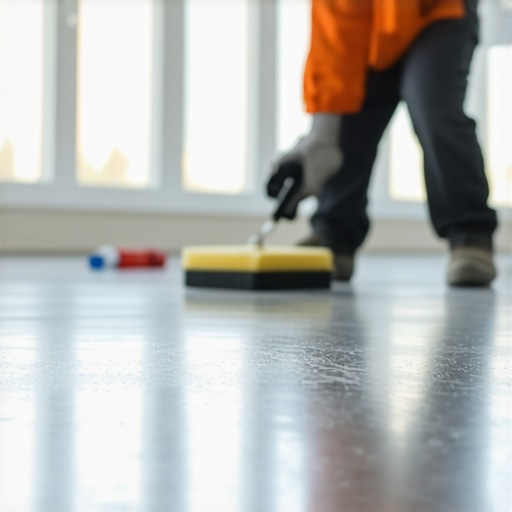
I spent three days grinding concrete on a job last month just so the floor would not click like a castanet. The homeowner thought I was trying to bill more hours until I showed him the 1/4 inch dip in the slab. You cannot hide gravity with a thin layer of mortar. Most guys skip the leveling compound. They think the underlayment will hide the dip. It will not. If you are starting a massive kitchen floor, your speed is not dictated by how fast you can swing a float, but by how well you prepared the structural base. A tile installation is a rigid system. Unlike flexible hardwood floors or floating laminate, tile and grout do not forgive movement. If that subfloor has a single millimeter of deflection, your grout will crack and your speed will matter for nothing when you are back for a warranty repair. Most kitchen installs fail at the bond level because of dust or improper moisture levels in the slab. I have seen showers leak and kitchen floors pop because an installer was in too much of a hurry to use a moisture meter. Speed comes from systemized precision. Here are the tools that actually move the needle on large scale kitchen projects.
The high density float for deep joint penetration
A high density grout float is a specialized tool with a stiffer rubber base designed to push material deep into the joints. Unlike soft, cheap floats that flex and pull grout back out of the joint, a professional grade float with a squared off edge ensures that the entire depth of the tile edge is filled. This prevents air pockets that lead to pinholes. When you are working with grout in a kitchen, you are often dealing with 300 to 500 square feet. A soft float will tire your wrist and leave a concave joint that collects dirt. You want a tool with a durometer rating that resists compression. This allows you to scrape the tile surface clean on the first pass, which reduces your wash time by half. Every gram of material you leave on the face of the tile is a gram you have to scrub off later with a sponge. Professionals use a 45 degree angle for application and a 90 degree angle for the final scrape.
The dual bucket wash system for water management
The dual bucket system separates clean rinse water from dirty grout residue to ensure a haze free finish. One of the biggest mistakes on large floors is using a single bucket of water until it looks like chocolate milk. Once that water is saturated with cement particles, you are just moving thin film around the tile surface. A professional wash station usually includes a set of rollers on top of a 5 gallon pail. You dip your sponge in the clean water, then use the rollers to squeeze it nearly dry. A sponge that is too wet will kill your grout. Excess water dilutes the polymer modifiers and causes the color to dry in inconsistent splotches. It also weakens the bond, leading to soft grout that powders out over time. If you want to finish a kitchen in one day, you need your water to stay clean and your sponges to stay damp, not dripping.
“A floor is only as good as the subfloor beneath it; deflection is the enemy of every joint.” – Master Flooring Axiom
The margin trowel for bucket management and mixing
A margin trowel is a flat, narrow tool used to scrape the sides of the mixing bucket and keep grout consistency uniform. When you mix a large batch of grout, the edges of the bucket often hold dry powder or unmixed polymers. If those lumps get onto the floor, you will have to stop your flow to dig them out. I always keep a margin trowel in my back pocket. It is the tool for cleaning your float and for scooping the last bit of material out of the pail. In a large kitchen, you cannot afford to leave five pounds of grout stuck to the walls of the bucket. That is wasted money. Furthermore, the chemistry of modern grout, especially high performance cementitious or epoxy varieties, requires a specific induction time. You mix it, let it slake for five to ten minutes, and then remix it. The margin trowel is the only tool that can reach the bottom corners of the pail to ensure that every chemical component is fully activated.
The low speed ribbon paddle for air free mixing
A ribbon paddle attached to a low speed drill prevents air bubbles from being whipped into the grout mixture. If you use a high speed paint mixer, you will introduce millions of microscopic air pockets. When that grout dries, those bubbles pop, leaving your joints looking like Swiss cheese. This is a nightmare in kitchens where grease and food particles will fill those holes. You need a drill that tops out at 300 RPM. The goal is to fold the water into the powder, not to aerate it. This is even more vital when dealing with epoxy grouts, which have a very high viscosity. If you whip air into epoxy, it becomes nearly impossible to spread and will look cloudy once it cures. A heavy duty, low speed mixing drill is a structural tool that ensures the molecular density of the grout joint is high enough to resist compression and water penetration.
The pre sealer for porous natural stone
Pre sealers or grout releases act as a temporary barrier that prevents grout pigment from staining the pores of the tile. If you are installing a slate or tumbled marble kitchen floor, the grout will get trapped in the surface texture. You will spend hours scrubbing the