
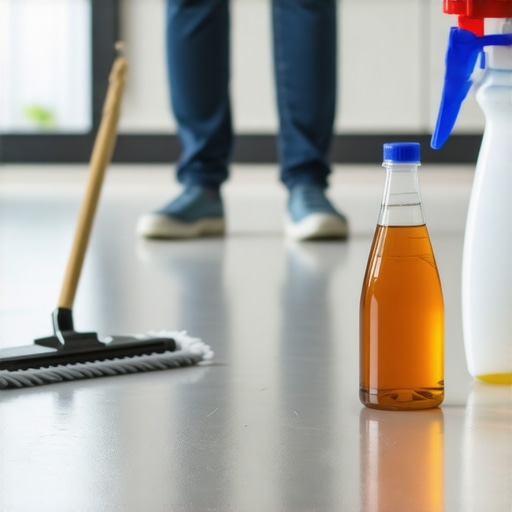
I have spent twenty five years on my knees with a moisture meter and a level. I have seen the same tragedy play out in hundreds of homes. A homeowner spends thousands of dollars on a beautiful new laminate floor, only to ruin it in eighteen months because they listened to a cleaning tip from a magazine that was written in 1974. I once walked into a house where a five thousand dollar installation was buckled so bad it looked like a mountain range. The culprit was a gallon of ammonia and a steam mop. People think laminate is plastic. They think it is bulletproof. It is not. Laminate is a precision-engineered wood product that requires a specific chemical balance to survive. When you pour ammonia on that surface, you are not cleaning it. You are performing a slow-motion demolition of the resin bonds that keep your floor together.
The chemical truth about ammonia and melamine resin
Ammonia is a high pH alkaline cleaner that typically sits around 11 on the scale. Most laminate wear layers are made of melamine resin and aluminum oxide. These materials are engineered to be pH neutral. When you introduce a high alkaline substance like ammonia, it begins to strip the protective resins from the surface. This creates a microscopic pitting in the wear layer. At first, you will not see it. The floor might even look clean. But over time, the finish becomes dull and cloudy. You think it is dirty, so you use more ammonia. This is a death spiral for your flooring. You are essentially removing the very shield that protects the high-definition print layer from the sun and foot traffic. Once that resin is gone, the floor is defenseless.
“A floor is only as good as the subfloor beneath it; deflection is the enemy of every joint.” – Master Flooring Axiom
The microscopic reality of aluminum oxide layers
The wear layer of your laminate is often rated by an AC scale, from AC1 to AC5. This layer contains aluminum oxide, which is one of the hardest minerals on earth. It is meant to resist scratches from dog claws and grit. However, this layer is brittle. It relies on the flexibility of the underlying resins to stay intact. Ammonia leaches the plasticizers out of those resins. This makes the surface prone to micro-cracking. Once these cracks form, moisture from your mop or even humidity from your showers can seep into the core. In regions like the humid Gulf Coast, this moisture is a constant threat. In the dry air of the high desert, the brittleness is even more pronounced. You need a cleaning agent that maintains the elasticity of the finish, not one that turns it into a dried-out shell.
Why your HDF core is acting like a sponge
Underneath that pretty wood grain picture is a core of High-Density Fiberboard, or HDF. This is made of wood fibers ground into a fine powder and mixed with wax and resin. It is incredibly stable under vertical pressure, but it is extremely sensitive to moisture. Ammonia is a liquid carrier. When it hits the seams of your laminate, capillary action draws it down into the core. Wood fibers are hygroscopic. They want to drink. When they absorb moisture, they expand. Since the top and bottom of the plank are sealed, the only place for that expansion to go is up. This is called peaking. If you see the edges of your planks starting to lift, your floor is already failing from the inside out. No amount of weight or drying will ever make those fibers shrink back to their original size.
The physics of the expansion gap
A floating floor is a living thing. It moves. It expands and contracts with the seasons. I always insist on a minimum of 3/8 inch or 1/2 inch expansion gap at every vertical obstruction. If you use harsh chemicals that cause the HDF core to swell, the floor will expand beyond the capacity of your gaps. It will hit the wall and then it will buckle in the middle of the room. I spent three days grinding concrete on a job last month just so the floor would not click like a castanet. That level of precision is wasted if you saturate the joints with liquid cleaners. The locking mechanism is a tiny piece of milled wood fiber. It is only as strong as the resin holding it together. Ammonia dissolves that strength.
Comparing the grit of hardwood versus laminate
Many homeowners treat laminate like they treat hardwood floors. They are different beasts. Solid hardwood can be sanded and refinished if you mess up the surface. Laminate is a one-shot deal. If you burn through the wear layer with chemicals, you are looking at a full tear-out. You cannot sand HDF. You cannot refinish a photograph of wood. This is why the maintenance of laminate is actually more technical than hardwood. You have to be a chemist and a physicist to keep it looking new for twenty years. You need to understand that the surface tension of your cleaner matters. If the cleaner beads up, it is not getting into the micro-texture. If it sits too long, it is destroying the core.
| Material | Typical Wear Layer | Moisture Sensitivity | Core Material || :— | :— | :— | :— || Laminate | 6-12 mil | High | HDF || Hardwood | N/A (Solid) | High | Organic Wood || Engineered | 2-4 mm | Medium | Plywood/HDF || LVP | 12-28 mil | Low | SPC/WPC |
Why grout knowledge matters for your laminate transitions
You might wonder what grout and showers have to do with your laminate in the living room. It is all about moisture management. In a bathroom, we use waterproof membranes and sealed grout to keep water away from the structure. When you transition from a tile shower area to a laminate hallway, that threshold is the most vulnerable point in your home. Steam from the shower creates a high-humidity microclimate. If you have been using ammonia on the laminate, the edges are already compromised. They will pull that steam in like a vacuum. I always recommend sealing the perimeter of laminate in transition areas with 100 percent silicone. It allows for movement while providing a water block. This is the difference between a floor that lasts five years and one that lasts thirty.
“Wood and wood-based products are hygroscopic, meaning they will absorb and release moisture to stay in equilibrium with their environment.” – NWFA Technical Guidelines
The 1/8 inch rule for subfloor success
I tell every apprentice the same thing. The subfloor must be flat within 1/8 inch over a ten foot radius. If the subfloor has a dip, the laminate will flex every time you walk on it. This flexing creates a pump action at the seams. If there is ammonia residue or excess water on the surface, that pump action sucks the liquid straight into the tongue and groove. This is why floors often fail in the high-traffic areas first. It is a combination of mechanical stress and chemical degradation. While most people want the thickest underlayment, too much cushion actually causes the locking mechanisms on laminate to snap under pressure. You want a high-density, thin underlayment that provides support without allowing the floor to bounce. [image placeholder]
A checklist for professional floor maintenance
- Always use a pH neutral cleaner specifically formulated for laminate.
- Dust mop or vacuum with a soft brush attachment daily to remove grit.
- Never use steam mops as the pressurized heat forces moisture into the HDF core.
- Immediately wipe up spills to prevent capillary action at the seams.
- Maintain a consistent indoor humidity between 30 and 50 percent.
- Ensure all furniture has heavy duty felt pads to prevent micro-scratches.
- Avoid any cleaners containing wax, oil, or polish which create a dulling film.
The bottom line on floor longevity
Stop looking for shortcuts. Your floor is a structural engineering challenge. It is an assembly of wood fibers, resins, and minerals held together by physics. Ammonia is a blunt instrument that destroys the fine chemistry of your floor. If you want your laminate to last, you must treat it with the same respect you would give a fine piece of furniture. Use the right tools. Measure your moisture. Keep the chemicals away. A well-maintained laminate floor can survive for decades, but an ammonia-soaked floor is a countdown to a landfill. I have seen it a thousand times. Do not let your home be the next one on my list of failures. Clean smart and keep your subfloor dry.