
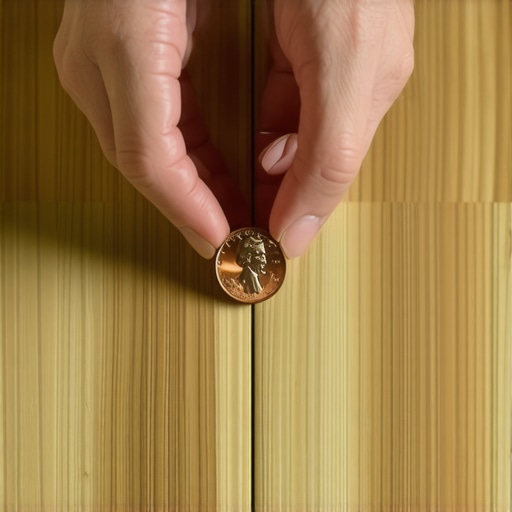
The penny test is a baseline for survival
The penny test for checking laminate expansion gaps involves placing a standard US penny into the space between your flooring and the wall to ensure a minimum clearance of 1/16th inch. This expansion gap is vital because laminate flooring is a floating floor system that moves based on humidity and temperature changes in the environment. Without this gap, the floor will buckle, peak, or delaminate as the HDF core expands against rigid structures like walls or door frames.
Why your subfloor is lying to you
Most guys skip the leveling compound. They think the underlayment will hide the dip. It won’t. I spent three days grinding concrete on a job last month just so the floor wouldn’t click like a castanet. That job was a nightmare. The homeowner had bought a high-end laminate, but the slab looked like the rolling hills of Kentucky. If I had just laid the planks down, every joint would have failed within six months. You see, when a subfloor has a dip, the plank flexes down. That flex puts immense torque on the locking mechanism. Over time, the click-lock tongue snaps off. Then you get gaps. Then you get dirt in the gaps. Then the whole thing looks like garbage. I told them we grind it flat or I walk. They paid for the grinding. It smelled like wet stone and sweat for eight hours, but that floor is now as solid as a bank vault. You have to treat the subfloor like the foundation of a skyscraper. If it is not flat to within 3/16 of an inch over a 10 foot radius, you are building on sand. I have seen guys try to use extra underlayment to fill the holes. That is a crime in the flooring world. Too much cushion actually causes the locking mechanisms on LVP and laminate to snap under pressure because the floor bounces. You want a firm, flat base, not a trampoline.
The physics of the floating floor
Laminate is not a static material. It is a living, breathing composite of wood fibers and resins. These fibers are hygroscopic. This means they are constantly seeking equilibrium with the moisture in the air. When the humidity in your house rises during a humid summer, those wood fibers absorb water molecules. The cell walls swell. In a large room, that microscopic swelling adds up to a significant physical shift. If you have a thirty foot run of flooring, that floor might grow by nearly half an inch across its total width. If you did not leave a gap at the wall, the floor hits the drywall and has nowhere to go. The force of expansion is incredible. It will literally lift the floor off the subfloor, creating a bubble in the middle of your room. This is called peaking. You walk on it and it feels like a sponge. Eventually, the pressure becomes so great that the decorative wear layer starts to crack or the planks separate at the ends. The penny test is the simplest way to ensure you gave the floor the breathing room it needs to exist without destroying itself.
“A floor is only as good as the subfloor beneath it; deflection is the enemy of every joint.” – Master Flooring Axiom
The chemistry of the laminate core
Inside every plank of laminate is a High-Density Fiberboard (HDF) core. This is not just sawdust and glue. It is a carefully engineered slurry of wood fibers, usually pine or spruce, mixed with melamine-urea-formaldehyde resins. The density of this core determines how much the floor will react to weight and moisture. Cheap laminate has a lower density, meaning more air pockets between the fibers. More air pockets mean more room for water to settle. This is why cheap floors swell like a sponge the moment a dog knocks over a water bowl. High-end laminate is pressed under extreme pressure to achieve a density that resists moisture penetration. However, even the best HDF will expand. The resin provides a bond, but the wood fibers still obey the laws of biology. They will expand. They will contract. When the winter heater kicks on and the air dries out, the floor will shrink. If you did not acclimated the floor properly before installation, this shrinkage can cause the planks to pull apart, leaving unsightly gaps that no amount of floor wax can hide. Unlike hardwood floors that are nailed down, laminate must be free to slide as a single unit across your subfloor.
The heavy island trap
Homeowners always ask why their waterproof vinyl or laminate is buckling. Usually, it is because they locked it under a heavy kitchen island. This is a classic mistake. A floating floor needs to move. If you install a beautiful laminate floor and then bolt a 500 pound granite-topped island right on top of it, you have essentially nailed that floor to the ground. When the floor tries to expand, the island acts as an anchor. The floor cannot move past it, so it buckles on the other side. You must install the island first and then install the flooring around it, or you must drill oversized holes through the laminate for the island’s mounting bolts so the floor can still slide back and forth. The same rule applies to heavy bookshelves and even some types of cabinetry. You are not just laying a floor, you are managing a moving system. If you treat it like a rigid surface, like tile with grout, you are going to have a bad time. Laminate is more like a tectonic plate. It is always shifting, and you have to account for those plate tectonics at every perimeter wall.
Perimeter physics and the quarter round lie
Many installers try to hide their lack of precision with thick molding. They leave a massive, uneven gap and then slap a piece of quarter round over it. While molding is necessary to cover the expansion gap, it should not be a mask for sloppy work. The gap should be consistent. If you use the penny test and find that a penny falls through the gap in some places but you cannot even fit a sheet of paper in others, your floor is going to bind. You also have to be careful when nailing your baseboards. If you nail the baseboard or the quarter round through the laminate and into the subfloor, you have once again locked the floor in place. The molding must be nailed only to the wall. This allows the floor to slide freely underneath the trim. It is a delicate balance. You want the trim to hold the floor down slightly, but not so tight that it pinches the wood. I have seen floors fail because a trim carpenter used three inch finish nails and shot them straight through the laminate into the bottom plate of the wall studs. That floor never had a chance.
Comparing expansion needs across materials
Different materials require different levels of respect for physics. Hardwood floors move differently than laminate. While laminate expands in all directions, solid hardwood moves primarily across the grain. This is why you see wider gaps at the sides of a hardwood room than at the ends of the boards. In contrast, laminate and LVP are more uniform in their movement. Showers and bathrooms are especially dangerous for laminate because the humidity is constantly fluctuating. If you put laminate in a bathroom, you better be using a 100 percent silicone sealant in that expansion gap to keep water from getting under the planks while still allowing for movement. Grout in a tile floor serves a completely different purpose. Grout is rigid because tile is rigid. If you try to treat a laminate joint like a grout line, the first season change will snap it. Below is a comparison of how different materials handle the need for space.
| Material Type | Recommended Expansion Gap | Primary Movement Driver | Acclimation Period |
|---|---|---|---|
| Laminate Flooring | 1/4 Inch to 3/8 Inch | Humidity and Heat | 48 to 72 Hours |
| Solid Hardwood | 3/4 Inch | Moisture Content | 7 to 14 Days |
| Engineered Wood | 1/2 Inch | Atmospheric Moisture | 3 to 5 Days |
| Vinyl Plank (LVP) | 1/4 Inch | Temperature Fluctuations | 24 to 48 Hours |
The humidity trap in modern basements
Installing laminate in a basement is a common project, but it is where most people fail. A concrete slab in a basement is a giant sponge. It is constantly pulling moisture from the earth through a process called capillary action. Even if the slab looks dry, it is likely emitting moisture vapor. You must use a 6 mil poly film as a moisture barrier before laying your underlayment and laminate. If you skip this, the moisture will collect under the planks and be absorbed by the HDF core. Within months, the edges of your planks will start to curl up. This is called cupping. Once a laminate floor cups, it is ruined. You cannot sand it down like you can with hardwood floors. You also need to increase your expansion gap in basements because the humidity levels are generally higher and more volatile. A penny might not be enough in a damp cellar. You might need to use two or even three pennies stacked together to ensure the floor has enough room to handle the summer humidity surge. I always use a pin-less moisture meter on the slab before I even bring the boxes of flooring into the house. If that meter reads high, we wait, or we use a specialized moisture-blocking primer on the concrete.
“Modern laminate systems are engineering marvels, but they are still slaves to the moisture levels of the environment they inhabit.” – Flooring Technical Institute
The checklist for a stable installation
If you want your floor to last for thirty years instead of three, you need to follow a strict protocol. It is about discipline. It is about respecting the material. Do not let the pretty wood grain fool you. This is a technical installation that requires a technical mind. Use this checklist before you click that first plank into place.
- Acclimate the flooring in the room where it will be installed for at least 48 hours with the boxes open and stacked flat.
- Test the subfloor for flatness and grind down any high spots or fill any low spots with a high quality self-leveling compound.
- Install a 6 mil moisture barrier if you are laying over concrete or a crawlspace.
- Use spacers at every wall to maintain a consistent expansion gap of at least 1/4 inch.
- Check the gap at every single wall, doorway, and fixed object using the penny test.
- Ensure that the floor is not pinned down by heavy cabinetry or oversized appliances.
- Avoid using T-moldings that are too tight, allowing the floor to move between rooms.
- Never nail your trim through the flooring material.
The ghost in the expansion gap
There is a sound that a failing floor makes. It is a sharp, plastic crackle. You hear it when you walk across the room. That sound is the ghost of a missing expansion gap. It happens when the floor has expanded so much that it is pressing hard against a wall. The planks are under tension. When you step on them, they rub against each other with thousands of pounds of force. That clicking and popping is the sound of your floor’s locking system slowly being ground into dust. If you find your floor making these noises, the first thing you should do is pull up your baseboards. Check the gaps. If you see the laminate is touching the drywall, you need to take a oscillating multi-tool and carefully trim back the edge of the floor to create that 1/4 inch space. Once the tension is released, the floor will settle back down and the noise will usually disappear. It is a simple fix for a problem that can be avoided entirely if you just use a penny during the install. Do not be the guy who thinks he knows better than the manufacturer. The instructions are in the box for a reason. They aren’t just suggestions. They are the laws of physics written down so you don’t waste five thousand dollars on a floor that buckles in the first heatwave. I have seen it happen a hundred times. The sawdust under my nails is a reminder of all the floors I have had to rip out because someone thought a 1/16 inch gap was enough. It never is.
The final word on acclimation
Acclimation is the most ignored step in flooring. People want their new floor today. They buy it from a big box store where it has been sitting in a cold, drafty warehouse and they want it in their living room by dinner time. That is a recipe for disaster. The floor needs to reach the same temperature and humidity as your home. If you take cold, dry laminate and install it in a warm, humid house, it will start expanding the moment you take it out of the box. If you install it tight to the walls, it will be buckled by the time you wake up the next morning. You have to let those boxes sit. You have to be patient. Flooring is a game of millimeters and hours. If you rush the clock or skimp on the gap, the house always wins. Stick to the penny test, respect the subfloor, and keep your moisture meter handy. That is how you build a floor that lasts a lifetime.