
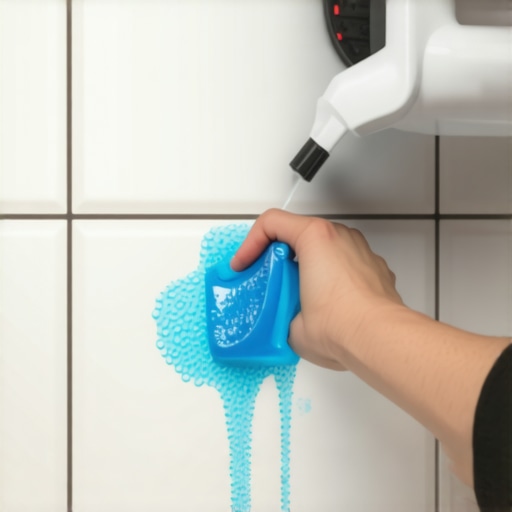
Most guys skip the leveling compound. They think the underlayment will hide the dip. It won’t. I spent three days grinding concrete on a job last month just so the floor wouldn’t click like a castanet. That same job had a bathroom where the grout looked like it had been through a coal mine. The homeowner was ready to rip out the whole shower because she thought the tile was permanent garbage. I told her to put away the sledgehammer. I have spent twenty-five years on my knees in the dirt and the dust of residential construction and I know that a floor is more than a surface. It is a structural assembly that requires precise chemistry to maintain. If your grout looks like a disaster it usually comes down to the microscopic pores of the cementitious material trapping oils and debris. This is where the blue dish soap trick comes into play. It is not magic. It is surfactant technology applied to porous substrates. You need to understand the physics of the bond before you start scrubbing with a toothbrush.
The hidden world of grout porosity
Grout is a mixture of cement and sand that acts as a structural filler between tiles. Because it is a cementitious product it contains millions of microscopic voids that absorb liquids through capillary action. When you shower or walk across a kitchen floor these voids pull in oils, soap scum, and dirty water. If you do not seal the grout every year these contaminants become part of the floor structure. The blue dish soap trick works because it targets the lipid bonds of the grime without the caustic reaction of acid-based cleaners. Acid cleaners are the enemy of cement. They eat away at the lime in the grout and eventually turn it to powder. A floor is only as good as the subfloor beneath it; deflection is the enemy of every joint. This means if your floor flexes because of a weak subfloor the grout will crack and these cracks will absorb even more filth. You need a stable surface before you can even think about aesthetic maintenance. Most people ignore the deflection rating of their joists but it determines the lifespan of every grout line in the house.
“A floor is only as good as the subfloor beneath it; deflection is the enemy of every joint.” – Master Flooring Axiom
The chemistry of blue surfactants
Blue dish soap is formulated as a powerful surfactant that reduces the surface tension of water. When you mix it with warm water the molecules arrange themselves to surround oil particles and lift them out of the cement pores. This is the same principle we use when cleaning tools after a long day of setting tile. The blue version of the soap is specifically engineered to handle heavy grease loads which makes it ideal for kitchen floors and bathroom soap scum. Most homeowners make the mistake of using too much soap. A single teaspoon in a gallon of warm water is enough. If you over-saturate the grout you leave a film that attracts more dirt later. You must follow the exact chemical ratio to ensure the surfactant can do its job without leaving a sticky residue. I have seen floors that felt like flypaper because someone dumped a whole bottle of soap onto the tile. That is not cleaning; that is creating a future problem for me to fix. You want the water to penetrate the pore, grab the oil, and then be rinsed away completely. It requires patience and a mechanical agitation that most people are too lazy to provide.
The danger of moisture on hardwood floors
Hardwood floors and moisture are natural enemies that will eventually destroy your home value. While the blue dish soap trick is great for tile you should never let that mixture get near your solid oak or engineered planks. Wood is a hygroscopic material. It wants to breathe and it wants to absorb water. If you use a wet mop with soap on a hardwood floor the liquid will seep into the tongue and groove joints. This causes the wood fibers to swell. Once those fibers swell they push against each other and the floor begins to cup. I once walked into a house where a 15,000 dollar wide-plank walnut floor was cupping so bad it looked like a potato chip because the installer didn’t check the crawlspace humidity and the homeowner was mopping it with a bucket of water. You have to treat wood with respect. Soap breaks down the finish over time and removes the protective oils that keep the wood stable. If you have a transition between tile and wood you must be extremely careful. The soap belongs on the ceramic and nowhere else. Wood requires a pH-neutral cleaner that evaporates quickly without penetrating the grain.
| Material Type | Porosity Level | Janka Hardness | Recommended Cleaner |
|---|---|---|---|
| Cement Grout | High | N/A | Blue Dish Soap Solution |
| White Oak | Medium | 1360 | pH-Neutral Wood Cleaner |
| Laminate HDF | Low | N/A | Damp Microfiber Only |
| Epoxy Grout | Zero | N/A | Steam or Mild Soap |
The 1/8 inch that ruins everything
Precision in the expansion gap is the difference between a floor that lasts and a floor that buckles. When we talk about grout we are talking about a rigid material. When we talk about laminate or LVP we are talking about floating systems that move. You cannot grout laminate. I have seen DIYers try to fill the gap between laminate and a bathtub with grout and it always fails. The floor expands and the grout shatters like glass. The blue dish soap trick is only for fixed surfaces like ceramic or stone. For laminate you have to be even more careful with soap. Laminate is essentially a photograph of wood glued to a high-density fiberboard core. If soap and water get into the clicking mechanism the core will blow up like a sponge. This is why I tell people to avoid the big-box store advice of deep-cleaning laminate. You use a damp cloth and you stay away from the soap bubbles. The chemistry of the glue in that HDF core is not designed to withstand the surfactants in blue dish soap. It will delaminate and the floor will be ruined within six months.
The shower grout maintenance protocol
Showers are the most aggressive environment for grout because of the constant cycles of wetting and drying. To use the blue dish soap trick effectively in a shower you need to understand the buildup of body oils and mineral deposits. In high-humidity regions like Florida or the Gulf Coast the grout also deals with mold spores that thrive in the damp pores. You start by spraying the soap solution and letting it sit for ten minutes. This allows the surfactants to penetrate the mineral crust. Do not use a wire brush. You will scratch the glaze on the tile. Use a medium-stiff nylon brush and work in small circles. This mechanical action breaks the surface tension and allows the soap to encapsulate the grime. Once you have scrubbed the area you must rinse it with clean water until the bubbles stop. If you leave soap behind it becomes a food source for mildew. It is a simple cycle of application, agitation, and evacuation. Most people skip the evacuation step and that is why their grout turns yellow after a month.
Grout Cleaning Checklist
- Mix one teaspoon of blue dish soap with one gallon of hot water.
- Apply the solution to the grout lines using a spray bottle.
- Wait ten minutes for chemical penetration.
- Scrub using a nylon brush in a circular motion.
- Rinse with clear water three times.
- Dry the area with a clean microfiber towel to prevent spotting.
- Reapply sealer once the grout is completely dry.
The ghost in the expansion gap
Every floor needs room to breathe and if you clog those spaces with debris the floor will fail. While cleaning your grout lines you might be tempted to scrub the perimeter where the tile meets the baseboard. This is often a caulk joint rather than a grout joint. You can tell the difference by poking it with a fingernail. If it is soft it is siliconized acrylic. The blue dish soap trick works on caulk too but you have to be careful not to peel it away from the substrate. In a proper installation there should be an expansion gap at the perimeter. If that gap is filled with hard grout the floor has nowhere to go when the house settles or the temperature changes. This results in tenting where the tiles pop off the floor. I have seen entire kitchens sound like a gunshot when the pressure finally gets too high and the tiles snap. Your maintenance routine should always involve checking for these pressure points. Cleaning is not just about looks; it is about monitoring the health of the installation.
“Cementitious grout is a living material that reacts to its environment; treat it with the same care you would a structural beam.” – Tile Council of North America Guidelines
Why your subfloor is lying to you
A subfloor may look flat to the naked eye but a ten-foot straightedge will reveal the truth. If your grout keeps getting dirty in the same spot it is often because there is a low point in the subfloor where water pools. No amount of blue dish soap will fix a structural dip. When I install a floor I spend more time with the floor patch and the grinder than I do with the actual tile. You want the surface to be flat within 1/8 inch over ten feet. If you have a dip the water from your mop will settle there and deposit all the dirt it has collected. This creates a dark stain that looks like dirty grout but is actually a drainage issue. You have to understand the topography of your house. If you are cleaning grout on a second floor you also have to consider the deflection of the plywood. Plywood subfloors flex more than concrete. This flex creates micro-fissures in the grout that are impossible to clean with soap alone. In those cases you might need to look at epoxy-based colorants to seal the surface permanently. Most homeowners want a quick fix but I am here to tell you that a floor is a system. The blue dish soap is just one tool in a massive kit of maintenance requirements.
The final word on grout integrity
Maintenance is a lifelong commitment to the materials you have chosen for your home. Using the blue dish soap trick is a smart way to maintain grout without destroying the chemical integrity of the cement. It avoids the harshness of bleach and the destructive nature of acids. However you must remember that grout is not waterproof. It is water-resistant at best. Every time you clean you are introducing moisture into the system. This is why drying the floor is just as important as washing it. You should never leave a floor to air dry if you want the grout to remain pristine. Use a shop vacuum or a stack of towels to pull the moisture out of the pores. This prevents the minerals in your water from settling back into the grout and causing efflorescence. Efflorescence is that white powdery substance that appears on grout and it is caused by salt migration. If you control the water you control the floor. It is that simple. Stick to the chemistry and the physics and your floor will outlive you. Stop looking for shortcuts and start looking at the microscopic reality of your home.