
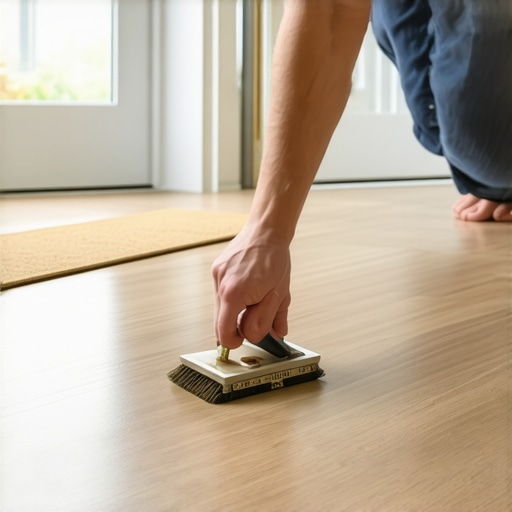
I smell like WD-40 and oak dust most days. My knees have the permanent calluses of a man who has spent twenty-five years chasing the perfect level on subfloors that were never meant to be flat. You see a floor as something to walk on. I see it as a structural diaphragm that is constantly fighting against the physics of your house. Most guys skip the leveling compound. They think the underlayment will hide the dip. It won’t. I spent three days grinding concrete on a job last month just so the floor wouldn’t click like a castanet. That is the reality of professional installation. When a homeowner tells me their laminate is creaking near the door, I do not see a cosmetic issue. I see a failure of geometry and a misunderstanding of friction. The sound you hear is the cry of a locking mechanism being pushed beyond its engineered tolerances. It is the result of the high-density fiberboard core rubbing against a door jamb or a subfloor high spot that should have been addressed before the first plank was ever laid. Hardwood floors have their own temperamental nature, but laminate is a different beast entirely. It is a floating system, meaning it needs to move. If you trap it at a doorway, it will scream about it.
The friction trap at the door casing
Laminate floor creaking near doors is usually caused by friction between the locking mechanism and the door jamb or the subfloor. Applying a dry lubricant like graphite powder or silicone spray into the expansion gap often stops the noise instantly by reducing the surface tension between the planks. This quick fix addresses the immediate vibration that occurs when the tongue and groove profile of the laminate is compressed under your weight. When you walk through a doorway, your entire body weight is concentrated on a small area of the floor. If the floor cannot slide slightly under the door casing, the tension builds until the joint releases with a sharp, audible pop. This is not a failure of the material, but a failure of the installation to account for the micro-movements required by a floating system. I often find that the installer did not undercut the door jamb deep enough. If the plank is wedged tight against the wood of the door frame, there is no room for the natural expansion and contraction that occurs with every change in humidity. This is especially true near bathrooms where showers create a localized micro-climate of high moisture. That moisture enters the HDF core of the laminate, causing it to swell by fractions of a millimeter. In the world of flooring, a millimeter is the difference between a silent walk and a floor that sounds like a haunted house.
Why your subfloor is lying to you
Subfloor flatness is the single most ignored factor in flooring installation and the primary cause of long-term creaking and joint failure. If a subfloor deviates more than one eighth of an inch over a ten foot span, the laminate joints will experience vertical deflection that causes friction. You might think that a thick foam underlayment will cushion the blow. You are wrong. In fact, while most people want the thickest underlayment possible, too much cushion actually causes the locking mechanisms on LVP and laminate to snap under pressure. Think of it like walking on a trampoline. If the floor bends too much into a dip, the tongue of the plank is forced upward while the groove is pushed down. They rub. They squeak. Eventually, they break. I have pulled up countless floors where the locking lip was completely sheared off because the installer was too lazy to use a bag of self-leveling underlayment. Unlike tile where grout can sometimes mask minor height variations, laminate requires a rigid, flat plane to maintain its structural integrity. If you hear a creak, get on your hands and knees. Press the floor. If you see it move down more than a sixteenth of an inch, your subfloor has a dip. No amount of lubricant will fix a structural void, but the five-minute trick can at least quiet the friction until you decide to do the job right.
“A floor is only as good as the subfloor beneath it; deflection is the enemy of every joint.” – Master Flooring Axiom
The physics of vertical deflection and molecular friction
To understand the squeak, you have to zoom into the molecular level of the laminate core. Most high-quality laminates use a High-Density Fiberboard (HDF) core. This is essentially wood fibers compressed with resin under immense pressure. When the floor is milled, the tongue and groove are cut with high-speed diamond bits to a tolerance that is tighter than a human hair. When the floor is flat, these pieces sit in a state of neutral equilibrium. However, when you step on a plank that is suspended over a subfloor dip, you are creating a lever. The resin-heavy fibers of the tongue rub against the walls of the groove. Because HDF is very dense, this friction produces a high-pitched sound. If you inject a dry lubricant, you are introducing microscopic spheres of graphite or PTFE between these two surfaces. This allows the fibers to slide past each other without catching. It is the same principle as greasing a rusty hinge, but on a much smaller scale. You must avoid oil-based lubricants. Oil will soak into the HDF core, causing it to soften and swell, which will permanently ruin the joint. Always use a dry spray or a powder. The chemistry of the bond matters just as much as the physical fit. This is why I always keep a tube of graphite in my kit. It is the only thing that can get into those tight tolerances without compromising the integrity of the resin bond.
| Subfloor Type | Maximum Allowable Deflection | Moisture Content Limit | |
|---|---|---|---|
| Plywood or OSB | L/360 | 12 percent MC | |
| Concrete Slab | 1/8 inch per 10 feet | 3 lbs per 1000 sqft | |
| Radiant Heat | L/480 | 2 percent CM Method |
The ghost in the expansion gap
An expansion gap of at least one quarter inch is required around the entire perimeter of a laminate floor to prevent binding and creaking. When a floor hits a wall or a door threshold, the kinetic energy of your footstep has nowhere to go but up, causing the joints to protest. I have seen floors that were installed tight against the drywall. In the summer, when the humidity hits, those floors grow. If they have no room to move, they will peak in the middle of the room or creak at the edges. Near doors, this is exacerbated by the presence of T-moldings. If you screw a T-molding track through the laminate and into the subfloor, you have effectively anchored the floor. You have killed the floating system. A floating floor must be free to drift as a single unit. If you pin it at the door, the planks near that door will be under constant stress. This is why the creak happens right at the transition. To fix this, you might need to pull the molding and check if the floor is touching the track or the door casing. If it is, you need to trim it back. A multi-tool with a plunge blade is the surgeon’s scalpel here. Shave back that quarter inch of material, and you will hear the floor breathe a sigh of relief. It is the difference between a floor that lasts thirty years and one that fails in three.
The five minute lubricant injection technique
If you have verified that your expansion gaps are clear and your subfloor is reasonably flat, but the creak persists, follow this protocol. First, vacuum the joint thoroughly. Any bit of grit or sawdust inside the locking mechanism will act like sandpaper. Second, take a dry silicone spray with a thin straw attachment. Aim the straw directly into the seam where the planks meet near the door. Apply a very small amount. You do not want to flood it. Third, step on the floor repeatedly to work the lubricant down into the tongue and groove. The sound should dampen almost immediately. If you prefer not to use a spray, graphite powder works exceptionally well but can be messy on lighter-colored floors. Wipe away any excess immediately. This process works because it addresses the surface-to-surface friction that occurs during the micro-flexing of the HDF core. It is a temporary fix for some, but for many, it is all that is needed to settle a floor that was installed just a bit too tight. Do not use WD-40 or any petroleum-based product. These will break down the resins in the laminate and can lead to delamination of the wear layer. You are looking for lubrication, not solvent action.
- Check the expansion gap under the door jamb.
- Vacuum the joints to remove abrasive debris.
- Apply dry graphite or silicone spray.
- Walk the joint to distribute the lubricant.
- Trim any molding that is pinching the floor.
“Deflection is the silent killer of click-lock flooring; if the subfloor moves, the joint fails.” – TCNA Installation Standards
Regional humidity and the behavior of HDF cores
The climate in your specific region plays a massive role in how your laminate behaves. If you live in a place with high seasonal humidity, your floor is going to expand significantly. In the swampy humidity of the South, a solid wood floor is a death wish for many homeowners, which is why they turn to laminate or engineered cores. However, even laminate has a limit. The HDF core is hygroscopic, meaning it absorbs moisture from the air. If you installed your floor in the dead of winter when the air was dry, and now it is July, those planks are wider than they were on day one. If they are creaking near the door, it is because they have expanded into the door frame. Conversely, in the dry heat of places like Phoenix, the core can shrink, causing the joints to open slightly. When the joints open, debris gets inside. Then, when the humidity returns, the floor expands against that debris, creating a grinding or creaking sound. Understanding the equilibrium moisture content of your home is vital. I always tell people to run a dehumidifier in the summer if they have a crawlspace. Moisture coming up through the subfloor is the number one cause of floor failure. Laminate is touted as waterproof, but that usually only refers to the surface. The underside is a sponge. If you do not have a 6-mil poly vapor barrier over your concrete slab, your floor is doomed to creak, buckle, and eventually rot from the bottom up.
The structural reality of transition strips
Transition strips are often the source of the mystery creak. In large open-concept homes, installers often try to run laminate through doorways without a break. This looks great for the minimalist curator who hates bulky T-molding, but it is a recipe for disaster. Every room has a different humidity level and a different amount of heavy furniture. If you run the floor continuously from a kitchen with heavy appliances into a hallway, the floor is pinned in the kitchen but free in the hall. When the floor tries to move, the stress accumulates at the narrowest point, which is the doorway. This is why we use T-moldings. They allow the floor in each room to move independently. If your floor is creaking at the door, check if it was installed as a continuous run. If it was, you might actually need to cut the floor at the doorway and install a transition strip to relieve the tension. It is a painful realization for those who love the zero-threshold look, but structural integrity must always come before aesthetics. A floor that looks perfect but sounds like a drum set is a failed installation. You have to respect the physics of the material. Laminate is not stone. It is a manufactured wood product, and it will always behave like one. Treat it with the respect its engineering requires, and it will remain silent under your feet for decades.