
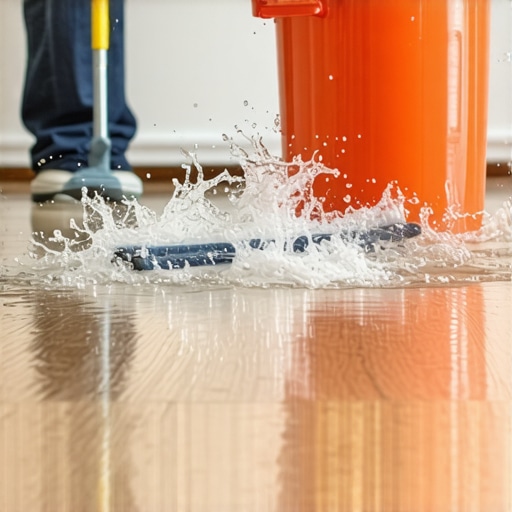
You probably think that because your laminate floor looks like wood or stone, it can handle a good old-fashioned scrubbing like the floors in your grandmother’s house. You are wrong. I have spent twenty five years crawling across subfloors with a moisture meter and a level, and the biggest killer of modern flooring is the homeowner who treats their laminate like a deck on a boat. I once walked into a house where the homeowners were devastated because their expensive new planks were buckling and clicking like a castanet. They had been using a steam mop every Saturday morning because they wanted it clean. They did not realize they were literally injecting high-pressure vapor into the heart of the floor, destroying the resin bonds and turning the core into a soggy mess. This is the reality of laminate, it is a structural engineering marvel until you introduce a bucket of water.
The cellular betrayal of fiberboard
Excess water ruins laminate because the High Density Fiberboard core is composed of compressed wood fibers and resins that act like a sponge. When water penetrates the unsealed joints, these fibers expand, causing permanent swelling, peaking, and delamination of the decorative layer. Unlike solid hardwood floors that might cup and then settle back down once the humidity drops, laminate is a one-way street. Once the fibers in that HDF core have expanded from moisture, they rarely return to their original state. The internal bond strength of the board is compromised at a molecular level. The resins that hold the wood dust together are not designed for total immersion. They are designed for stability under normal atmospheric conditions. When you slop a wet mop across the surface, the liquid does not just sit on top. Surface tension pulls that water into the tiny micro-gaps of the click-lock system. From there, gravity and capillary action do the rest. The water travels down into the tongue and groove, where there is no protective melamine wear layer. This is where the swelling begins. You will see it first as a slight rise at the edges of the planks. By the time you notice the edges are higher than the center of the board, the damage is done. The floor is technically failing. [IMAGE_PLACEHOLDER]
How water travels through a locking joint
The mechanical locking system of a laminate floor is a masterpiece of precision milling, but it is not a waterproof seal. To win the featured snippet of your home maintenance journey, you must understand that water molecules are smaller than the milling tolerances of even the highest quality laminate. Surface tension draws moisture into the interlocking channels, where the unprotected HDF core absorbs the liquid, leading to hydroscopic expansion. Most people assume the clicking sound of the floor is a result of a bad subfloor. Often, it is actually the result of the joints swelling just enough to rub against each other. When you walk across it, the friction of the swollen wood fibers creates that annoying squeak. This is different from the way showers are waterproofed. In a shower, you have a waterproof membrane and grout that is often sealed. In a laminate floor, you have nothing but the tight fit of the planks. There is no chemical bond at the joint. If you leave a puddle of water on a seam for more than ten minutes, you are essentially starting a slow-motion demolition of your living room.
“A floor is only as good as the subfloor beneath it; deflection is the enemy of every joint.” – Master Flooring Axiom
The marketing myth of the waterproof label
Marketing departments love the word waterproof, but in the world of flooring, it is a relative term. When a manufacturer says their laminate is waterproof, they usually mean the surface is topical-moisture resistant for a specific window of time, usually 24 to 72 hours. This does not mean the floor is a submarine. It means if you spill a glass of water and wipe it up, you are fine. It does not mean you can use a soaking wet mop or a steam cleaner. The heat from a steam mop is particularly lethal. It opens the pores of the material and forces moisture deeper than liquid water could ever go. I have seen floors that were only six months old look like they were twenty years old because of steam cleaning. The heat also attacks the adhesives used to laminate the wear layer to the core. You will start to see white cloudy spots or actual peeling. Once that wear layer delaminates, the floor is trash. You cannot sand it. You cannot refinish it. You can only replace it. This is why I always tell my clients to ignore the flashy stickers on the box and read the fine print in the warranty. Most warranties specifically state that the use of a steam mop or excessive water voids your coverage. They know the physics of their product even if the salesperson at the big box store does not.
Laminate vs Other Surfaces Moisture Resistance
| Feature | Laminate | Engineered Wood | LVP (Vinyl) |
|---|---|---|---|
| Core Material | High Density Fiberboard | Plywood or HDF | PVC or Stone Composite |
| Joint Sensitivity | Very High | Moderate | Low |
| Steam Mop Safe | Never | Never | Rarely |
| Moisture Response | Permanent Swelling | Cupping/Crowning | Minimal to None |
The physics of the swelling core
To truly understand why water is the enemy, we have to look at the manufacturing process. Laminate is made under immense pressure, often exceeding 300 kilograms per square centimeter. This pressure creates a dense, stable board. However, that density is also its downfall when it comes to water. Because the fibers are so tightly packed, when they do absorb water, the internal pressure within the board becomes massive. There is nowhere for the water to go but out. This is why the edges of the planks peak. The core is literally exploding on a microscopic scale. This expansion can also put pressure on your walls. If you did not leave a proper expansion gap at the perimeter of the room, the floor will hit the drywall and have nowhere to go but up. I have seen entire floors lift off the subfloor in a giant bubble because of a combination of high humidity and wet mopping. It is a structural failure triggered by a simple cleaning mistake. Many homeowners think a thick underlayment will save them. It will not. In fact, if the underlayment is too soft, it allows for more vertical movement at the joints, which opens the seams even further and lets more water in. A thinner, high-density underlayment is actually better for protecting the integrity of the joints.
“Modern laminate is a high-performance composite, but its Achilles heel remains the hydroscopic nature of its cellulose-based core.” – NWFA Technical Manual
The 1/8 inch that ruins everything
Precision is everything in flooring. When I install a floor, I am looking for subfloor flatness of 1/8 inch over a 10 foot span. If the subfloor has a dip, the laminate will flex every time you step on it. This flexing acts like a pump. If there is water sitting on the surface, that mechanical pumping action of the joint moving up and down actually sucks the water down into the core. This is why a perfectly level subfloor is the best defense against moisture damage. A flat floor keeps the joints tight and closed. A wavy floor opens the joints and invites the water in. Most installers skip the floor prep because it is hard work. They do not want to spend three days grinding concrete or pouring self-leveling compound. But if you want a floor that survives a accidental spill, you need that subfloor to be dead flat. I have spent more time with a grinder in my hand than a hammer lately, and that is why my floors do not peak when someone spills a drink.
Proper maintenance protocols for longevity
If you want your laminate to last thirty years instead of five, you have to change your relationship with cleaning. You do not need water to get a floor clean. You need a microfiber mop and a dedicated laminate cleaner that evaporates quickly. The goal is to use a fine mist, not a flood. Here is the checklist I give every one of my customers after an installation.
- Use a vacuum with the beater bar turned off to remove grit and sand that can scratch the wear layer.
- Mist the microfiber pad, not the floor, to ensure you are not over-saturating the seams.
- Clean up spills immediately with a dry cloth, do not let them sit.
- Avoid any cleaners that promise a shine, as these often contain waxes or oils that build up and trap dirt.
- Maintain indoor humidity between 35 and 55 percent to prevent the core from shrinking or expanding.
By following these steps, you protect the investment you made in your home. You prevent the structural breakdown of the HDF core and keep the locking joints intact. Remember, you are walking on a highly engineered wood product, not a piece of plastic. Treat it with the respect that wood deserves. If you want a floor you can hose down, go buy some tile and use high-quality epoxy grout. But if you want the beauty and comfort of laminate, put the bucket away and stick to the spray bottle.