
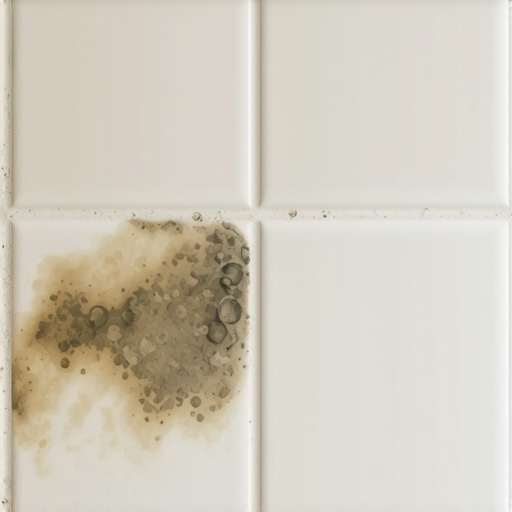
The corrosive myth of the white line
Sanded grout lines are composed of Portland cement and silica sand, making them highly alkaline and porous. Using sodium hypochlorite, commonly known as bleach, causes a violent chemical reaction that breaks down the polymer binders and the calcium carbonate structure of the grout. This lead to efflorescence, crumbling joints, and eventually the failure of the tile installation. Most homeowners reach for the bleach bottle because they want a quick fix for mildew or discoloration, but they are actually inviting structural decay. I spent three days grinding concrete on a job last month just so the floor wouldn’t click like a castanet, and let me tell you, fixing bleached grout is even worse. I once walked into a luxury bathroom where the homeowner had used straight bleach every week for two years. The sanded grout had the consistency of wet sugar. You could scrape it out with a fingernail. The moisture barrier behind the tile was completely shot because the grout no longer acted as a hydraulic seal. I had to rip out twenty thousand dollars of Italian marble because someone thought a gallon of Clorox was a substitute for a pH-neutral cleaner. It was a tragedy of chemical ignorance. My hands still smell like the oak dust from the next job, but that bathroom stays in my mind as a warning. Grout is not a plastic. It is a mineral matrix. When you hit it with oxidizing agents, you are essentially acid-washing the life out of your floor. The bleach penetrates the capillary pores of the cement. It reacts with the calcium hydroxide. It creates salt crystals. These crystals grow inside the grout and create internal pressure. It is a slow explosion. Your grout does not just get clean. It gets brittle. It gets weak. It fails. [image placeholder]
The microscopic reality of cement decay
Portland cement in grout forms a crystalline lattice that holds sand aggregate in a rigid suspension. When bleach is applied, it initiates leaching where the calcium minerals are pulled from the cement paste, leaving behind a brittle skeleton that cannot support structural loads or resist water penetration. This is not just about looks. It is about mechanics. The sand particles in sanded grout act like rebar in concrete. They provide tensile strength. The cement is the glue. Bleach dissolves the glue. You end up with loose sand at the bottom of your shower. That sand acts as an abrasive. Every time you step on the tile, the loose sand grinds against the edge of the tile. It wears down the glaze. It creates micro-scratches. These scratches then hold more bacteria. It is a cycle of floor destruction. You think you are cleaning. You are actually sanding your floor from the inside out. I see it in entryways and kitchens more than anywhere else. The high-traffic areas lose their integrity first. The grout turns a chalky white. That is not cleanliness. That is death. It is the sign of a failed bond. You cannot fix it with more cleaning. You have to re-grout. That means hours of dusty labor. It means a vacuum that never gets all the grit out. It means sore knees and a tight back. All because of a cleaning myth.
“A floor is only as good as the subfloor beneath it; deflection is the enemy of every joint.” – Master Flooring Axiom
The chemical war against pigments
Grout pigments are often iron oxide or synthetic dyes that are chemically sensitive to oxidation. Bleach acts as a powerful oxidizer that strips the color molecules, leading to blotchy patches and permanent fading that cannot be reversed by sealing or scrubbing. Most guys skip the leveling compound, and they also skip the technical data sheets for cleaners. They don’t realize that pigment stability is a delicate chemical balance. When you throw a high pH substance like bleach on a colored grout, you are performing a chemical extraction. The vibrant gray or deep charcoal you picked out at the showroom turns into a sickly yellow. Or a ghostly white. It looks like the floor is diseased. I have had architects call me screaming because their color-matched grout looks like camouflaged paint. I ask them what the janitorial crew uses. It is always bleach. Every single time. You cannot spot-clean with bleach either. You will end up with halos. The chemical migration through the porous sub-surface ensures that the bleach travels further than the liquid you see on top. It creeps under the tile. It sits on the adhesive. Some thin-sets do not like chlorine. It can cause debonding. Your tiles start to hollow out. You walk across the floor and hear that click-clack sound. That is the sound of money leaving your pocket. It is the sound of a full-tear out. I tell my apprentices to look at the chemistry before the aesthetics. If you do not understand the pH scale, you have no business maintaining a floor.
| Cleaner Type | pH Level | Impact on Grout | Long-term Effect |
|---|---|---|---|
| Bleach | 11-13 | Corrosive | Crumbling and Debonding |
| Vinegar | 2-3 | Acidic Etching | Pitting and Sand Loss |
| Neutral Cleaner | 7 | Safe | Maintains Structural Integrity |
| Epoxy Cleaner | 8-9 | Targeted | Removes Film Only |
The ghost in the expansion gap
Expansion gaps are the breathing room of any flooring system, and when bleach seeps into these perimeter joints, it can degrade the silicone caulk or urethane sealants required by TCNA standards. A rigid floor is a cracking floor. You need that flexibility at the transitions. Bleach is an elastomer killer. It makes flexible sealants turn hard and brittle. Once the sealant cracks, water goes straight to the subfloor. If you have plywood subfloors, they start to delaminate. If you have OSB, it swells like a sponge. I have seen subfloors so rotted from bleach-water runoff that I could put a screwdriver through them with one finger. It starts at the grout line. It ends at the joists. People think the tile is the waterproof layer. It is not. The grout and sealer are the first line of defense. Bleach is the traitor that lets the enemy in. You need to keep the integrity of the perimeter. You need to respect the movement joints. When the house settles, or the seasons change, the floor needs to shift. If the grout is brittle from chemical abuse, it will snap. You will see hairline cracks. Those cracks wick moisture. In a shower, that moisture breeds black mold. Not on the surface, where you can see it, but under the tile. In the mud bed. In the wall cavity. By the time you see the stain on the ceiling below, the damage is in the thousands. All because you wanted the grout lines to be snow white.
“Cementitious grout is a porous mineral product; any chemical introduction must be balanced against its alkaline nature to prevent structural erosion.” – Tile Council of North America Standard
The physics of capillary action in porous materials
Capillary action is the physical phenomenon where liquids are pulled into the micro-pores of the sanded grout, carrying corrosive chlorine deep into the mortar bed where it cannot be neutralized or rinsed away. This deep-seated contamination leads to chronic off-gassing and material fatigue. You cannot just mop the bleach off. It is inside the floor now. It stays there for weeks. It continues to react with the moisture in the air. This is why bleached bathrooms often have that lingering chemical smell even after a heavy rinse. The chemistry is still active. It is eating the alkali. It is weakening the bond wires if you have metal lath in your shower pan. I have seen metal lath completely rust away because of bleach migration. The entire shower floor becomes a floating slab of failure. It bounces when you step on it. That deflection is the death knell for tile. You need a solid substrate. You need immobile grout. You need to treat the surface with respect. Use a soft brush. Use a specialized cleaner. Stop treating your luxury finishes like gas station bathroom floors. Even those floors are dying from the harsh chemicals. I see the pitting in the commercial tile. I see the gray grout turned yellow-white. It is a universal mistake. It is a habit that needs to break. Your floor is an investment. It is structural. Treat it like a machine that needs the correct oil. Bleach is sand in the gears. It will grind until there is nothing left.
The 1/8 inch that ruins everything
Grout joints as small as 1/8 inch provide the essential spacing for thermal expansion, but when bleach compromises their density, the lateral pressure from seasonal temperature shifts causes the tiles to tent or pop. A dense grout is a strong grout. Bleach creates voids. It turns a solid mass into a honeycomb. You cannot see the holes with the naked eye, but they are there. They are microscopic stress points. When the sun hits that kitchen floor, the tiles expand. They push against the grout. If the grout is compromised, it crushes. Then the tiles have nowhere to go but up. I have seen porcelain tiles snap like glass because the grout joints were bleach-weakened. It is a physics problem. You are removing the compressive strength of the assembly. You are turning a hard surface into a soft one. This is why maintenance is part of the engineering. You cannot separate the cleaning from the installation. They are linked. A bad cleaner is a bad installer by proxy. I tell homeowners to throw away the scrub pads and the bleach bottles. Get a steam mop if you must, but keep the chemicals to a minimum. A properly sealed grout line only needs warm water and a mild surfactant. Anything more is overkill. Anything more is sabotage. My knees hurt just thinking about the number of floors I have had to rip out because of this. Don’t be that job for me next month. Keep the bleach in the laundry room where it belongs. It is for whites, not for joints. Your subfloor will thank you. Your wallet will thank you. The silica sand will stay where I put it. It will lock those tiles in place for fifty years if you just leave it alone.
- Never mix bleach with ammonia based cleaners near grout.
- Always use a pH-neutral stone and tile cleaner for daily maintenance.
- Rinse all cleaning agents thoroughly with clean water to prevent residue buildup.
- Reseal sanded grout every six to twelve months depending on foot traffic.
- Inspect grout lines for hairline cracks which indicate structural movement or chemical damage.