
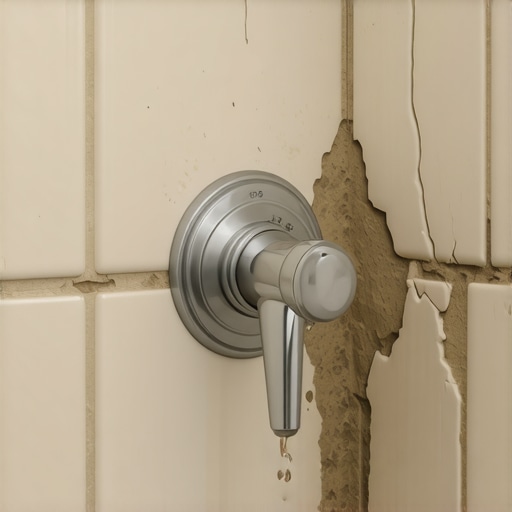
I spent three days grinding concrete on a job last month just so the floor wouldn’t click like a castanet. Most guys skip the leveling compound. They think the underlayment will hide the dip. It won’t. I saw the same laziness in a bathroom remodel last week. I walked into a master suite where the homeowner was complaining about a hairline fracture in the grout right behind the shower handle. They thought it was a bad batch of sand. It wasn’t. It was the fact that the installer didn’t secure the mixing valve to the framing. The whole pipe was vibrating every time the water turned on. That vibration is a silent killer for rigid cement. People treat tile like it is a solid sheet of granite, but it is actually a system of moving parts. If one part moves more than the others, something has to snap. Usually, it is the grout. My hands are still stained with the grey dust of that tear-out. You cannot fix a structural problem with a topical solution. You have to understand the physics of the wall cavity.
The structural movement of mixing valves
Cracking grout behind faucet handles is primarily caused by mechanical deflection of the plumbing fixture against the rigid tile assembly. When the mixing valve is not braced with solid wood blocking, the force of turning the handle transfers torque into the backer board. This movement exceeds the shear strength of standard sanded grout. The valve is the heart of the shower. If that heart is not anchored to the studs, it beats against the tile. Every morning, you reach in and yank that handle to get the hot water going. That is five to ten pounds of pressure being applied to a point of leverage. If the plumber just let the copper pipes hang in the air, that pressure travels through the pipe, hits the valve, and pushes against the back of the tile. The tile is held in place by thin-set, which is basically a brittle rock. Rocks do not like to bend. When the valve pushes and the tile resists, the grout in the middle gets crushed. It is a simple matter of physics. You are using the faucet as a lever to pry your own wall apart. I have seen valves move as much as a quarter inch inside a wall because someone was too lazy to screw a two-by-four between the studs. That is why your grout looks like a spiderweb. It is not a cosmetic defect. It is a structural failure of the plumbing rough-in. You can smear all the new grout you want into that crack, but it will be back in a month. The only real fix is to stabilize the pipe or use a material that actually has some give to it.
The chemistry of grout saturation and bond failure
Moisture intrusion behind the escutcheon plate leads to grout softening and the deterioration of modified thin-set. When water leaks past the faucet handle seal, it saturates the cementitious matrix, causing hydrostatic pressure that pushes the grout out of the joint. This is a capillary action failure. Grout is porous. It is basically a hard sponge. If you do not have a perfect seal around the hole where the valve comes through the wall, water is going to get back there. Once the back of the grout stays wet, the polymers start to break down. Modern grout has latex and other chemicals to make it strong, but those chemicals are not meant to be submerged 24/7. When the water gets behind the tile, it starts a process called leaching. It pulls the minerals out of the cement. This makes the grout brittle and chalky. You might notice the color changing first. It gets darker or looks stained. Then the cracks appear. This is not just about the water you see. It is about the vapor and the moisture that gets trapped between the tile and the waterproofing membrane. If you are using an old-school felt paper or a cheap plastic liner, that moisture has nowhere to go. It sits there and rots the bond. I have pulled tiles off walls where the thin-set was the consistency of wet sand because of this. You need to ensure that the hole for the valve is cut precisely and that the gap between the valve and the tile is filled with a high-quality 100 percent silicone sealant, not grout. Grout should never be used to seal a hole for a pipe. It is too rigid.
“A floor is only as good as the subfloor beneath it; deflection is the enemy of every joint.” – Master Flooring Axiom
[IMAGE_PLACEHOLDER]
The 1/8 inch that ruins everything
Expansion gaps at plane changes and around plumbing penetrations are mandatory to prevent compressive stress fractures in the shower. The TCNA Handbook specifies that flexible movement joints must be used where different materials meet to accommodate thermal expansion and structural settling. When you butt the tile tight against the mixing valve, you are leaving no room for the house to breathe. Houses are made of wood. Wood moves with the seasons. In the winter, the air gets dry and the studs shrink. In the summer, the humidity rises and the studs swell. If your tile is locked tight against the faucet, that movement has to go somewhere. It goes into the grout. I always leave at least an eighth of an inch gap around the valve. I don’t care if the escutcheon plate covers a bigger hole. I want that valve to have a little bit of breathing room. This is the same principle we use in hardwood flooring. You never run the wood tight to the wall; you leave an expansion gap. In a shower, the gap is even more important because the temperature changes are so extreme. You go from 60 degrees to 105 degrees in a matter of seconds when you turn on the shower. That causes the materials to expand at different rates. Metal expands fast. Ceramic expands slow. Grout doesn’t expand at all; it just breaks. Using a color-matched silicone caulk in these areas is the mark of a pro. It looks the same as grout, but it can stretch and compress. If your installer used grout all the way up to the handle, they set you up for failure. It is a rookie mistake that I see on high-end jobs all the time. They want it to look “seamless,” but a floor or wall without joints is just a wall waiting to crack.
| Material Type | Flexibility Rating | Moisture Resistance | Typical Failure Mode |
|---|---|---|---|
| Sanded Grout | Very Low | Moderate | Cracking and crumbling | Epoxy Grout | Moderate | High | Bond failure at edges | 100% Silicone | Very High | Maximum | Peeling if applied to wet surface | Urethane Grout | High | High | Staining during install |
Why your subfloor is lying to you
Subfloor deflection and joist spacing directly impact the stability of the shower pan and the vertical walls connected to it. If the floor system has too much bounce, it will pull the wall studs inward, creating tensile stress on the grout lines around the faucet. You think the wall is separate from the floor. It isn’t. Everything is connected. If I walk across your bathroom floor and the vanity mirrors jiggle, your shower grout is going to crack. It is all about the L/360 rating. That is the industry standard for how much a floor can bend. For natural stone, you need L/720, which is twice as stiff. Most builders do the bare minimum. They use 2×10 joists at 16 inches on center and think that is enough. It isn’t enough for a heavy tile shower. You have the weight of the mortar bed, the weight of the tile, and then you add 40 gallons of water and a 200-pound person. That floor is sagging. When it sags, it pulls on the bottom of the wall. That pull creates a hinge effect. The point of greatest stress is usually right around the plumbing because that is where the wall is the weakest. You have big holes cut in the studs for the pipes. You have a big hole in the backer board for the valve. It is the weak link in the chain. I have spent years explaining to homeowners that they don’t need new tile; they need to sister their floor joists. If the foundation is moving, the decoration is going to break. It is inevitable. You have to look at the whole house as a single machine. If the gears don’t line up at the bottom, the clock won’t tick at the top. I don’t care how expensive your marble is. If the plywood underneath it is 5/8 inch thick, it is going to fail.
- Verify the mixing valve is screwed to a cross-brace between studs.
- Ensure the backer board is screwed every 6 inches on the edges.
- Apply a waterproof membrane like Kerdi or RedGard over the valve hole.
- Use 100 percent silicone caulk around the escutcheon plate.
- Check the plumbing for water hammer issues that cause pipe vibration.
- Measure the floor deflection to ensure it meets TCNA standards.
The ghost in the expansion gap
Internal wall pressure and thermal cycling create a dynamic environment where rigid grout cannot survive behind a faucet handle. The temperature gradient between the hot water pipe and the ambient wall cavity causes the metal valve body to expand and contract. This is why you see cracks. The valve is literally growing and shrinking every time you shower. If you have a solid connection between the valve and the tile, you are trying to fight thermodynamics. You will lose every time. I have seen guys try to use epoxy grout to fix this. They think that because it is stronger, it will hold. It won’t. Epoxy is stronger, but it is still rigid. All it does is pull the face of the tile off instead of cracking the grout. You need a soft joint. I have a rule in my shop: if the plane changes or the material changes, use silicone. The area behind the faucet is a change in material. You are going from ceramic or porcelain to brass or chrome. That is a textbook case for a flexible joint. Also, you have to look at the water hammer. If your pipes bang when you turn the water off, that is a massive shockwave hitting that grout. It is like hitting your tile with a tiny hammer every single day. Eventually, the bond gives up. You need to install water hammer arrestors if you want your grout to last. It is these small details that separate a master from a handyman. A handyman sees a crack and fills it. A master sees a crack and asks why the house is moving. I would rather spend two hours fixing a pipe than ten minutes smearing grout. One is a repair. The other is a lie. You have to be honest with your materials. If you treat them with respect and give them the space they need to move, they will stay beautiful for fifty years. If you try to force them to be still, they will break just to spite you. That is the reality of the trade. It is a constant battle against gravity and moisture.
“Tile is a finish, but the installation is engineering.” – Master Flooring Axiom