
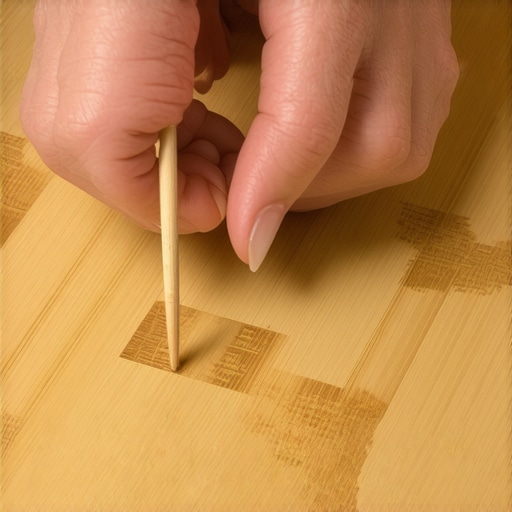
The Toothpick Trick for Fixing Small Scratches in Bamboo Flooring
I once walked into a house where a expensive wide-plank bamboo floor was cupping so bad it looked like a corrugated roof because the installer did not check the crawlspace humidity and the owner tried to fix scratches with a soaked mop. It was a disaster that cost fifteen thousand dollars to rip out and replace. Bamboo is a grass. It is not wood. If you treat it like oak, you will fail. I have spent thirty years on my knees with a moisture meter and a level. I have seen every shortcut in the book. Most guys try to hide a scratch with a glob of putty that looks like gum on a sidewalk. That is a rookie move. The toothpick trick is the only way to achieve surgical precision when the finish of your strand-woven bamboo gets compromised by a sliding chair or a dropped tool.
The science of grass versus wood
Bamboo flooring consists of compressed grass fibers bound together by high pressure and specialized resins that create a surface harder than most hardwoods. This material possesses a high silica content that naturally resists pests but makes the surface brittle under certain mechanical stresses. When you see a scratch on bamboo, you are usually seeing a fracture in the aluminum oxide finish rather than the fiber itself. Understanding the Janka hardness scale is vital because strand-woven bamboo can reach ratings over three thousand pounds of force. This means the surface is incredibly dense. A standard wood filler will not bond to it. You need to address the scratch at a molecular level by filling the void without overlapping onto the surrounding factory finish. The goal is to restore the refractive index of the surface so light passes through the repair instead of bouncing off the white edges of the scratch.
“A floor is only as good as the subfloor beneath it; deflection is the enemy of every joint.” – Master Flooring Axiom
The ghost in the expansion gap
Expansion gaps at the perimeter of a room allow bamboo to breathe as humidity levels fluctuate throughout the changing seasons. If you do not have a proper gap, the floor will buckle. If you have a scratch, it often points to a larger movement issue. Before you reach for a toothpick, check your perimeter. Is the floor tight against the drywall? If it is, the tension is actually pulling the finish apart. I have seen scratches appear out of nowhere because the floor was under so much pressure that the finish literally shattered at the weakest point. This is why site-finished bamboo is rare. Most people buy pre-finished planks that have seven to nine coats of UV-cured urethane. When that finish breaks, it creates a white line. That line is an air pocket between the finish and the bamboo. The toothpick is your tool for injecting a binder back into that pocket to clear the air and hide the damage.
Why a toothpick outperforms a brush
A toothpick allows for the application of minute amounts of finish specifically into the groove of a scratch without touching the healthy surface. Brushes are too clumsy for bamboo. A brush carries too much volume and creates a halo effect around the repair. On a high-sheen bamboo floor, a halo is worse than a scratch. The toothpick works through capillary action. You dip the tip into your finish or stain, and you let the scratch draw the liquid in. This is about control and patience. You are not painting. You are performing a microscopic fill. I tell my apprentices that if they can see the repair from a standing position while they are doing it, they are using too much material. You should be inches away, smelling the resin and the dust, ensuring the filler stays inside the trench of the scratch.
| Material Type | Janka Hardness Rating | Acclimation Time Required | Moisture Sensitivity |
|---|---|---|---|
| Strand Woven Bamboo | 3000+ lbs | 7 to 10 Days | High |
| Natural Vertical Bamboo | 1380 lbs | 5 to 7 Days | Moderate |
| Red Oak | 1290 lbs | 3 to 5 Days | Standard |
| Engineered Bamboo | Varies | 3 to 5 Days | Low |
The chemistry of the aluminum oxide barrier
Aluminum oxide is a mineral additive used in flooring finishes to provide extreme scratch resistance and long term durability. It is essentially liquid sandpaper that has been hardened under ultraviolet light. This makes it nearly impossible to sand down a single plank for a repair. If you sand a pre-finished bamboo plank, you will create a dull spot that will never match the rest of the floor. This is why the toothpick method is a lifesaver. You are not sanding. You are filling. You need to use a high-quality polyurethane or a specialized bamboo touch-up kit that matches the sheen level of your floor. Whether it is matte, semi-gloss, or high-gloss, the chemistry must match. If you put a high-gloss filler into a matte floor, it will look like a snail trail in the moonlight. I have seen homeowners ruin fifty square feet of flooring by using the wrong gloss level on a two-inch scratch.
Prepping the surface without destroying the sheen
Cleaning the scratch with a lint-free cloth and a tiny amount of mineral spirits removes oils and dust that prevent bonding. Do not use water. Bamboo absorbs water faster than a dry sponge. If you get water into the raw fibers of a deep scratch, the fibers will swell and the scratch will become a hump. This is called telegraphing. I use a microfiber cloth and a gentle touch. You want to clear out any loose finish flakes. Sometimes I use a dry soft-bristled toothbrush to flick out the debris. Once the area is clean, you must let it dry completely. Even a microscopic amount of solvent left in the crack will cause the new finish to bubble or turn cloudy. This is where most people fail. They are in a rush. They want it fixed in five minutes. A real floor pro knows that the prep takes an hour and the fix takes ten seconds.
- Inspect the scratch for depth and width
- Clean the area with mineral spirits on a cotton swab
- Select a stain pen or finish that matches the plank exactly
- Dab a small amount of liquid onto a clean surface like a plastic lid
- Use the tip of the toothpick to pick up a single drop of material
- Apply the material to the center of the scratch and let it flow naturally
- Wipe away any excess with a dry finger or clean cloth immediately
“Wood and bamboo flooring will always perform best when the environment is controlled between thirty and fifty percent relative humidity.” – NWFA Standards
Surgical precision in the repair process
Applying the finish in layers is the secret to a repair that lasts for decades instead of weeks. If the scratch is deep, do not try to fill it in one pass. The finish will shrink as it dries. You will end up with a divot. Apply a thin layer with your toothpick, let it cure for twenty-four hours, and then apply another layer. This builds up the mass of the repair. It is the same principle as the way they build the floor in the factory. They don’t just pour a gallon of finish on the plank. They apply thin, microscopic layers. This ensures the bond is tight and the clarity is high. I have spent days on high-end jobs just layering finish into gouges caused by furniture movers. It is tedious work, but it saves the homeowner from a full floor replacement. When you finish, the repair should be slightly proud of the surface. As it cures, it will pull down and level out with the rest of the plank.
Selecting the right filler for high density grass
High density bamboo requires fillers that have high solids content to ensure they do not shrink or pop out over time. Standard wood putties are meant for porous materials like oak or pine. Bamboo is so dense that these putties have nothing to grab onto. They just sit on top and eventually crumble. You need a resin-based filler or a wax-based hard stick. If the scratch has gone through the color layer, you must use a stain pen first. Apply the stain with the toothpick, let it dry, and then seal it with clear finish. If you just use a colored putty, the color will look flat and muddy. The toothpick allows you to layer the color and the clear coat just like a professional automotive painter would fix a scratch on a car door. This is not about aesthetics. This is about structural integrity. An open scratch is a doorway for moisture to enter the core of the plank.
Prevention through structural common sense
Installing high-quality felt pads on every piece of furniture is the primary defense against scratching a bamboo floor. I tell people to throw away those cheap plastic glides that come on chairs. They are garbage. They trap grit and turn your chair into a wood-grinder. Use heavy-duty wool felt. Also, keep your pets’ nails trimmed. A large dog running across a bamboo floor can create hundreds of micro-scratches in a single afternoon. These are the hardest to fix because there are so many of them. At that point, the toothpick trick is useless. You are looking at a screen and recoat. If you treat your floor like the precision engineered surface it is, you won’t need me to come out and grind your concrete or replace your planks. A floor is a tool. You must maintain your tools if you want them to last a lifetime. Do not be the person who ignores a small scratch until the whole floor starts to delaminate.