
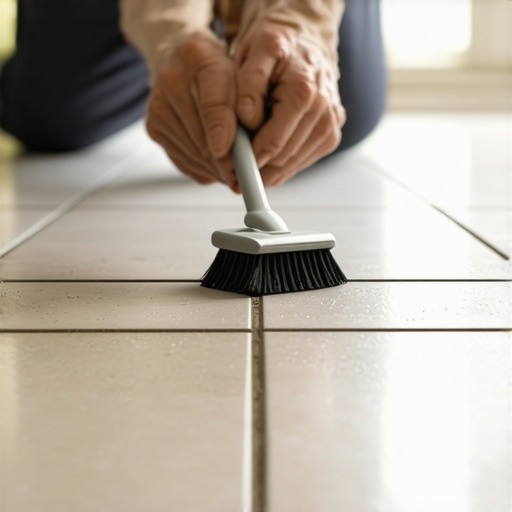
Most guys skip the leveling compound. They think the underlayment will hide the dip. It won’t. I spent three days grinding concrete on a job last month just so the floor wouldn’t click like a castanet, and that is where I found the real problem. As the grinder hit the slab, the heat released a stench that could peel paint. The previous owners had a Great Dane, and for five years, that dog had been using the kitchen corner as a relief station. The urine had bypassed the sealer, traveled through the cementitious grout, and saturated the concrete slab. This is the reality of flooring. It is not about what looks pretty on top. It is about the structural integrity and the chemical purity of the layers beneath. When you are dealing with pet urine in grout, you are not just cleaning a surface. You are performing a microscopic extraction from a mineral matrix. Grout is essentially a hard sponge. If you do not understand the capillary action of Portland cement, you will never get the smell out. You will just be masking a biological disaster with floral-scented chemicals that the urine will eventually eat for breakfast.
The porous nightmare under your feet
Grout is a cementitious, porous matrix that absorbs liquids through capillary action, allowing pet urine to migrate deep into the subfloor and create persistent odors. Because grout lacks the density of the tile it surrounds, it acts as a primary drainage channel for any liquid spilled on the floor. When pet urine sits on this surface, the urea and proteins begin to sink immediately. Within minutes, the liquid moves past the surface tension of the sealer, especially if that sealer is more than six months old, and begins to fill the voids between the sand particles and the cement binder. This is not a surface stain. This is a structural infiltration. You have to think about the grout line as a canyon. The deeper the canyon, the more space there is for uric acid crystals to take up residence and begin their long-term off-gassing process. Most homeowners make the mistake of using a mop. A mop just pushes more liquid into the canyon. It hydrates the crystals and reactivates the smell. You need a vacuum, chemistry, and patience.
“A floor is only as good as the subfloor beneath it; deflection is the enemy of every joint.” – Master Flooring Axiom
The molecular physics of uric acid crystals
Uric acid crystals are the primary source of pet odors because they are insoluble in water and bond to the porous walls of the grout line. To remove these crystals, you must employ enzymatic cleaners that catalyze a chemical reaction to break down the urea and alkaline salts. When urine first hits the floor, it has an acidic pH. As it sits, bacteria begin to consume the urea, producing ammonia and shifting the pH to a highly alkaline state. This shift is what damages your grout sealer and allows the liquid to penetrate deeper. The crystals that form as the liquid evaporates are like tiny shards of glass embedded in the cement. They are hydrophobic. If you use standard soap, the water just slides over them. This is why a floor can smell fine in the winter but suddenly reek in the summer. The humidity in the air reactivates the crystals, starting the off-gassing process all over again. You are fighting a battle at the molecular level, and your only weapon is an enzyme that can digest those specific protein chains.
| Method | Penetration Depth | Chemical Efficacy | Structural Risk |
|---|---|---|---|
| Surface Mopping | 0.5 mm | 5% | High (Moisture spread) |
| Steam Cleaning | 3.0 mm | 40% | Medium (Sealant damage) |
| Enzymatic Saturation | 8.0 mm | 95% | Low |
| Grout Replacement | Full Depth | 100% | Medium (Tile chipping) |
Why your subfloor is lying to you
The subfloor often hides a massive reservoir of pet waste that grout lines have allowed to seep through over years of neglect. If you have a plywood subfloor under your tile, the situation is even more dire than with concrete. Plywood is organic. It is food for the bacteria that live in urine. Once the liquid passes through the grout and the thin-set, it hits the wood and begins to rot the fibers. I have seen 3/4 inch subfloors that had the structural consistency of wet cardboard because of a