
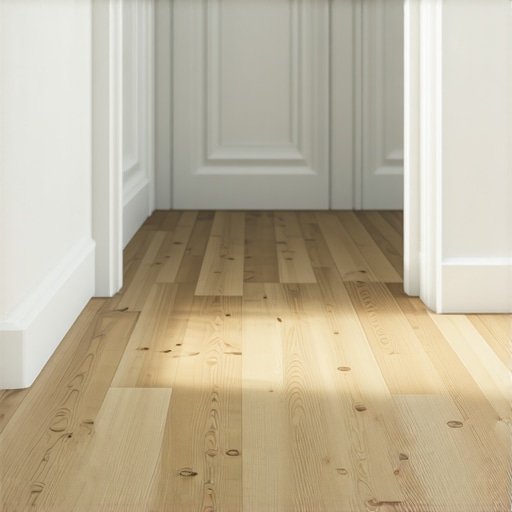
I once walked into a luxury ensuite where $4,000 worth of white oak planks were cupping like a row of canoes. The homeowner was devastated. The installer had used wide seven inch planks in a tiny five by eight foot bathroom with zero ventilation and a high moisture shower. Within three weeks the wood had absorbed so much ambient vapor that it literally tried to push the walls out. This is the reality of wide plank flooring in tight spaces. Most people look at a magazine and see a beautiful open concept master bath but they do not see the science of the subfloor that makes it possible or more often makes it fail. I have spent twenty five years fixing these mistakes. If you do not respect the physics of wood or the chemistry of adhesives the bathroom will win every single time.
The visual trap of oversized flooring material
Wide planks fail in small bathrooms because the limited surface area creates a disproportionate ratio of expansion joints to fixed perimeter points. In a small space the physical expansion of a seven inch plank is harder to manage than narrow strips because the movement is concentrated into fewer joints. When you install a wide board you are dealing with a larger piece of organic material that reacts more violently to the humidity spikes caused by showers. In a grand living room that movement is distributed across fifty or sixty boards. In a small bathroom you might only have six or seven boards across the entire width. This means if each board expands by just one thirty second of an inch you have a massive amount of pressure hitting your baseboards and your vanity. It is a recipe for buckling.
“A floor is only as good as the subfloor beneath it; deflection is the enemy of every joint.” – Master Flooring Axiom
The physics of hygroscopic expansion in tight quarters
Wood is a hygroscopic material that naturally seeks equilibrium with its environment by absorbing or releasing moisture from the air. In a small bathroom the concentrated steam from showers increases the relative humidity faster than a standard vent fan can extract it leading to rapid plank swelling. This is not just a surface issue. The moisture penetrates the cellular structure of the hardwood floors. When the top of the plank gets wet from steam but the bottom stays dry against the subfloor you get cupping. The edges of the board lift higher than the center. In a wide plank this effect is magnified. A three inch strip might cup slightly but a seven or nine inch plank will curl so aggressively it can trip a person walking to the sink. This is why narrow boards or engineered products with a cross grain ply core are usually the smarter move for wet areas.
Subfloor deflection and the hidden structural failure
Subfloor deflection refers to the amount of vertical flex in a floor system when weight is applied and it is the primary killer of wide plank stability. Wide planks require a much higher level of stiffness because their larger surface area puts more stress on the tongue and groove locking mechanisms during movement. If your subfloor has a dip of even an eighth of an inch the wide plank will bridge that gap rather than following the contour. This creates a hollow sound. More importantly it creates a lever effect. Every time you step on that plank you are putting massive pressure on the joint. Eventually the wood will splinter or the glue bond will fail. I have spent days grinding concrete or adding layers of marine grade plywood just to get a floor flat enough for a wide plank. If you skip this the floor will click and pop like a castanet every time you walk on it.
| Material Type | Expansion Potential | Moisture Tolerance | Best Use Case |
|---|---|---|---|
| Solid White Oak | High | Low | Large Dry Rooms |
| Engineered Wood | Medium | Moderate | Main Bathrooms |
| Laminate | Medium | Varies | Powder Rooms |
| Luxury Vinyl Plank | Low | High | Full Showers |
The chemical reality of adhesive failure in high humidity
Adhesives used in flooring installations are often sensitive to the pH levels and moisture content of the subfloor which can be compromised in bathroom environments. High humidity can re emulsify certain glues or prevent them from ever reaching a full structural cure leading to plank shifting. When dealing with showers and constant water exposure you cannot just use a basic construction adhesive. You need a moisture cured urethane that creates a waterproof barrier. Even then if the concrete slab has a high moisture vapor emission rate the glue will eventually let go. I always use a calcium chloride test or an in situ probe to check the slab before a single board goes down. If the numbers are too high we do not install. Period. People think they can cheat the chemistry but the chemistry does not care about your timeline or your budget.
Why laminate and grout are often misunderstood
Laminate flooring and traditional grout lines react differently to the localized environmental stresses of a small bathroom compared to larger open areas. Laminate is essentially a high density fiberboard core which acts like a sponge if water gets past the wear layer or into the expansion gaps. Many homeowners choose laminate because they think it is a cheap alternative to hardwood floors but in a bathroom it is often a ticking time bomb. Once the edges swell they never go back down. Similarly grout is not a waterproof material. It is porous. If you have a wide plank tile look the grout lines are fewer but they are under more stress from the movement of the larger tiles. You need a high polymer modified grout to handle the potential flex of a small room. Using a cheap bag of grout from a big box store is the fastest way to see cracks within six months.
“Standard wood flooring requires a stable environment between 60 and 80 degrees Fahrenheit and 35 to 55 percent humidity to prevent structural failure.” – NWFA Technical Guidelines
The expansion gap secret for small spaces
The expansion gap is the intentional space left around the perimeter of a room to allow the floor to move without hitting the walls or heavy fixtures. In small bathrooms this gap is frequently neglected around toilets and vanities which causes the entire floor to lock and eventually buckle. I see this all the time. An installer runs the floor tight against the toilet flange or the heavy oak vanity. Now the floor has nowhere to go. When summer hits and the humidity rises that wood expands. Since it is pinned down by the vanity it has to go up. That is when you get the dreaded hump in the middle of the floor. You must maintain at least a quarter inch gap everywhere and cover it with baseboards or shoe molding. Do not ever caulk that gap with hard silicone. Use a flexible color matched sealant if you must but the floor needs to breathe.
- Always check subfloor moisture with a pinless meter before starting.
- Ensure the subfloor flatness is within 3/16 of an inch over a 10 foot radius.
- Acclimate the wide planks in the bathroom for at least 72 hours.
- Use a vapor barrier underlayment with a high perm rating.
- Install a high CFM vent fan to manage steam from showers.
- Leave a consistent expansion gap around all vertical obstructions.
The contrarian truth about underlayment thickness
While most people want the thickest underlayment thinking it provides more comfort too much cushion actually causes the locking mechanisms on wide planks to snap under pressure. A floor needs a firm foundation. If you put a heavy wide plank over a thick soft foam the plank will deflect too much when you walk on it. This puts a massive amount of torque on the tongue and groove. Over time that tongue will shear right off. You want a high density underlayment that is thin but firm. This provides the sound dampening you want without sacrificing the structural integrity of the floor joints. It is a common mistake made by DIYers who think more padding equals more luxury. In the world of structural flooring more padding usually equals a broken floor. Follow the manufacturer specs and do not get creative with your padding choices.