
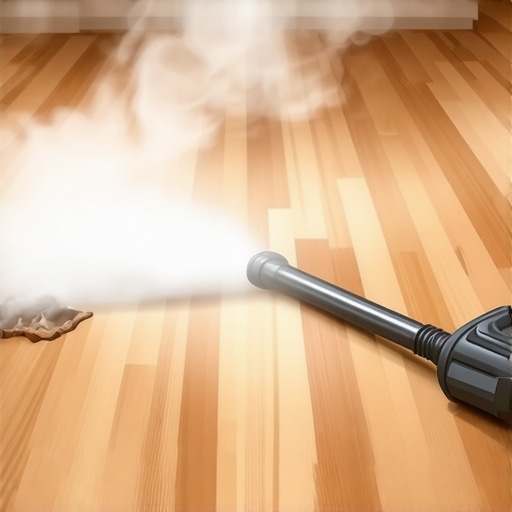
Steam cleaners provide an efficient way to sanitize hard surfaces, but using them on laminate flooring is a catastrophic error that instantly nullifies your manufacturer warranty and destroys the structural integrity of the planks. In the world of high-performance flooring, heat and moisture are the primary enemies of longevity. While homeowners believe they are deep-cleaning their floors, they are actually forcing pressurized vapor into the most vulnerable parts of the installation, leading to irreversible swelling and joint failure. This guide explains the technical reasons why steam is lethal for laminate and how to maintain your floors without losing your legal protection.
The expensive truth about manufacturer fine print
Every major laminate manufacturer including brands like Mohawk, Pergo, and Shaw explicitly states that the use of steam mops will void the product warranty. I spent three decades behind the counter of a floor covering shop and I have had to tell hundreds of customers that their expensive new floor is a total loss. Homeowners always ask why their waterproof vinyl or laminate is buckling. Usually, it’s because they locked it under a heavy kitchen island, killing the floor’s ability to breathe, or they hit it with a 200-degree steam blast. The warranty is designed to protect the manufacturer from improper maintenance. Once that pressurized steam hits the core of the plank, the chemical bond is broken. Manufacturers use forensic testing to determine the cause of failure. They can see the specific type of edge swelling that only occurs from steam saturation. If they find it, your claim is denied immediately.
“A floor is only as good as the subfloor beneath it; deflection is the enemy of every joint.” – Master Flooring Axiom
Why heat and moisture destroy HDF cores
Laminate flooring is a composite product consisting of a wear layer, a decorative image layer, a High-Density Fiberboard (HDF) core, and a backing layer. The HDF core is the structural engine of the plank. It is made from refined wood fibers highly compressed with resin. Under normal conditions, this core is stable. However, steam is not just water. It is a gas under pressure. When you pull the trigger on a steam mop, you are forcing water molecules into the microscopic gaps between the locking joints. These joints are cut with tolerances of less than 0.1 millimeters. The steam bypasses any surface-level topical moisture protection and hits the raw wood fiber inside the core. Once these fibers absorb the moisture, they undergo a process called hygroscopic expansion. The wood fibers swell and lose their ability to return to their original shape. This causes the edges of the planks to lift, a phenomenon known as peaking.
The ghost in the expansion gap
Flooring is a living system that requires room to move. A common mistake I see is the neglect of the perimeter expansion gap. Laminate is a floating floor. It is not glued or nailed to the subfloor. It sits on an underlayment and must be allowed to expand and contract based on the relative humidity of the room. When you introduce steam, you are artificially and rapidly increasing the moisture content of the planks. If you have not left a proper 1/4 inch to 3/8 inch gap at the walls, the floor has nowhere to go. It will hit the wall and then start to rise in the center of the room. This creates a trampoline effect. Every time you walk on it, the locking mechanisms are stressed. Eventually, the click-lock tongue will snap off, and the floor will separate. I have seen floors buckle so severely they actually pop the baseboards off the wall. It is a structural failure caused by a cleaning tool that was marketed as a convenience.
The myth of the waterproof click lock
Marketing teams love the word waterproof. It sells floors to people with kids and pets. However, in the flooring industry, waterproof usually refers only to the surface material, not the entire installation. A laminate plank might have a melamine wear layer that can hold a puddle of water for 24 hours without damage. But the joint where two planks meet is the Achilles heel. Even with wax coatings or tight tolerances, pressurized steam will find a way through. Comparing laminate to tile in showers or hardwood floors is a mistake. Tile uses grout and thin-set to create a semi-permanent moisture barrier. Hardwood floors are solid organic material that can often be sanded and refinished. Laminate is a one-shot deal. Once the HDF core is blown, there is no fixing it. You cannot sand laminate. You cannot flatten it back out. You can only replace it.
| Feature | Laminate | Solid Hardwood | Ceramic Tile |
|---|---|---|---|
| Cleaning Method | Damp Mop Only | Dry Sweep / Wood Cleaner | Steam / Wet Mop |
| Moisture Resistance | Moderate (Surface) | Low | High |
| Joint Sensitivity | High (Vulnerable to Steam) | Moderate | Low (If Grouted) |
| Warranty vs. Steam | Voided | Voided | Approved |
The 1/8 inch that ruins everything
Subfloor flatness is the most overlooked aspect of flooring. If your subfloor has a dip of more than 1/8 inch over a 6-foot span, your laminate is already at risk. When you walk over a dip, the planks flex. This flexion opens the micro-gaps at the seams. If you are steam cleaning while that seam is opened under the pressure of your footsteps, you are effectively injecting water directly into the heart of the floor. Most guys skip the leveling compound. They think the underlayment will hide the dip. It won’t. I spent three days grinding concrete on a job last month just so the floor wouldn’t click like a castanet. That level of prep is what makes a floor last 20 years. Without it, even the best cleaning routine won’t save you from a failing locking system.
“The National Wood Flooring Association (NWFA) standards dictate that moisture testing must be performed on all concrete slabs regardless of the age of the structure.” – Installation Standards Bureau
Why your subfloor is lying to you
Before any floor is installed, you must know the Relative Humidity (RH) of the slab. Even if the house is 50 years old, moisture can migrate through concrete via capillary action. If your subfloor is exhaling moisture and you are adding more moisture from the top with a steam mop, you are creating a mold sandwich. The underlayment acts as a vapor barrier to some extent, but it cannot stop the environmental pressure from both sides. Always use a pinless moisture meter to check your subfloor before installation. If the levels are above 4% for concrete or 12% for wood subfloors, you have a problem that no amount of fancy laminate can solve. You need a calcium chloride test or an in-situ RH probe to get the real story. Ignoring the subfloor is the fastest way to end up in my shop complaining about a floor that is falling apart.
A better way to handle your daily maintenance
If you want to keep your warranty intact and your floors beautiful, throw the steam mop away. Use a microfiber mop and a pH-neutral cleaner specifically designed for laminate. The goal is to use as little liquid as possible. The “mist and wipe” method is the industry standard. This prevents any liquid from sitting on the seams long enough to penetrate the core. For stubborn messes, use a plastic scraper or a slightly damp cloth with a bit of isopropyl alcohol. This evaporates quickly and does not leave a residue that attracts more dirt. Follow this checklist to ensure your floor stays within warranty parameters.
- Use a microfiber dust mop daily to remove abrasive grit.
- Only use cleaners approved by the floor manufacturer.
- Maintain indoor humidity between 35% and 55%.
- Never use wax, polish, or oil-based soaps on laminate.
- Place breathable rugs at all exterior entry points.
- Apply felt protectors to the bottom of all furniture legs.
The chemistry of the wear layer
Laminate wear layers are usually composed of aluminum oxide, which is one of the hardest minerals on earth. This is why laminate is so scratch-resistant. However, aluminum oxide is susceptible to clouding if exposed to high heat and chemical residues. Steam mops can cause a phenomenon called etching or hazing. The heat reacts with previous cleaning residues or the melamine itself, leaving a cloudy film that is nearly impossible to remove. You end up with a floor that looks dirty even when it is clean. This is not a defect in the floor; it is a chemical reaction to heat. To keep that crystal-clear image of the oak or hickory underneath, you must keep the temperature low. A floor is a structural engineering challenge. It requires a balance of chemistry, physics, and patience. Treat it like the investment it is, and it will serve you. Treat it like a kitchen counter, and you will be back in my shop buying a replacement sooner than you think.