
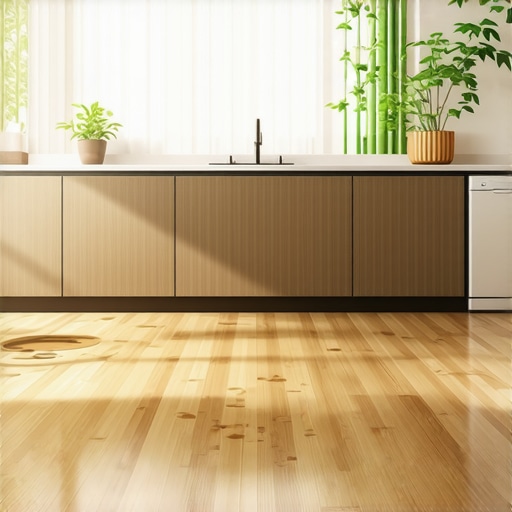
The myth of bamboo durability
Bamboo flooring is often marketed as a sustainable and harder alternative to hardwood floors, but its cellular structure makes it a liability in a kitchen. Because bamboo is technically a grass and not a wood, its vascular bundles absorb moisture at a rate that far exceeds domestic hardwoods like oak or maple. In a kitchen setting where humidity fluctuations from cooking and potential plumbing leaks are constant, bamboo often fails through extreme cupping or structural delamination. I once walked into a house where a $15,000 wide-plank bamboo floor was cupping so bad it looked like a potato chip because the installer did not check the crawlspace humidity or the subfloor moisture content before the hammer hit the first plank. My knees have the scars from thirty years of fixing mistakes like that. I smell like sawdust and WD-40 today because I just finished ripping out a two year old strand-woven floor that turned into a moldy mess behind a leaking dishwasher. The homeowner thought they were getting a lifetime product, but they were sold a bill of goods by a big box retailer who does not understand the physics of moisture vapor transmission rates.
The microscopic reality of grass fibers
At a molecular level bamboo lacks the radial rays and lignin structure that give traditional hardwood floors their dimensional stability. While a tree grows in rings that provide a predictable expansion pattern, bamboo is composed of individual fibers bundled together with phenolic resins. When water molecules enter these bundles, they push the fibers apart with immense hydrostatic pressure. This is why you see bamboo floors peaking at the seams in a kitchen. It is not just about the water on the surface; it is about the moisture in the air. A kitchen is a localized tropical environment every time you boil a pot of pasta or run the dishwasher. Solid hardwoods can handle some of this movement, but bamboo is brittle. It does not bend; it breaks. The adhesive bonds between the grass strands can fail when the moisture content jumps from six percent to twelve percent in a single afternoon. I have seen floors literally lift off the subfloor because the expansion was so violent it sheared the glue right off the concrete.
“A floor is only as good as the subfloor beneath it; deflection is the enemy of every joint.” – Master Flooring Axiom
Why carbonization ruins the structural integrity
Carbonized bamboo is the softest and most unstable version of the product because the heating process destroys the natural sugar and starch bonds. Many homeowners choose carbonized bamboo for its dark, rich coffee color, thinking it is as tough as it looks. It is not. To get that color, the bamboo is pressure-steamed, which effectively cooks the fibers. This process drops the Janka hardness rating by nearly thirty percent. While natural bamboo might sit at 1300 on the Janka scale, carbonized versions can drop below 1000, making them softer than cherry or even some pines. In a kitchen, you drop a heavy cast iron pan on a carbonized floor and you will see a crater, not a dent. You are walking on a surface that has been structurally compromised for aesthetics. Most guys skip the leveling compound and hope the thickness of the plank hides the dips in the subfloor. When you put a soft, carbonized plank over a dip, the locking mechanism will snap within six months of foot traffic.
| Material Type | Janka Hardness Rating | Acclimation Time Required | Moisture Resistance |
|---|---|---|---|
| Natural Strand Woven Bamboo | 3000+ | 10 to 14 Days | Moderate |
| Carbonized Bamboo | 1000 to 1100 | 10 to 14 Days | Low |
| White Oak Hardwood | 1360 | 5 to 7 Days | Moderate |
| High Quality Laminate | N/A (Wear Layer Focus) | 48 Hours | High |
The chemistry of failed adhesives and VOCs
The resins used to bind bamboo flooring are often sensitive to the alkaline environment of a concrete slab or the high humidity of a kitchen. To turn stalks of grass into a solid plank, manufacturers use massive amounts of urea-formaldehyde or MDI resins. In a dry bedroom, these chemicals stay stable. In a kitchen with a subfloor that has not been properly sealed with a moisture barrier, the moisture reacts with the alkaline salts in the concrete. This creates a high-pH environment that can chemically attack the resins holding the bamboo together. You will start to see the floor splintering or what we call hairy seams. This is not just a cosmetic issue; it releases more volatile organic compounds into your kitchen air. I always tell people that if they want something waterproof, they should look at tile with high-quality grout or a high-end laminate with a wax-sealed joint. Bamboo is a sponge that has been glued together, and sponges do not belong in kitchens.
The heavy island lockdown effect
Installing a heavy kitchen island on top of a floating bamboo floor is a recipe for a structural blowout. Bamboo flooring needs to move. It expands and contracts with every change in the weather. When you pin the floor down under a five hundred pound granite island, you have created a dead point. The floor wants to expand toward the walls, but it is anchored in the center. This causes the planks to buckle and lift at the weakest point, which is usually right in the middle of your walkway. I spent three days grinding concrete on a job last month just so the floor would not click like a castanet because the previous installer locked the floor under the cabinets. You should always install your cabinets and islands first, then bring the floor to the feet of the cabinetry, leaving a proper expansion gap. If you do not leave that 3/8 inch gap at the perimeter, the floor will find its own gap by pushing your baseboards off the wall. The physics do not lie even if the salesman does.
“Hardwood flooring is a living product that reacts to its environment; ignore the humidity and you ignore the warranty.” – NWFA Technical Manual
Kitchen grout and better performance alternatives
While bamboo fails in wet zones, materials like porcelain tile or engineered hardwood floors with a plywood core offer much better dimensional stability. If you are dead set on the look of wood in a kitchen, engineered products are superior because the cross-grain plys resist the urge to cup. Even laminate has come a long way with high-density fiberboard cores that can withstand standing water for 24 to 72 hours. Bamboo cannot claim that. I have seen bamboo swell from a simple ice cube that melted under the fridge. If you want a floor that lasts, you look at the subfloor first. You check the moisture with a calcium chloride test or a Tramex meter. You make sure the subfloor is flat within 1/8 inch over a 10 foot radius. Most homeowners think the underlayment will hide the dip. It will not. A thick, squishy underlayment actually makes bamboo worse because it allows the tongue and groove joints to flex and eventually crack under the weight of your appliances.
- Always use a 6-mil poly film moisture barrier over concrete slabs.
- Verify that your kitchen humidity stays between 35 and 55 percent year-round.
- Never install cabinets on top of a floating bamboo floor.
- Acclimate the bamboo in the kitchen for at least two weeks before starting the job.
- Use a high-quality moisture meter to ensure the subfloor is within 2 percent of the flooring moisture content.
The ghost in the expansion gap
The expansion gap is the most misunderstood part of any kitchen installation and is usually the first thing a DIY installer messes up. People think it looks ugly, so they push the planks tight against the drywall or the cabinet toe kick. But that 1/4 inch or 3/8 inch gap is the lungs of the floor. Without it, the floor suffocates. In a kitchen, the heat from the oven and the steam from the dishwasher cause the bamboo cells to expand rapidly. If those cells have nowhere to go, they will move upward. That is why your floor feels bouncy when you walk on it. It is not the subfloor; it is the floor itself forming a bridge because it is too tight against the walls. I have had to go into kitchens and use a toe-kick saw to cut back the expansion gap that some guy forgot to leave. It is a dusty, miserable job that could have been avoided with a few plastic spacers and a bit of common sense. Flooring is not just about laying planks; it is about managing the invisible forces of pressure and moisture. If you treat it like a decoration, it will fail you. If you treat it like a structural engineering project, it might just last long enough for me to retire. [{“@context”: “https://schema.org”, “@type”: “Article”, “headline”: “Why Bamboo Flooring is a Bad Idea for Kitchens”, “author”: {“@type”: “Person”, “name”: “Master Floor Installer”}, “description”: “Expert analysis on why bamboo flooring fails in kitchen environments due to moisture, cellular structure, and installation errors.”}]