
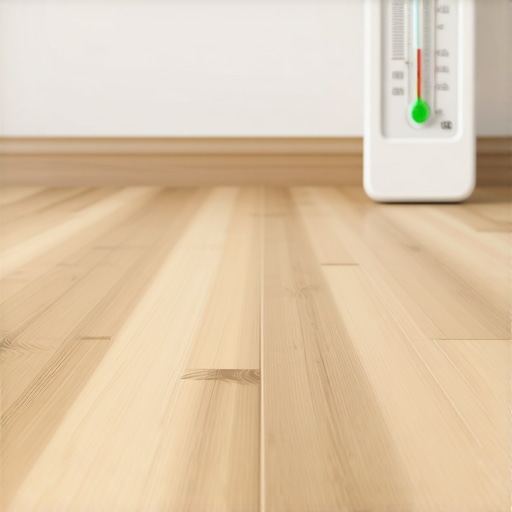
The ghost in the concrete slab
Bamboo flooring cups despite low air humidity because the moisture is not in the air but trapped within the subfloor or migrating from adjacent wet areas like showers. This phenomenon occurs when a moisture gradient exists between the top and bottom of the plank. Even if your room feels like a desert, a wet concrete slab or a damp crawlspace will force water into the bottom of the bamboo, causing the cells to swell and the edges of the plank to rise. I once walked into a luxury condo where a fifteen thousand dollar wide-plank bamboo floor was cupped so severely it looked like a field of potato chips. The homeowner was baffled because his hygrometer read thirty percent humidity. I pulled up a single board and found the culprit. The installer had skipped the moisture barrier over a green concrete slab, and the grass was drinking every drop of vapor that rose from the ground. It did not matter that the air was dry. The physics of the subfloor outweighed the chemistry of the room. Bamboo is a grass, not a wood, and its vascular structure makes it a hyper efficient straw for any liquid it touches.
The botanical lie about grass
Bamboo is often marketed as a more stable alternative to hardwood floors, but this is a dangerous half truth for the uneducated installer. Unlike traditional oak or maple, bamboo is a monocot. Its anatomy is comprised of vascular bundles surrounded by parenchyma cells, which are designed to transport water from roots to leaves with extreme efficiency. When you process this material into flooring, those cells do not lose their thirst. In a standard hardwood plank, the expansion is relatively predictable based on the grain direction. In bamboo, especially strand-woven varieties, the material is shredded and compressed with resins under massive pressure. This creates a dense product that feels like stone but still possesses the hygroscopic soul of a plant. If the subfloor emits moisture, the bottom of the plank absorbs it, while the dry air in the room pulls moisture out of the top. This imbalance creates internal stress that no amount of adhesive can hold back. It is a structural engineering failure masquerading as an aesthetic one.
“A floor is only as good as the subfloor beneath it; deflection is the enemy of every joint.” – Master Flooring Axiom
The chemistry of resin and vapor pressure
The manufacturing process of bamboo involves boiling the raw strips to remove sugars and then bonding them with urea formaldehyde or phenolic resins. While these resins provide some resistance to liquid water, they do nothing to stop water vapor at a molecular level. Vapor pressure is a relentless force. If your concrete slab is not fully cured, or if it lacks a dedicated six mil polyethylene vapor retarder, the moisture will move from areas of high concentration to low concentration. This is basic thermodynamics. As the vapor hits the underside of the bamboo, it gets trapped by the resin saturated fibers on the top. This creates a localized zone of high moisture at the base of the plank. The cells at the bottom expand, but the cells at the top stay the same size. The result is a curve. This is why you see cupping even when the room is dry. In fact, very dry air can actually make the cupping worse by accelerating the drying of the top surface, increasing the tension between the top and bottom layers.
| Material Type | Janka Hardness | Acclimation Time | Stability Rating |
|---|---|---|---|
| Strand Bamboo | 3000+ | 14 Days | Moderate |
| Solid Oak | 1290 | 7 Days | High |
| Engineered Maple | 1450 | 3 Days | Very High |
| Premium Laminate | N/A | 2 Days | Excellent |
The 1/8 inch gap that ruins everything
Expansion gaps at the perimeter of the room are not suggestions, they are requirements for the survival of the floor. Many installers think they can hide a tight fit under the baseboard and call it a day. However, bamboo requires a minimum of a half inch gap around every vertical obstruction. If the floor begins to swell due to subfloor moisture and hits a wall, the pressure has nowhere to go but up. This creates a trampoline effect where the floor bounces or buckles. Unlike laminate, which is designed to float as a single unit, glue down bamboo is locked to the subfloor. If you do not have that relief valve at the edges, the internal pressure will eventually snap the tongues and grooves. I have seen entire rooms where the floor lifted six inches off the joists because the installer pinned the planks against a heavy kitchen island. You must allow the material to breathe, or it will destroy itself.
The grout and shower connection
Moisture often migrates from unexpected places, such as adjacent bathrooms where the grout in the showers has failed. Water is a traveler. If there is a leak behind a shower wall or a crack in the floor grout, that moisture can travel laterally through the subfloor or along the surface of the concrete. It will eventually find its way under your bamboo planks in the hallway or bedroom. Most people look at the ceiling for leaks, but the smartest pros look at the subfloor. I have seen cases where a slow drip in a shower three rooms away caused bamboo cupping because the slab acted as a wick. This is why I always recommend a waterproof membrane not just in the wet area, but also a liquid applied moisture barrier on the slab for at least five feet outside the bathroom door. You are protecting the wood from the water you cannot see.
“Wood and bamboo flooring will always reach an equilibrium with their environment; the installer’s job is to ensure that environment is stable.” – Master Flooring Axiom
The subfloor checklist for survival
Before you ever open a box of bamboo, you must perform a rigorous audit of the installation site. Skipping these steps is a guarantee of future failure. Use this checklist to ensure your investment does not turn into a mess of warped grass.
- Test concrete slabs using ASTM F2170 in-situ probes to ensure internal RH is below 75 percent.
- Ensure the subfloor is flat within 1/8 inch over a 10 foot radius to prevent clicking and hollow spots.
- Check that the crawlspace has a 100 percent ground cover of 6 mil black poly to stop earth moisture.
- Acclimate the bamboo in the actual room for at least 14 days with the HVAC system running at normal levels.
- Verify that the adhesive used is a moisture cure urethane with an integrated vapor barrier.
The failure of big box advice
Big box retailers often sell bamboo as a DIY friendly product that can be installed just like laminate. This is a lie that leads to thousands of dollars in losses. Laminate is a photographic layer over a dense fiberboard core that is relatively inert. Bamboo is a living, breathing biological material. It has a high sugar content and a complex cellular structure. You cannot treat it like plastic. If you use a water based adhesive on bamboo, you are literally feeding the floor the very moisture that will cause it to cup. Professional installers use silane modified polymers that contain zero water. These adhesives create a waterproof membrane while they cure, locking the bamboo to the subfloor while simultaneously protecting it from vapor. If your installer is using a bucket of cheap white glue, fire them on the spot. They are building a ticking time bomb in your living room.