
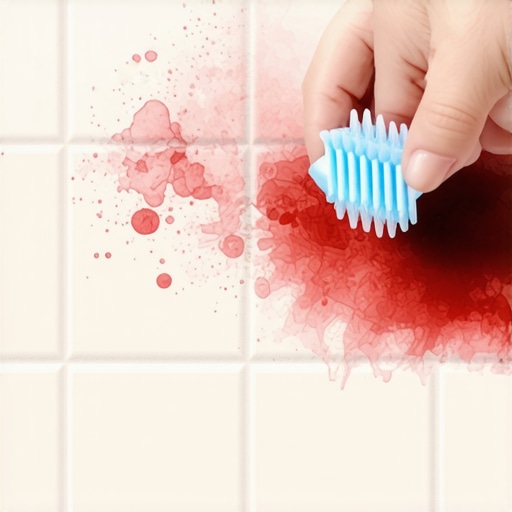
The wine hits. The white grout drinks. You freeze. This is the moment where most people ruin their floors forever. I have seen it a thousand times in three decades of laying tile and sanding hardwood floors. Last year I walked into a luxury condo. The owner had spilled a glass of Merlot on a brand new Carrara marble floor with white grout. Instead of blotting, she used a stiff wire brush and undiluted bleach. She did not just remove the stain. She ate through the sealer and etched the stone. It was a five thousand dollar mistake that started with a five dollar glass of wine. I spent three days grinding concrete and resetting stone on a job last month just so the floor would not click like a castanet, and let me tell you, fixing grout is just as much about the physics of the subfloor as it is about chemistry.
The physics of the porous matrix
Removing red wine from white grout requires immediate capillary interruption using absorbent materials and pH-neutral surfactants to prevent the anthocyanin pigments from bonding with the calcium carbonate structure of the cementitious matrix. Grout is a rigid sponge with millions of microscopic voids that pull liquids deep into the surface through surface tension. Most homeowners think of grout as a solid barrier. It is not. Unless you are dealing with a high-performance epoxy, your grout is a mixture of Portland cement and sand. Portland cement is naturally porous. It is full of tiny tunnels. When red wine hits the surface, those tunnels act like straws. The wine is pulled down. This is why a surface wipe never works. You have to pull the wine back out. If you have hardwood floors nearby, you know that wood has pores too, but wood has cell walls. Grout has crystalline structures. The red wine molecules, specifically the tannins and the chromophores, find a permanent home in those crystals if you do not act fast. The moisture content of your subfloor can even play a role here. If your slab is damp, the grout might already be saturated, which actually slows the wine absorption. If the slab is bone dry, it will suck that wine in like a vacuum.
“A floor is only as good as the subfloor beneath it; deflection is the enemy of every joint.” – Master Flooring Axiom
Why acid is the enemy of lime based grout
Acidic cleaners like vinegar or lemon juice should never be used on white grout because they dissolve the calcium carbonate binder that holds the grout together and opens up the pores even further for future staining. Using acid on cementitious grout creates a chemical reaction that weakens the structural integrity of the installation. I see it on every showers restoration job. People think vinegar is a natural miracle. In reality, vinegar is an acetic acid. When you put acid on grout, it starts to fizz at a microscopic level. It is eating the lime. You might get the wine out, but you are also removing the top layer of your floor. This makes the grout feel sandy. Once the grout is sandy, it is toast. It will never stay clean again. It will trap dirt, skin cells, and more wine. Laminate floors have a plastic wear layer that can handle some acidity, but grout is a mineral product. It needs to stay alkaline. If you want to keep your showers or kitchen floors looking like the day they were installed, keep the vinegar in the pantry for salad dressing. I always tell my clients that a floor is a living system. You have to respect its chemistry. If you use the wrong chemical, you are basically performing a slow-motion demolition of your own house.
Oxygen bleach is your only friend
Oxygenated bleach solutions like sodium percarbonate are the most effective way to lift red wine from white grout because they use oxygen bubbles to physically push the pigment out of the pores without damaging the cement binder. Unlike chlorine bleach, oxygen bleach is color-safe and does not weaken the grout structure over time. When you mix oxygen bleach with water, it creates a reaction. It releases O2. Those tiny bubbles get into the tunnels of the grout. They find the wine. They push it to the surface. It is a mechanical action happening at a molecular scale. I recommend a heavy paste. Let it sit for twenty minutes. You will see the foam turn pink. That is the wine leaving the building. Do not use a wire brush. Use a stiff nylon brush. A wire brush will leave tiny flakes of metal in your grout. Those flakes will rust. Then you will have red wine stains replaced by orange rust stains. I have seen guys try to sand grout lines to get stains out. That is a fool’s errand. You just end up with uneven lines that collect shadows. It looks terrible. Stick to the chemistry. Let the oxygen do the heavy lifting while you stay off your knees. Use a shop vac to suck up the dirty solution. This prevents the wine from just settling back into the next hole.
| Sealer Type | Active Ingredient | Expected Lifespan | Wine Resistance |
|---|---|---|---|
| Topical Sealer | Acrylic or Urethane | 1 to 2 Years | Moderate |
| Penetrating Sealer | Silane or Siloxane | 3 to 5 Years | High |
| Epoxy Grout | Two-Part Resin | 20+ Years | Total |
| Stone Enhancer | Impregnating Oil | 1 to 3 Years | Low |
The mechanical action of the scrub brush
Effective grout cleaning requires a vertical agitation technique using a nylon bristle brush to break the surface tension of the liquid stain without abrading the surrounding tile or stone edges. The brush should be used in short, circular motions rather than long sweeps to ensure the cleaning agent penetrates the full depth of the grout joint. Most people scrub like they are trying to start a fire. That is not how it works. You want to agitate the solution. You are trying to mix the oxygen bleach with the wine. Think of it like a laboratory experiment. You are creating a suspension. If you scrub too hard, you are just pushing the dirt around. I have spent years watching apprentices do this wrong. They lean into it. Their shoulders hurt. They get nowhere. The trick is the bristles. You want a brush that fits inside the grout line. If the brush is too wide, it just rides on the tile. It never hits the grout. This is especially true in showers where the tile is often smaller. In those cases, you need a detail brush. Laminate floors are easier because they are flat. Grout is always a valley. You have to go into the valley to get the results. If you are not in the valley, you are just wasting your time and your cleaning products.
“Cementitious grout is a hydraulic binder; its strength comes from the hydration process, and its weakness comes from the porosity of its cure.” – TCNA Technical Manual
A checklist for your grout emergency
- Blot the spill immediately with a white microfiber cloth to prevent color transfer.
- Apply a mixture of warm water and sodium percarbonate powder to the affected area.
- Let the solution dwell for at least fifteen minutes to allow oxygen release.
- Agitate gently with a nylon brush using circular motions.
- Extract the liquid using a wet-dry vacuum to prevent re-absorption.
- Rinse the area with distilled water to remove any chemical residue.
- Check the sealer status once the area is dry using the water drop test.
The invisible barrier that saves your sanity
Applying a high-quality penetrating sealer to white grout creates a hydrophobic barrier that prevents red wine and other liquids from entering the pores of the cement through molecular repulsion. A properly sealed floor will cause liquids to bead on the surface for several minutes, allowing for easy cleanup without staining. This is the part everyone skips. They spend five thousand dollars on tile and then refuse to spend fifty dollars on a bottle of sealer. It drives me crazy. I have walked off jobs where the homeowner told me they would seal it themselves. I know they won’t. Then they call me six months later complaining about the grout. If your grout is not sealed, it is an open door. Red wine sees that door and walks right in. A penetrating sealer is different from a topical one. A topical sealer is like a coat of paint. It wears off. A penetrating sealer goes into the tunnels I talked about earlier. It fills them with a chemical that hates water. When the wine hits it, it stays in a ball. You can just pick it up with a paper towel. It is like magic. But you have to reapply it. In a high-traffic kitchen, do it every year. In showers, maybe every two years. If you have hardwood floors, you know about polyurethane. Sealer is the polyurethane of the tile world. Without it, you are just waiting for a disaster to happen. Most people want the thickest underlayment, but too much cushion actually causes the locking mechanisms on LVP to snap under pressure, and similarly, too much sealer can cause a hazy film. You need the right amount. Just enough to fill the pores. No more, no less.