
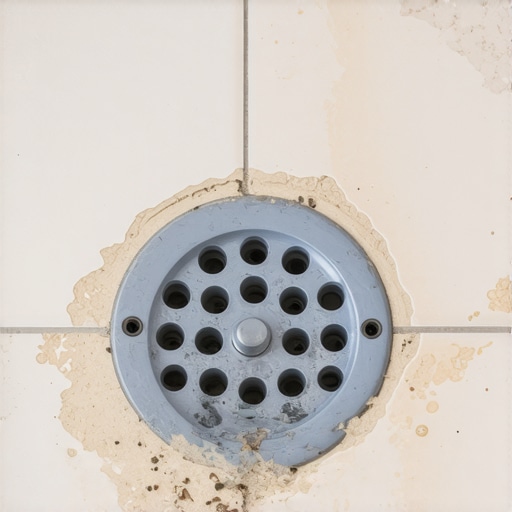
I spent three days grinding concrete on a job last month just so the floor wouldn’t click like a castanet. Most guys skip the leveling compound. They think the underlayment will hide the dip. It won’t. When I stepped into that master bath, the tile around the drain wasn’t just loose. It was rising. It looked like a slow-motion volcanic eruption of porcelain and grout. The homeowner thought the house was settling. I knew better. It was a failure of the mechanical bond and a total disregard for the physics of the shower pan assembly. That drain flange was never secured to the subfloor. As the house breathed, the pipe pushed up. The tile had nowhere to go but up and out.
The structural anatomy of a drain failure
A shower drain flange pushes up tiles when the plumbing stack lacks proper vertical support or the subfloor undergoes significant deflection. This mechanical heave occurs because the PVC or ABS pipe is rigid while the mortar bed is brittle. When the subfloor moves or the pipe expands, the flange acts as a hydraulic jack against the tile. You have to understand the chemistry of the bond. A standard three-piece clamping ring drain relies on a friction fit against the waterproof membrane. If the installer didn’t use a specialized mortar or failed to provide a solid base of four-to-one sand and cement mix under that flange, the assembly is hollow. A hollow assembly is a failing assembly. We see this often in new builds where the plumber and the tile setter didn’t talk. The plumber leaves the pipe too high, and the tile guy just tries to bury it in thin-set. Thin-set is an adhesive, not a structural filler. When you exceed the maximum thickness of a modified thin-set, it shrinks. That shrinkage pulls the tile down while the rigid pipe stays put. The result is a broken bond and a flange that looks like it is growing out of the floor.
Why your subfloor is lying to you
Subfloor deflection and moisture levels are the hidden killers of every shower installation in modern homes. If your plywood subfloor has even a fraction of an inch of bounce, the grout lines will crack and the drain will eventually separate from the surrounding tile. You need to check the joist spacing. If you are running sixteen inches on center with single-layer three-quarter-inch tongue and groove, you are on the edge of failure for a heavy mud bed. I always add a layer of half-inch exterior grade plywood or a cementitious backer unit. I do this because I have seen too many showers fail because the house moved two millimeters. Those two millimeters are enough to shear the bond between the PVC flange and the mortar. People think waterproofing is just about the water. It is about the movement. If the subfloor is moving, the waterproofing is stretching. Eventually, it snaps. I have seen laminate floors in adjacent hallways buckle because the moisture from a failing drain wicked through the subfloor. Laminate is basically high-density fiberboard, which is fancy talk for sawdust and glue. It drinks water. Once that moisture hits the laminate, it is over. You get peaked seams and a floor that feels like a sponge. This is why the shower pan is the most technical part of the house.
“A floor is only as good as the subfloor beneath it; deflection is the enemy of every joint.” – Master Flooring Axiom
The physics of expansion in plumbing stacks
Plumbing pipes made of PVC or ABS have a high coefficient of thermal expansion which causes them to grow when hot water runs through the drain. This vertical growth can lift a flange that is not mechanically fastened to the subfloor structure. Think about the last time you took a ten-minute hot shower. That water is hitting the pipe at over a hundred degrees. The plastic expands. If there is no expansion loop or if the pipe is tight against a floor joist, that energy goes up. It pushes the flange into the bottom of the tile. You need a gap. You need a break. Most installers forget that plastic and stone do not play by the same rules. Stone and tile are stable. Plastic is alive. I use a specific type of bonded flange that integrates with a fleece-lined membrane. This creates a larger surface area for the bond. It distributes the mechanical stress. If you are using the old-school bolt-down drains, you better make sure those bolts are driven into the subfloor. Do not just let it float in the mortar. Floating is for boats, not for drains.
The 1/8 inch gap that saves your grout
The expansion gap between the drain grate and the surrounding tile is the most overlooked detail in shower construction today. Without this small void, the natural movement of the building and the thermal expansion of the drain will crush the grout. I always use a high-quality 100 percent silicone sealant at this junction rather than grout. Grout is rigid. It will crack. Silicone is an elastomer. It can compress and return to its original shape. This is the difference between a repair in two years and a floor that lasts thirty. I have seen guys grout right up to the metal edge of the drain. Within six months, the grout is a powder. The homeowner sees the powder and thinks the drain is leaking. It might not be leaking yet, but it will be soon. Once the grout is gone, water sits in that crevasse. It works its way under the tile. It hits the thin-set. If you used a non-waterproof thin-set, it starts to emulsify. This is how the whole system collapses. It starts with one eighth of an inch of laziness.
| Material Type | Janka Hardness / PSI | Moisture Resistance | Best Use Case |
|---|---|---|---|
| Solid White Oak | 1360 lbf | Low | Dry Living Areas |
| Engineered Maple | 1450 lbf | Medium | Temperature Varied Zones |
| Porcelain Tile | 7000+ PSI | High | Wet Areas and Showers |
| LVP (Vinyl) | N/A | High | Basements and Mudrooms |
A checklist for the perfect drain installation
- Verify the plumbing stack is supported in the crawlspace or basement to prevent vertical movement.
- Check the subfloor for deflection and install additional bracing if the span exceeds TCNA standards.
- Ensure the pre-slope under the waterproofing membrane is a minimum of one quarter inch per foot.
- Fasten the drain flange body directly to the wood or concrete subfloor using stainless steel screws.
- Clean the weep holes in the clamping ring to ensure secondary drainage reaches the pipe.
- Use a high-solids modified thin-set for the bond between the tile and the membrane.
- Replace grout at the drain interface with a color-matched 100 percent silicone sealant.
The chemistry of the bond between flange and mortar
Modified thin-sets contain polymers that allow for a tiny amount of flexibility and a much stronger chemical bond to non-porous surfaces like PVC flanges. Using a standard unmodified mortar in a modern shower assembly is a recipe for catastrophic delamination. The polymers act as bridges. They hook into the microscopic pores of the tile and the ridges of the flange. If you use cheap mud, you are relying on a mechanical bond only. A mechanical bond is just the mortar sitting in the holes. In a wet environment, that is not enough. You need the chemical bond. This is especially true if you are dealing with large format tiles. Large tiles have fewer grout lines. Fewer grout lines mean less room for the assembly to breathe. The pressure builds up under the tile. If the bond at the flange is the weakest point, that is where the failure happens. I have seen $20,000 marble bathrooms ruined because the installer saved ten dollars on a bag of mortar. It is a tragedy of physics. You have to respect the materials. Hardwood floors and laminate have no place in this conversation, but I see people try to bring them into the bathroom anyway. They put a transition strip right at the shower door. The moisture from the shower hits the end grain of that wood. It swells. It pushes against the tile. Now you have pressure coming from the drain and pressure coming from the door. The tile has no chance.
“A floor is only as good as the subfloor beneath it; deflection is the enemy of every joint.” – Master Flooring Axiom
The final walk through of shower mechanics
The reality is that a shower is a small engine. It has heat, it has pressure, and it has fluid dynamics. If you treat it like a piece of art, it will fail. You have to treat it like a machine. The flange is the anchor of that machine. If the anchor moves, the machine breaks. I always tell my apprentices to look at the drain like it is the most dangerous part of the room. It is the only place where the plumbing of the house truly touches the finish of the house. Everything else is separated by air or walls. Here, they are one. You need to make sure that the flange is seated, the membrane is integrated, and the tile is floating on a bed of high-quality adhesive. Don’t let a plumber tell you it is fine to leave the pipe loose. Don’t let a tile guy tell you that grout is waterproof. It isn’t. Only the system is waterproof. And the system only works if the flange stays where it belongs. Grounded, level, and solid. That is how you build a floor that outlives the mortgage.