
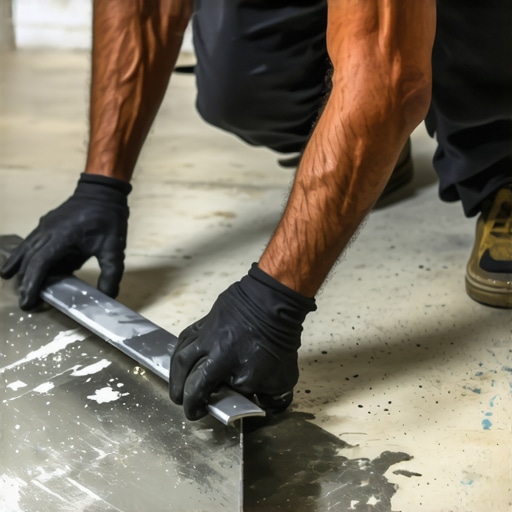
Most guys skip the leveling compound. They think the underlayment will hide the dip. It won’t. I spent three days grinding concrete on a job last month just so the floor wouldn’t click like a castanet. I have seen fifteen thousand dollar wide-plank walnut floors ruined because the installer was too lazy to check for old adhesive residue. You think that thin layer of yellow glue is harmless, but it is a chemical ghost waiting to haunt your new installation. If you are putting down hardwood floors, laminate, or even tile in showers, the substrate is your foundation. If the foundation is contaminated, the project is a failure before it even begins.
The myth of the clean slab
Removing adhesive from concrete requires eliminating all residues that could cause chemical reactions or height variances. Professionals use mechanical grinding or soy-based solvents to open the concrete pores. This ensures that the new flooring bond remains stable and prevents the telegraphing of old ridges through the new surface material. Concrete is not a solid, inert block. It is a porous, breathing sponge. When old carpet glue or linoleum mastic sits on that surface for twenty years, it migrates into the pores. You might scrape the top until it looks smooth, but the chemical roots remain. If you pour a modern self-leveling compound over those roots, the bond will fail. I have seen entire floors delaminate because the installer did not understand the physics of the bond. You need a clean, profile-ready surface that meets the International Concrete Repair Institute (ICRI) standards for surface roughness. Without it, you are just gambling with your client’s money.
The 1/8 inch that ruins everything
Subfloor flatness is measured by the deviation over a ten foot radius, and old adhesive is the primary culprit for floor failure. Even a small ridge of dried multi-purpose glue can cause high spots that lead to joint separation in click-lock laminate. Achieving a flat surface requires aggressive mechanical removal. Most people think they can just put a thicker underlayment over the old glue. That is a rookie mistake. Too much cushion actually causes the locking mechanisms on LVP to snap under pressure. When the floor flexes over a ridge of old glue, the plastic tongues in the joints experience shear stress. Eventually, they crack. Then you get gaps. Then the homeowner calls you to complain about the floor clicking. You have to be a stickler for the 1/8 inch over 10 feet rule. It is the difference between a floor that lasts thirty years and one that fails in three months.
“A floor is only as good as the subfloor beneath it, deflection is the enemy of every joint.” – Master Flooring Axiom
Chemical ghosts in the concrete
Old adhesives like black cutback mastic often contain asbestos and require specialized removal techniques to avoid hazardous dust. Modern urethane adhesives react poorly with old residues, leading to plasticizer migration that softens the new glue. Identifying the chemical makeup of the old adhesive is the first step in remediation. If you see black glue, stop. That is likely cutback mastic. Up until the mid-1980s, that stuff was loaded with asbestos. If you hit that with a dry grinder, you are filling the house with poison. You need to use a wet-scraping method or a chemical mastic remover that encapsulates the fibers. Even if it is just yellow carpet glue, you have to worry about the PH levels. High PH in concrete can emulsify old adhesives, turning them back into a sticky mess that will bleed through your new grout or ruin the backing of your hardwood floors. I always keep a PH testing kit in my truck. If the slab is over a PH of 9, you have work to do before the first plank goes down.
Adhesive Removal Comparison Table
| Adhesive Type | Removal Method | Risk Level | Tools Required |
|---|---|---|---|
| Black Mastic | Chemical Solvent | High (Asbestos) | Scraper, Solvent |
| Yellow Carpet Glue | Mechanical Grinding | Low | 7-inch Grinder, Shroud |
| Urethane Wood Glue | Heat and Scrape | Medium | Heat Gun, Sharp Blade |
| Pressure Sensitive | Scrub and Wash | Low | Degreaser, Pad |
Why your scraper is lying to you
Manual scraping only removes the surface bulk of the adhesive and leaves the deep-seated polymers inside the concrete pores. To ensure a professional bond, you must use mechanical abrasion to reach the virgin concrete. This process opens the capillaries of the slab for better adhesive penetration. You can spend all day on your knees with a hand scraper and still not have a clean floor. The scraper blade skips over the low spots. Those low spots still hold the old oils. I use a walk-behind floor grinder with diamond segments. It is the only way to be sure. The diamond bits chew through the top 1/32 of an inch of the concrete, taking the glue and the top layer of laitance with it. This creates a CSP-2 or CSP-3 profile. That is what the NWFA wants to see. It is loud, it is dusty, and it is the only way to do it right. If you are not using a HEPA-filtered vacuum with a shroud, you are just making a mess that you will be cleaning up for a week. Oak dust and concrete dust are not things you want in your lungs or the homeowner’s HVAC system.
- Check for moisture vapor transmission before starting.
- Identify if the adhesive contains asbestos.
- Clear the room and seal off air vents.
- Use a floor grinder with diamond attachments.
- Vacuum the slab twice with a HEPA system.
- Perform a water drop test to check porosity.
“Surface preparation is the most essential part of any flooring installation, skipping it is a recipe for disaster.” – TCNA Handbook Standards
The molecular reality of bond failure
Bond failure occurs when the surface energy of the concrete is lower than the surface tension of the adhesive. Contaminants like old glue lower this energy, preventing the new adhesive from wetting out the surface. Proper cleaning increases the surface area for the chemical bond to take hold. Think of it like paint on a greasy car. It does not matter how good the paint is, it will peel off. Adhesive works the same way. The molecules of the new glue need to wrap around the microscopic peaks and valleys of the concrete. If those valleys are filled with old, brittle multi-purpose glue, the new glue just sits on top. It is a physical bond, not just a sticky one. When I am working on a subfloor, I am looking for that dull, gray, open-pored look. If the concrete looks shiny, it is either sealed or contaminated. Either way, the new floor is not going to stick. I have seen guys try to use primer to cover it up. Primer is not a magic wand. It is a bridge. But if the bridge is built on mud, it is still going to fall down.
The moisture trap in humid climates
If you are working in a swampy area like Houston or New Orleans, the humidity is your enemy. Old adhesive residue acts as a moisture trap. It can hold onto dampness and lead to mold growth under your new laminate or hardwood. In these regions, you cannot just scrape and go. You need to ensure the concrete is dry and that you have removed every bit of organic material that mold can feed on. I always use a calcium chloride test or an in-situ RH probe. If the slab is pushing out too much water, that old glue residue will turn into a bacterial breeding ground. This is why removing the adhesive is not just about flatness, it is about health. A clean slab is a sterile slab. You want that concrete to be as clean as a dinner plate before you even think about opening a box of flooring.
Final professional verdict
Removing old adhesive is the hardest, dirtiest, and most important part of the job. It is not glamorous. You cannot put a picture of a clean concrete slab on Instagram and get a thousand likes. But you will get the satisfaction of knowing that floor will never move, never squeak, and never fail. Most homeowners do not want to pay the extra thousand dollars for subfloor prep. You have to explain it to them. You have to show them the ridges and the dust. You have to tell them that the 1/8 inch they ignore today is the gap they will be tripping over next year. Use the right tools, wear your respirator, and do not stop until you see virgin concrete. That is how a master installer works.