
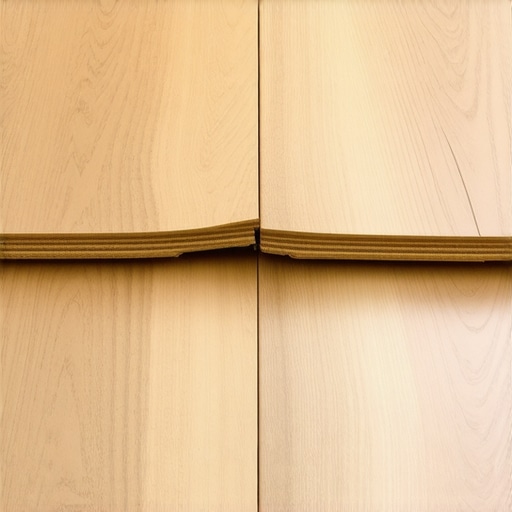
The air in this workshop smells like a mixture of WD-40 and fine oak dust, a scent that most people find abrasive but I find comforting. It is the smell of precision. I have spent twenty five years on my knees with a moisture meter and a six foot level, and if there is one thing I have learned, it is that a floor is not a decoration. It is a structural engineering challenge that happens to look like wood. Most people buy laminate because they want the look of hardwood floors without the maintenance or the price tag. They see a pretty box at a big box retailer and assume the click-lock system is magic. It is not magic. It is a calculated friction fit that relies entirely on the geometry of the subfloor. I spent three days grinding concrete on a job last month just so the floor wouldn’t click like a castanet. Most guys skip the leveling compound. They think the underlayment will hide the dip. It won’t. I have seen fifteen thousand dollar wide-plank walnut floors cup like potato chips because of poor prep, and laminate is even more sensitive to subfloor failure because its locking joints are only a few millimeters thick. When your laminate planks start pulling apart at the ends, it is a signal that the physics of your room have overcome the engineering of the plank.
The hidden physics of the click lock joint
Laminate end gap separation occurs when the structural integrity of the tongue and groove locking mechanism fails due to subfloor deflection, improper acclimation, or excessive friction between the plank and underlayment. These factors cause the planks to migrate away from one another during natural thermal expansion cycles, leading to visible gaps at the short ends. To understand why this happens, you have to look at the molecular makeup of a laminate plank. We are talking about High Density Fiberboard, or HDF. This is not just sawdust and glue. It is a matrix of wood fibers compressed under extreme pressure with phenolic resins. When moisture enters the room, these fibers swell. When the air dries out, they shrink. If the floor is installed correctly, the entire floor moves as one giant unit. This is why we call it a floating floor. However, if even one section of that floor is pinned down by a heavy kitchen island or if the subfloor has a dip, the floor cannot move as a unit. Instead, the tension focuses on the weakest point of the assembly, which is always the short end joint. The joint eventually yields, the locking profile shears or slips, and you are left with a gap that looks like a missing tooth in a smile.
Why your subfloor is lying to you
Subfloor flatness is the single most ignored variable in flooring failures, and a subfloor that appears level can still be unacceptably uneven. Most manufacturers require a flatness of 1/8 inch over a ten foot radius, which is a tighter tolerance than most builder grade subfloors ever achieve. When you lay a stiff laminate plank over a dip in the subfloor, you create a bridge. Every time you walk over that bridge, the plank deflects downward. This movement acts like a lever. The long side of the plank is the lever arm, and the short end joint is the fulcrum. Over thousands of footsteps, that lever action puts incredible stress on the HDF tongue. Eventually, the microscopic fibers in the tongue begin to fatigue and compress. Once the tongue has been compressed or micro-fractured, it no longer has the friction required to stay locked into the groove of the adjacent plank. This is why you might see gaps in high traffic areas like hallways but not in the corners of a bedroom. The subfloor is the foundation of the system, and no amount of expensive underlayment can compensate for a slab that looks like the rolling hills of Kentucky.
“A floor is only as good as the subfloor beneath it; deflection is the enemy of every joint.” – Master Flooring Axiom
The ghost in the expansion gap
Expansion gaps are required around the entire perimeter of a laminate installation to allow the HDF core to expand and contract with changes in humidity. If you install your laminate tight against the baseboards or a door casing, the floor has nowhere to go when it expands. In a humid summer, the planks will push against the walls. Because the wall will not move, the force is redirected back into the center of the floor. This causes the planks to peak or buckle. However, the real trouble happens when the weather turns cold and dry. As the planks shrink, they should pull inward from the walls. But if the floor has been pinned at one end, perhaps by a heavy bookshelf or a poorly installed transition strip, the shrinking force will pull the planks apart at their weakest joints. This is the irony of laminate installation. You need the floor to be loose enough to move, but tight enough to stay together. If you did not leave a 3/8 inch gap at the perimeter, you have essentially turned your floor into a ticking time bomb of tension and compression.
How heavy furniture acts like an anchor
Heavy objects such as kitchen islands, grand pianos, or floor to ceiling bookshelves pin floating floors to the subfloor and prevent necessary movement. This is known as the anchor effect. A floating floor must be free to slide across the underlayment as it reacts to the atmosphere. When you place a 500 pound object on a section of the floor, you have effectively nailed that section to the ground. If the other side of the room is free to move, the floor will expand and contract away from the anchored point. This creates a massive amount of tension. Laminate joints are designed to handle some lateral force, but they are not designed to hold back the collective weight of a shrinking floor. Eventually, the joint nearest the anchor point will fail. I have seen this happen dozens of times in modern open concept homes where people install laminate first and then build a heavy kitchen island on top of it. It is a recipe for disaster. If you must have heavy furniture, the floor needs to be cut around the legs or the island, with expansion gaps covered by molding, so the floor remains truly floating.
The friction coefficient of underlayment
Underlayment provides a thermal barrier and sound dampening, but using a product that is too thick or too soft will cause the locking mechanisms to snap. There is a common misconception that more cushion is better. Homeowners think a thick, squishy underlayment will make the floor feel like carpet. This is a fatal error for laminate. A soft underlayment allows for too much vertical movement. When you step on a plank, it sinks into the foam. The adjacent plank, which is not being stepped on, stays at the original height. This creates a vertical shearing force on the joint. Laminate joints are strong horizontally but very weak vertically. If the floor is constantly bouncing up and down, the tongue will eventually snap off. Once the tongue is gone, there is nothing holding the planks together, and they will drift apart. You want a high density underlayment that is thin, usually 2mm to 3mm, with a high compression strength to support the joints. This is especially true in areas near showers or kitchens where the humidity might already be softening the HDF core.
Technical Specifications Comparison
| Material Property | Standard MDF | HDF (Laminate Core) | Solid Oak (Reference) |
|---|---|---|---|
| Density (kg/m3) | 600 to 700 | 800 to 900 | 700 to 750 |
| Moisture Expansion Rate | High | Moderate | Very High |
| Joint Shear Strength | Low | High | N/A (Tongue and Groove) |
| Vertical Deflection Limit | Minimal | 0.5mm | N/A |
The 1/8 inch that ruins everything
The precision of the tongue and groove milling on modern laminate is so fine that a variance of a fraction of a millimeter can lead to failure. When I talk about zooming into the physics, I mean looking at the actual profile of the click system. Most manufacturers use a patented angle-angle or drop-lock system. These profiles are milled using diamond-tipped cutters that run at incredibly high speeds. If those cutters are dull, the fit will be loose. If the installer uses a tapping block too aggressively, they can mushroom the edge of the tongue. You might not see it at the time of installation, but you have created a burr that prevents the joint from seating fully. Over time, as the floor moves, that burr wears down, and the gap opens up. This is why I always tell people to check the scrap pieces. If the tongue looks fuzzy or frayed, the milling is poor, and the floor will eventually fail. You get what you pay for with laminate. The discount stuff from the big box store usually has a lower density core and less precise milling than the premium stuff from a dedicated flooring shop.
“Deflection is the silent killer of the floating floor; if the subfloor moves, the joint fails.” – NWFA Technical Guidelines
Diagnosis and repair protocol
Repairing separated laminate gaps requires identifying the root cause before attempting to close the joints with adhesives or mechanical force. If the gaps are caused by a lack of expansion space, you must first go to the perimeter and cut back the planks to create the necessary room. If you just tap the planks back together without fixing the expansion issue, they will just pop open again the next time the weather changes. Once the perimeter is clear, you can use a floor gap fixer, which is a tool that uses a high strength adhesive pad to grip the plank so you can tap it back into place with a mallet. In some cases, a small drop of PVA wood glue in the groove can help keep the joint together, but this is a last resort. If the tongue is snapped, no amount of glue will hold it forever.
Checklist for diagnosing end gap separation
- Measure the perimeter expansion gap under the baseboards to ensure it is at least 3/8 inch.
- Use a six foot straight edge to check for subfloor dips larger than 3/16 inch over ten feet.
- Check the ambient relative humidity with a hygrometer; it should stay between 35 and 55 percent.
- Inspect for heavy objects that may be pinning the floor to the subfloor.
- Verify the underlayment thickness and ensure it is not too soft or compressible.
- Look for signs of moisture intrusion near bathrooms or entryways that could swell the HDF core.
The reality is that laminate flooring is a high performance product that requires high performance installation. You cannot just slap it down over an old plywood subfloor and expect it to behave like a solid piece of wood. It is a system of interlocking parts, and like any system, it is only as strong as its weakest link. If you ignore the subfloor, if you ignore the humidity, and if you ignore the expansion gaps, the physics of the environment will eventually tear your floor apart. I have seen it happen on a thousand jobs, and it always starts with that first tiny gap at the end of a plank. Take care of the subfloor, and the floor will take care of you. Ignore it, and you will be spending your weekends with a tapping block and a bottle of glue, fighting a war against physics that you are destined to lose.