
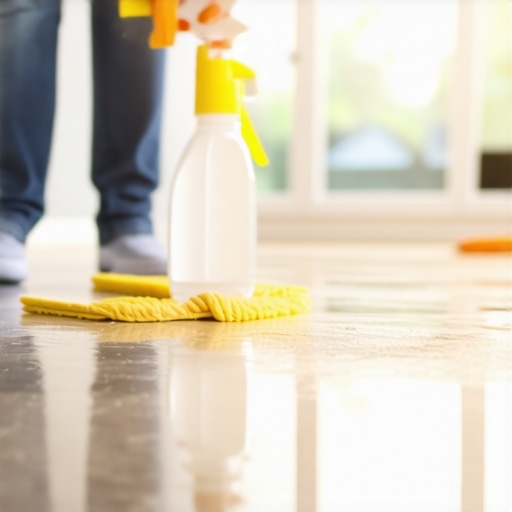
I have spent twenty five years with my knees on a subfloor and my hands covered in oak dust. I have seen the rise of the laminate floor from the early days of glue together planks to the modern click lock systems that dominate the big box retailers today. Homeowners always ask why their waterproof vinyl or laminate is buckling. Usually, it is because they locked it under a heavy kitchen island, killing the floor’s ability to breathe and move. I have walked into hundreds of homes where the owners were proud of their green cleaning habits, only to find that their expensive floor looked like a chalkboard. They used white vinegar thinking it was a safe, natural alternative. It is not. It is an acid that slowly dissolves the very thing you paid for. Laminate is an engineered performance surface, not a slab of granite. If you treat it like a lab experiment with kitchen pantry items, you will be calling me to rip it out in five years instead of twenty. This is a technical breakdown of why your cleaning routine is failing and what the chemistry of a floor actually requires.
The chemical reality of vinegar on resin
Laminate flooring features a melamine resin wear layer that is highly vulnerable to acidic solutions like distilled white vinegar. Repeated application causes chemical etching of the aluminum oxide finish, resulting in permanent haze, surface clouding, and degradation of the protective coating that shields the decorative print layer.
When we talk about laminate, we are talking about a sandwich of materials. The top layer is a wear layer of melamine resin often infused with aluminum oxide particles for scratch resistance. Below that is the decorative paper, and below that is the High Density Fiberboard or HDF core. Vinegar is acetic acid. While it is great for pickling or cleaning glass, it is a disaster for resins. An acid with a pH of around 2.5 to 3.0 will slowly eat into the molecular structure of the melamine. It does not happen overnight. It happens over months of weekly mopping. You start to notice that the floor does not have that factory sheen anymore. It looks dull. You think it is dirty, so you use more vinegar. You are actually just etching the surface deeper. Once that resin is compromised, the floor becomes porous. Now, every bit of dirt and foot oil can penetrate the surface. You have effectively turned a non porous floor into a sponge. I have seen floors where the wear layer was so thinned out by acid cleaning that the decorative paper started to show wear in high traffic areas within thirty six months. That is a failure of maintenance, not a product defect.
The ghost in the expansion gap
Expansion gaps are the perimeter voids required for laminate floors to accommodate hygroscopic expansion and contraction driven by relative humidity. Improper cleaning with excessive liquid can bypass these gaps, causing edge swelling and irreversible peaking of the HDF core material.
Every floating floor needs to move. It is not attached to the subfloor. It sits on an underlayment and moves as a single unit. If you mop with a bucket of water and vinegar, that liquid is not just sitting on top of the plank. Capillary action pulls that liquid into the joints. Laminate joints are the weakest point of the system. While the surface is waterproof, the raw HDF in the tongue and groove is a thirsty beast. Vinegar lowers the surface tension of the water, allowing it to penetrate deeper and faster into those tight tolerances. Once the HDF core absorbs that moisture, it expands. Because the floor is locked together, there is nowhere for that expansion to go but up. This is what we call peaking. You will see the edges of the planks start to rise, creating a little mountain range at every seam. No amount of drying will fix this. Once HDF fibers have swollen, they stay swollen. You are looking at a full floor replacement because you wanted to save five dollars on a proper cleaner. It is a structural engineering failure caused by a household condiment.
“A floor is only as good as the subfloor beneath it; deflection is the enemy of every joint.” – Master Flooring Axiom
The 1/8 inch that ruins everything
Subfloor flatness is measured by industry standards of one eighth inch over a ten foot radius to ensure locking mechanism integrity. When subfloor dips occur, the plank joints undergo vertical deflection, which leads to fatigue failure and separation of the click lock system.
I spent three days grinding concrete on a job last month just so the floor wouldn’t click like a castanet. Most installers skip the leveling compound. They think the underlayment will hide the dip. It won’t. When you combine a poor subfloor with the wrong cleaning agents, you create a perfect storm. The vinegar weakens the resin at the joints, and the deflection of the floor under foot traffic creates mechanical stress. Every time you walk over a dip, the tongue and groove rub against each other. If that joint has been softened by acidic cleaners, the friction increases. Eventually, the locking mechanism snaps. Now you have a gap. That gap is an open door for more moisture. I have seen grout lines in adjacent tile floors crack because the laminate was moving so much it put pressure on the transition strips. It is all connected. You cannot separate the cleaning chemistry from the structural physics of the installation. If you want a floor that lasts, you have to respect the tolerances of the material. [IMAGE_PLACEHOLDER]
The chemistry of proper pH neutral cleaning
pH neutral cleaners are specifically formulated to emulsify surface oils without altering the chemistry of the floor finish. These solutions maintain a pH of 7.0, ensuring the integrity of the melamine wear layer while providing surfactants that lift contaminants safely from the laminate surface.
You need to stop thinking about cleaning as a way to kill germs and start thinking about it as a way to preserve a finish. A neutral cleaner does not react with the aluminum oxide. It simply surrounds the dirt particles and lifts them so they can be wiped away. I recommend products that are specifically approved by the NWFA or the manufacturer of your floor. Look for a solution that does not require heavy rinsing. Water is the enemy of any wood based product, including laminate. Use a microfiber mop that is barely damp. If you can squeeze a single drop of water out of the mop head, it is too wet. The moisture should evaporate within thirty seconds of touching the floor. If it lingers, you are inviting disaster. People think more water equals more clean. In the world of flooring, more water equals more problems. You are dealing with a product that is 90 percent wood fiber. Treat it with the respect that wood deserves.
“Wood and wood-based products are hygroscopic, meaning they will expand and contract based on the relative humidity of the environment.” – Master Flooring Axiom
Why your subfloor is lying to you
Concrete slabs often harbor hidden moisture that can be detected through calcium chloride testing or in situ probes. Even if a subfloor looks dry, hydrostatic pressure can drive water vapor through the vapor barrier, affecting the dimensional stability of the laminate planks above.
I have seen guys lay laminate over a slab that felt dry to the touch, only to have the whole floor fail in six months. They did not check the moisture content. In a basement or a ground level slab, moisture is always trying to move from the ground into your house. If you do not have a 6 mil poly film at minimum, that vapor is going to hit the bottom of your laminate. Now, imagine you are also mopping the top with a vinegar solution. You are attacking the HDF core from both sides. The bottom is getting hit with ground vapor, and the top is getting hit with acid and water. The floor does not stand a chance. It will warp, it will smell like mildew, and it will eventually rot. When you are cleaning, you are only seeing the top 1/16th of an inch of the system. I am thinking about the entire four inch thick slab and the soil beneath it. That is the difference between a decorator and an architect of floors.
Laminate maintenance comparison
| Cleaning Agent | pH Level | Effect on Resin | Structural Risk |
|---|---|---|---|
| White Vinegar | 2.5 – 3.0 | Etching / Dulling | High Joint Swelling |
| Dish Soap | 8.0 – 9.0 | Residue Buildup | Moderate Streaking |
| pH Neutral Cleaner | 7.0 | Safe / Protective | Low / Recommended |
| Steam Mops | N/A | Heat Damage | Critical Core Failure |
While most people want the thickest underlayment possible, too much cushion actually causes the locking mechanisms on LVP and laminate to snap under pressure. A subfloor that is too soft allows the floor to bounce. That bounce puts immense strain on the plastic or HDF tongue. You want a high density underlayment that provides support, not a squishy foam that feels like a mattress. The same logic applies to cleaners. You want something that works at the surface level without penetrating the core. The goal is a stable, clean, and dry environment.
Essential maintenance checklist
- Use only pH neutral cleaners approved for laminate or hardwood floors.
- Avoid all steam mops as the high pressure heat forces moisture into the HDF core.
- Implement felt protectors on all furniture legs to prevent scratching the wear layer.
- Maintain indoor relative humidity between 35 and 55 percent to prevent shrinkage.
- Dust mop or vacuum with a hard floor attachment daily to remove abrasive grit.
- Never use wax or polish on laminate floors as it creates a sticky film that attracts dirt.
The war between wood and plastic
Hardwood floors and laminate products require distinct maintenance protocols despite their visual similarities. While solid oak can be sanded and refinished, laminate is a disposable surface that relies entirely on the integrity of its factory finish to survive daily wear.
I have a lot of respect for a site finished white oak floor. It is a living thing. You can sand it, stain it, and give it a new life. Laminate is different. It is a high performance plastic and wood hybrid. Once you scratch it, you are done. Once you dull it with vinegar, you cannot just buff it out. You are stuck with it until you replace it. This is why the cleaning protocol is even more vital for laminate than it is for wood. You have no safety net. People think laminate is the cheap option so they can treat it poorly. I argue that because it is a finite surface, you have to treat it with more care. You cannot afford to lose a single micron of that wear layer. The same goes for grout and showers in nearby bathrooms. If you are using harsh acids to clean your shower grout, and that runoff hits your laminate transition, you are going to see the laminate fail right at the door. I have seen it a thousand times. The chemicals we use in one room do not stay in that room.
The moisture barrier myth
Vapor retarders are often misunderstood as waterproof membranes, but they are actually designed to slow down the migration of moisture. In high humidity climates like Florida or Houston, the vapor pressure can exceed the perm rating of standard underlayments, leading to buckling.
If you live in a swampy area, your floor is under constant attack. The air is heavy with water. If you add a wet mop and vinegar to that equation, you are just accelerating the inevitable. In these climates, I always tell people to lean towards engineered cores or even luxury vinyl plank, but if you have laminate, you must be a fanatic about dryness. The dry heat of a place like Phoenix has the opposite problem. It will shrink your baseboards until they show a gap and it will make your laminate joints open up. When those joints open, your cleaning solution goes straight to the core. There is no winning with water and wood. The only way to win is to keep them apart. Use a dry cloth to follow up after any damp mopping. It takes an extra ten minutes, but it adds ten years to the life of the floor. I do not care what the lady on the internet said about vinegar being a miracle. She does not have to deal with the warped boards and the broken hearts that I see every week. Stick to the science, respect the resin, and keep your subfloor dry.