
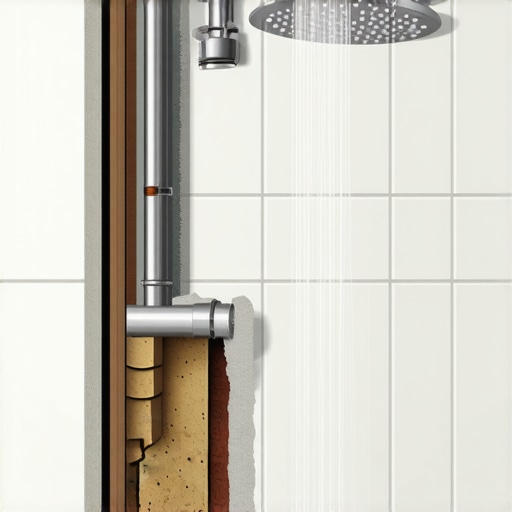
I once walked into a house where a $15,000 wide-plank walnut floor was cupping so bad it looked like a potato chip because the installer didn’t check the crawlspace humidity. In that case, it wasn’t just the air. It was a pinhole leak behind the master shower wall that had been weeping for six months. I could smell the damp oak dust and the metallic tang of WD-40 on my tools as I pried up the first board. The subfloor was a sponge. Most people think a leak is a puddle on the tile, but the real damage happens behind the drywall where the shower arm meets the drop-ear elbow. That water travels. It follows the path of least resistance, which is usually straight down your wall studs and into the sleeper system of your hardwood floors or the core of your laminate.
The ghost in the plumbing wall
Shower heads leak behind the wall primarily due to failing thread sealant, cracked drop-ear elbows, or excessive vibration within the plumbing assembly. When the connection between the shower arm and the internal pipe fitting loses its integrity, water escapes into the wall cavity every time the valve is opened. This hidden moisture bypasses the waterproof membrane of your shower stall and saturates the structural framing. Over time, this localized humidity creates a vapor drive that forces moisture into the adjacent flooring materials, causing structural failure that no amount of surface drying can fix. You might see the grout start to crumble or the laminate planks near the bathroom door start to peak at the seams. By then, the damage is already deep in the subfloor.
The physics of a shower leak involve more than just gravity. We are talking about capillary action. Water can travel upward through porous materials like drywall or the end grain of wood studs. If you have solid hardwood floors, they are basically a series of straws. Each board is made of tracheids and vessels designed to move water when the tree was alive. Even after the wood is kiln dried and finished, those cells remain hygroscopic. When the humidity in the wall cavity spikes because of a leaking shower arm, those boards start to drink. They expand. Since they are nailed down, they have nowhere to go but up. That is how you get cupping. I have seen guys try to sand it flat, but if you do not fix the leak in the wall, the floor will just cup again two weeks later.
“A floor is only as good as the subfloor beneath it; deflection is the enemy of every joint.” – Master Flooring Axiom
Why your subfloor is lying to you
Subfloors often mask significant water damage until the structural integrity of the top floor is compromised. Whether you have a concrete slab or a plywood subfloor, these materials can hold a massive amount of water without showing immediate surface wetness. On concrete, a leak behind the wall can lead to high hydrostatic pressure. The moisture moves through the slab and sits under your flooring, emulsifying the adhesive or causing the locking mechanisms on laminate to swell and snap. If you are not using a pinless moisture meter to check the impedance of the subfloor, you are just guessing. A subfloor that looks dry might actually be at 90 percent relative humidity, which is a death sentence for any wood product.
When I am on a job, I look for the 1/8 inch that ruins everything. That is the gap that was not left for expansion or the tiny crack in the grout that everyone ignored. People think grout is waterproof. It is not. Cementitious grout is a porous mineral. If the shower head is leaking behind the wall, that moisture is hitting the back of the tile. It then moves through the grout lines from the inside out. You might notice the grout looks darker or stays wet longer than usual. That is a sign that the wall cavity is saturated. If you have laminate floors, the situation is even worse. Most laminate has a high density fiberboard core. This is essentially compressed sawdust and glue. When it gets hit with the moisture from a wall leak, it undergoes an irreversible thickness swell. The edges will never go back down even after the leak is repaired.
| Material Type | Moisture Tolerance | Expansion Rate | Recommended Sealant |
|---|---|---|---|
| Solid White Oak | Low | High | Urethane Adhesive |
| Engineered Maple | Moderate | Medium | Silane Polymer |
| Laminate HDF | Very Low | Extreme | PVA Joint Sealer |
| Luxury Vinyl Plank | High | Low | Pressure Sensitive |
The chemistry of water migration in wood
Water migration in flooring follows the laws of thermodynamics and vapor pressure differentials. Moisture moves from areas of high concentration to areas of low concentration. If the area behind your shower wall is wet, and your living room is air conditioned and dry, the water will be pulled through the wall and into your hardwood floors. This is why you see floor damage ten feet away from the bathroom. The wood cells react to this moisture by expanding across the grain. The cell walls actually thicken as they absorb water molecules through hydrogen bonding. This physical change is powerful enough to buckle a floor and lift a heavy kitchen island if the floor was not installed with an adequate perimeter expansion gap.
I remember a job in a high humidity area like Houston where the installer did not acclimate the wood. He just brought it from the warehouse and nailed it down. Two weeks later, a tiny leak started in the shower. The combination of the unacclimated wood and the new moisture source caused the floor to heave so violently it actually popped the baseboards off the wall. This is why the National Wood Flooring Association is so strict about moisture testing. You need to know the moisture content of the floor and the subfloor before you ever open a box of material. If there is more than a 4 percent difference between the wood and a wood subfloor, or if the concrete slab is over 75 percent relative humidity, you have to stop. You have to find the source. Often, that source is a plumbing fitting that was not torqued correctly or a shower arm that was installed without enough Teflon tape.
Grout is not a waterproof shield
Grout serves as a filler for tile joints and provides structural stability, but it does not prevent water from penetrating to the substrate. Many homeowners believe that as long as their grout is intact, their floors are safe. This is a dangerous myth. Water molecules are smaller than the pores in standard cement grout. If your shower head is leaking behind the wall, the water will saturate the thin set mortar and move into the wall studs. From there, it wicks into the subfloor. Once the moisture is under the tile, it has no way to evaporate. It stays there, rotting the plywood or causing the concrete to off gas. This can lead to mold growth that you cannot see until the smell becomes unbearable.
If you are working with laminate, the risk is even higher. While the top wear layer of laminate is plastic and waterproof, the joints are the weak point. Even a small amount of moisture traveling from a shower leak can get into those joints. Once the fiberboard core absorbs water, it loses its structural integrity. The floor will feel soft or bouncy when you walk on it. This is because the core has turned into mush. There is no fix for this other than replacement. You cannot dry out a laminate core once it has reached its saturation point. This is why I always tell people to spend the extra money on a high quality underlayment with a built in vapor barrier, but even then, a leak from above or behind the wall can bypass that protection if it gets to the edges.
“Wood is hygroscopic. It will reach an equilibrium moisture content based on the relative humidity of its environment.” – NWFA Technical Manual
The 1/8 inch that ruins everything
Precision in installation is the only defense against the inevitable movement caused by moisture. Flooring is an engineering challenge. You are dealing with materials that want to move. If you do not leave a 1/8 inch or 1/4 inch gap at the perimeter, the floor has no room to expand when that shower leak starts. It will hit the wall and then start to peak at the seams. This is especially true for click lock systems. The locking mechanism is only a few millimeters thick. It is the first thing to snap when the floor is under pressure. People want the thickest underlayment they can find, thinking it will be more comfortable. But too much cushion actually causes the locking mechanisms on luxury vinyl or laminate to flex and snap under the weight of furniture. You need a dense, high quality underlayment that resists compression.
- Inspect the shower arm connection for any signs of corrosion or crusty mineral deposits.
- Use a moisture meter to check the base of the drywall outside the shower.
- Remove the shower escutcheon plate and look inside the wall with a flashlight while the water is running.
- Check the flooring for any signs of cupping, crowning, or dark staining near the bathroom transition.
- Ensure that all plumbing penetrations are sealed with high grade silicone to prevent surface water from entering the wall.
Hardwood versus laminate in high moisture zones
Choosing the right material for areas adjacent to bathrooms requires an understanding of how different cores react to humidity. Solid hardwood is the most sensitive. It is beautiful, but it is a living product. Engineered hardwood is better because the cross ply construction limits movement, but it is still susceptible to delamination if the leak is severe. Laminate is the most vulnerable to edge swelling. If you are worried about leaks, luxury vinyl plank with a stone plastic composite core is the most stable option. It won’t swell or rot, but it can still trap moisture underneath it, which can lead to mold on your subfloor. No floor is truly waterproof if the water is coming from behind the wall. The term waterproof only refers to the surface of the plank, not the entire installation ecosystem.
When I see a floor failing, I don’t just look at the boards. I look at the whole house. I look at the HVAC system and how it handles humidity. I look at the crawlspace. And I always, always look at the shower. If that shower head was installed by a DIY enthusiast who didn’t know about the importance of brass fittings and proper sealing, that $5,000 bathroom remodel can easily turn into a $20,000 whole house flooring replacement. Water is a patient enemy. It will find the smallest gap in your plumbing and use it to destroy the most expensive finishes in your home. You have to be more patient than the water. You have to be a stickler for the details. That means checking your moisture levels every single day of the install and never ignoring a damp spot on the wall.