
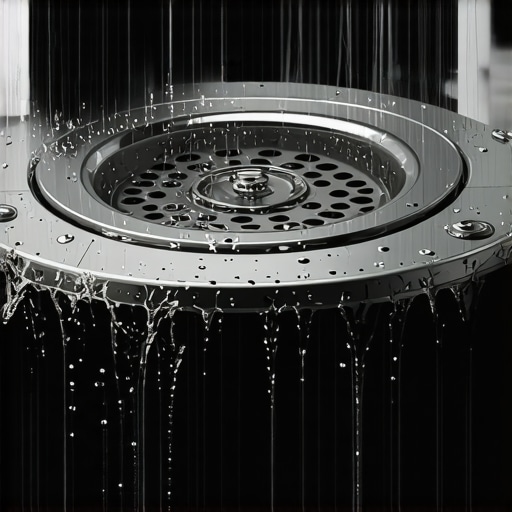
I spent three days grinding concrete on a job last month just so the floor wouldn’t click like a castanet. Most guys skip the leveling compound because they think the underlayment will hide the dip. It won’t. I have seen it time and again. A homeowner calls me because their beautiful hardwood floors in the master bedroom are starting to cup and peak. They blame the wood. They blame the humidity. Then I walk into their bathroom with a moisture meter and find the real culprit. It is not the tile. It is the shower drain flange. Most people think a leak happens because of a crack in the grout or a chipped tile. That is a myth. Water moves through grout like it is a sponge. The real waterproofing happens an inch below the surface, and if that flange was not set with the precision of a watchmaker, your subfloor is already rotting. I can smell the damp oak from here. It is a sharp, earthy scent that tells me someone cut corners on the plumbing assembly. Flooring is a structural engineering challenge, not a decorative choice.
The structural lie of the shower pan
Shower drain leaks occur when the mechanical bond between the waterproofing liner and the drain body fails due to improper compression or clogged weep holes. This failure allows water to bypass the drainage system and saturate the mortar bed, eventually migrating into the adjacent hardwood floors or laminate. You have to understand the physics of a traditional three piece drain. You have the bottom flange, the middle clamping ring, and the top strainer. If the installer does not use a bead of 100 percent silicone between the liner and the bottom flange, you have a path for water. I have seen guys try to use plumber’s putty here. That is a rookie mistake. Putty dries out and cracks. Silicone remains flexible, which is vital because a house moves. Every time you step in that shower, the floor flexes. If your drain is rigid while the floor is moving, that seal is going to snap. It is a slow death for your subfloor. We are talking about microscopic droplets that accumulate over months. By the time you see a stain on the ceiling below, the damage is done.
| Feature | Traditional PVC Drain | Integrated Bonding Flange | Linear Drain Systems |
|---|---|---|---|
| Waterproofing Method | Clamping Ring | Surface Membrane | Integrated Flange |
| Common Failure Point | Clogged Weep Holes | Improper Thin-set Bond | Peripheral Seal Gap |
| Subfloor Impact | High risk of rot | Low if bonded correctly | Moderate |
| Required Slope | 1/4 inch per foot | 1/4 inch per foot | Variable |
The physics of the clamping ring and the weep holes
Weep holes are the small passages in a drain base that allow moisture collected by the waterproof liner to escape into the drain pipe. When these holes become blocked by mortar or grout, water sits on the liner until it finds a weak spot in the flange assembly. Imagine a bucket with a tiny hole at the bottom. If you plug that hole, the bucket overflows. In a shower, that overflow goes straight into your laminate flooring in the next room. I always tell my apprentices to protect those weep holes with crushed stone or a plastic spacer. If you just dump thin-set over them, you are building a swimming pool under your tile. The chemistry of the mortar bed is also a factor. Standard sand-and-cement mixes are porous. They are designed to let water pass through to the liner. If the water cannot get out through the weep holes, it stays in the mud bed. This creates a constant state of hydrostatic pressure against the drain flange. Over time, that pressure will find a way through the bolt holes or the threads of the strainer. It is not a matter of if, but when.
“A floor is only as good as the subfloor beneath it; deflection is the enemy of every joint.” – Master Flooring Axiom
Why grout is never a waterproof barrier
Grout is a cementitious product that is naturally porous and serves as a joint filler rather than a liquid barrier for showers. Even high-performance epoxy grouts can develop hairline fractures due to the expansion and contraction of the building envelope, allowing water to penetrate the assembly. People see a solid surface and assume it is watertight. That is a dangerous assumption. Think about the molecular structure of cement. It is a network of microscopic voids. Water enters those voids through capillary action. If your showers are built on the idea that tile and grout will stop the water, you have already lost the battle. The real work is done by the membrane. Whether you are using a topical sheet membrane or a traditional PVC liner, that material must be integrated perfectly into the drain flange. I have seen $20,000 bathrooms ruined because the installer did not understand the difference between a liquid-applied membrane and a sheet-applied one. They try to mix and match systems. You cannot do that. The chemical bonding agents are different. You need a singular, unified system from the subfloor up to the tile.
How shower leaks destroy hardwood floors
Moisture from a leaking shower drain travels laterally across the subfloor through wick action, causing solid hardwood to swell and cup. This happens because wood is hygroscopic, meaning it absorbs water from the environment, leading to irreversible structural deformation of the planks. I once walked into a house where a $15,000 wide-plank walnut floor was cupping so bad it looked like a potato chip because the installer didn’t check the crawlspace humidity, and the shower was leaking right next to it. The water moves under the transition strip. It hits the end grain of the hardwood floors. Once water gets into the end grain, it travels up the length of the board. You might see the damage six feet away from the shower. It is heartbreaking to see a beautiful floor ruined by a $50 plastic drain part. Laminate is even worse. Most laminate has a fiberboard core. Once that core gets wet, it expands and never goes back down. It is like a sponge. You can dry out hardwood sometimes if you catch it early and use a high-powered dehumidifier, but laminate is a total loss. You are ripping it out and starting over.
- Check the drain bolts for proper torque before tiling
- Ensure weep holes are protected with pea gravel or specialized spacers
- Verify the subfloor slope meets the 1/4 inch per foot requirement
- Perform a 24-hour flood test before any tile is installed
- Use 100 percent silicone beads at all flange-to-liner interfaces
The chemistry of the bond and the 1/8 inch rule
The 1/8 inch gap between the drain flange and the surrounding mortar is a critical expansion zone that prevents mechanical stress from cracking the waterproofing seal. When installers pack mortar tight against the drain neck without allowing for thermal expansion, the movement of the house will eventually sheer the bond. I use a specific type of modified thin-set for my drain assemblies. It has a high polymer content. This allows for a slight amount of flexibility. Think about the temperature swings in a shower. You go from a 65 degree room to 100 degree water in seconds. Everything expands. The PVC drain, the mortar, the tile, and the subfloor all expand at different rates. If you do not have a flexible bond at the flange, something has to give. Usually, it is the waterproofing. I have spent decades studying how these materials interact. It is not just about slapping some mud down. It is about understanding the coefficient of thermal expansion for every layer of the floor. If you ignore the chemistry, the physics will punish you. There are no shortcuts in flooring. You either do it right, or you do it twice.
“The assembly shall be designed to provide a slope of 1/4 inch per foot toward the drain.” – TCNA Handbook Logic
The final inspection of the drainage path
A successful shower installation requires a verified moisture barrier that is mechanically fastened to the drain flange and tested under pressure. If you skip the flood test, you are gambling with your client’s home. I fill every shower pan I build with water and let it sit for a full day. I mark the water line with a pencil. If that line moves even a fraction of an inch, I don’t tile. I tear it down. It is better to lose a day of work than to replace a whole floor of hardwood floors later. You have to be a stickler for the details. The industry is full of guys who want to get in and out in a day. They love the click-lock shortcuts. They love the fast-setting mud. But they don’t understand the long-term reality of moisture. A floor is a living thing. It breathes. It moves. And if that shower drain flange is not perfect, it will die. You have to respect the water. It is the most patient force on earth. It will find the one bolt you didn’t tighten. It will find the one spot where the grout is thin. Protect your subfloor. Protect your reputation. Do the work.