
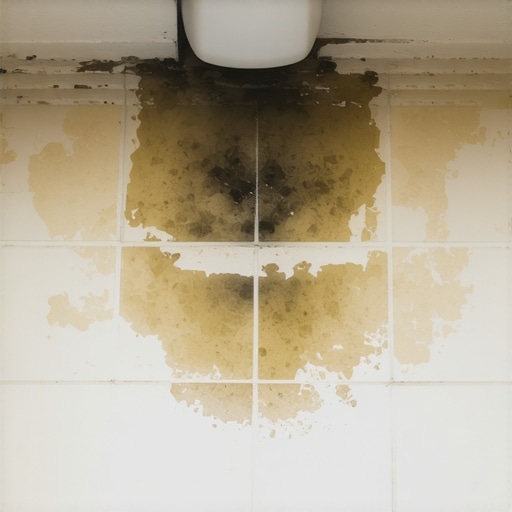
I spent three days grinding concrete on a job last month just so the floor wouldn’t click like a castanet. Most guys skip the leveling compound. They think the underlayment will hide the dip. It won’t. I have seen it all in twenty five years of flooring. I have smelled the rot and the WD-40 and the fresh oak dust. When you step near a toilet and feel that sickening give, that sinking sensation where the floor feels like a wet sponge, you are not just looking at a cosmetic issue. You are witnessing a structural failure. It is the sound of wood fibers surrendering their integrity to constant moisture. It is a slow motion disaster hidden under your tile or laminate.
The deceptive nature of the wax ring
A failed wax ring or a leaking toilet flange is the most common reason for a spongy bathroom floor near the commode. Every time you flush, a small amount of wastewater escapes the seal and saturates the subfloor plywood. Over months or years, this moisture triggers fungal growth and wood rot, which compromises the structural load-bearing capacity of the floor joists and decking. The wax ring is a simple piece of technology. It is literally a circle of wax that creates a compression seal between the porcelain horn of the toilet and the plastic or cast iron flange. If the toilet wobbles because the floor is uneven, that movement breaks the wax seal. Once the seal is broken, the wax cannot heal itself. Every gallon of water that passes through the trapway has the potential to seep into the end grain of your subfloor. This is where the physics of capillary action takes over. The wood sucks up the water like a straw. It moves from the flange opening outward into the rest of the room. By the time you feel the floor move, the damage is often three feet wide.
“A floor is only as good as the subfloor beneath it; deflection is the enemy of every joint.” – Master Flooring Axiom
The 1/8 inch gap that creates a swamp
Subfloor deflection and improper joist spacing lead to cracked grout lines and water infiltration in bathroom settings. If your subfloor assembly moves more than 1/360th of the span, the bond between the tile and the thin-set will fail, allowing moisture from showers to penetrate the wood. I have walked into houses where a 15,000 dollar wide plank walnut floor was cupping so bad it looked like a potato chip because the installer didn’t check the crawlspace humidity. In a bathroom, the stakes are higher. If you have hardwood floors in a bathroom, you are playing with fire. Wood is hygroscopic. It breathes. It expands when the humidity hits 80 percent during your shower and shrinks when the heater kicks on. If you do not have a perfectly flat subfloor, the movement is magnified. That 1/8 inch dip you ignored becomes a pivot point. Every time you walk on it, you are pumping air and moisture into the gaps. If you have grout that is crumbling near the toilet, that is not a grout problem. It is a floor movement problem. The grout is the canary in the coal mine.
The chemical breakdown of OSB and plywood
Oriented Strand Board and Plywood react differently to prolonged moisture exposure near bathroom fixtures. OSB is made of wood strands bonded with phenol-formaldehyde resins, which can swell significantly at the edges and lose structural thickness when saturated. Plywood tends to delaminate, where the individual veneer layers separate as the water dissolves the glue. When we talk about a spongy floor, we are talking about the loss of the shear strength of these materials. Plywood is built in layers with the grain running in opposite directions. This gives it incredible strength across the span of the joists. But water is a universal solvent. It gets between those layers. It causes the wood to soften until it has the consistency of wet cardboard. If you have laminate floors in this area, the situation is even worse. Laminate has a high-density fiberboard core. This is essentially sawdust and glue. Once water touches the edge of a laminate plank, it wicks into the core and the floor ruins itself within hours. It will buckle. It will peak at the seams. It will never lay flat again.
| Material Type | Moisture Resistance | Structural Rigidity | Best Use Case |
|---|---|---|---|
| Exterior Grade Plywood | High | Excellent | Main bathrooms and wet areas |
| OSB (Standard) | Low | Moderate | Dry living areas only |
| Cement Backer Board | Extreme | Brittle | Underlayment for tile showers |
| LVP (Stone Core) | High | Rigid | Modern waterproof flooring |
The structural engineering of the toilet flange
The toilet flange height must be exactly 1/4 inch above the finished floor level to ensure a watertight compression seal with the wax ring. If the flange is flush with the subfloor or buried beneath layers of new tile, the wax gasket will not compress sufficiently, leading to sewage leaks. Most DIY installers make the mistake of adding a second wax ring. This is a temporary fix that often fails because the stack of wax is unstable. It can shift and partially block the drain. The real solution is a flange extender or a deep-seal gasket. You also have to look at the floor leveling. If I am installing a floor, I spend more time with a level and a straight edge than I do with the actual flooring material. If the floor is not flat within 3/16 of an inch over 10 feet, the toilet will rock. A rocking toilet is a leak waiting to happen. You can shim the toilet, but if the subfloor is already soft, those shims will just sink into the wood. You are treating the symptom instead of the disease.
“Proper subfloor preparation is the foundation of any successful installation, requiring a maximum variation of 1/8 inch over 10 feet.” – NWFA Standards
The physics of the shower transition
Water migration from curbless showers often travels through the subfloor toward the toilet area through capillary pathways. If the waterproofing membrane is not integrated between the shower pan and the bathroom floor, liquid moisture will find the lowest point, usually the toilet cutout. This is why you see rot around a toilet even if the wax ring is brand new. The water is coming from the shower. It travels under the tile, through the thin-set, and pools at the flange. I have seen guys build beautiful custom showers and then fail to waterproof the floor outside the door. They think the bath mat will catch it. It won’t. Water follows gravity. If there is a dip in the subfloor near the toilet, that is where the water will live. This is especially true with hardwood floors. The water gets under the finish and turns the wood black. That black color is a sign of advanced decay. At that point, the wood is no longer wood. It is compost.
- Check for any water staining on the ceiling directly below the bathroom.
- Press a screwdriver into the subfloor near the flange to test for soft spots.
- Measure the moisture content of the wood using a pin-style meter.
- Inspect the grout lines for hairline cracks or powdery residue.
- Ensure the toilet is bolted tightly to the flange, not just the floor.
- Verify that the flange sits on top of the finished flooring, not under it.
The 1/8 inch that ruins everything
Expansion gaps are required around the perimeter of the room and around fixed objects like the toilet flange to prevent floor buckling. If hardwood or laminate is installed tight against the flange, the floor cannot expand and contract with temperature changes, leading to joint separation. This separation creates a path for water to reach the subfloor. I hate seeing floors installed tight to the wall. It shows a lack of understanding of the material. Wood is alive. It moves. If you don’t give it space, it will find space by lifting up. This is what we call crowning or tenting. In a bathroom, this creates a hollow space under the floor where humid air can condense. This condensation is a silent killer. It rots the floor from the bottom up while the top looks perfect. By the time you notice the sponge, the joists might need sistering. This is why I insist on a moisture barrier even over wood subfloors in some cases. You have to isolate the finish floor from the structural floor. You have to manage the moisture vapor transmission rate. If you don’t, the floor will fail. It is a law of physics. It is not an opinion. It is how materials behave in the real world. Stop looking at the color of the tile and start looking at the health of the wood beneath it.