
Most guys skip the leveling compound. They think the underlayment will hide the dip. It won’t. I spent three days grinding concrete on a job last month just so the floor wouldn’t click like a castanet. That job taught me that if you do not respect the flat plane of a subfloor, the laminate will eventually surrender. You might see a beautiful oak pattern on the surface, but underneath, there is a mechanical battle happening every time you take a step. When your laminate starts sliding apart at the ends, it is not a mystery. It is a failure of physics and preparation. I have spent twenty-five years fixing these gaps. I have seen floors that looked like a jigsaw puzzle after a single winter because the installer ignored the basics of moisture and friction. If you want a floor that stays together, you have to stop thinking about how it looks and start thinking about how it moves.
The mechanical reality of the floating floor system
Laminate flooring end gaps occur because the locking mechanism has failed to overcome the internal tension or external friction acting on the planks. When a floating floor is installed, it relies on a tongue and groove system, often a click-lock profile like Uniclic or Valinge, to maintain a continuous surface. If the subfloor flatness is outside of the NWFA standards, the planks will deflect. This vertical movement creates a ratcheting effect that slowly pumps the short ends of the planks away from each other. Over time, the HDF core of the laminate loses its grip, and a visible gap appears. This is not just an aesthetic problem. It is a sign that the structural integrity of the installation is compromised.
The 1/8 inch that ruins everything
Subfloor prep is the most ignored phase of any flooring project. If your subfloor has a dip of more than 1/8 inch over a 6 foot radius, your laminate is doomed. When you walk over a low spot, the plank bends into the void. This puts immense pressure on the end joints. Unlike the long edges, which have more surface area for the lock to engage, the short ends are the weak point. In a room with high foot traffic, this constant flexing acts like a crowbar. It slowly pries the joint open. I have seen homeowners try to fill these gaps with wood putty or caulk. That is a waste of time. The movement will just crack the filler. You have to address the deflection. If the floor is already down, you might be able to inject a low-expansion foam or a specialized floor shim, but usually, it means the subfloor was never flat enough to begin with. You cannot hide a bad foundation with a pretty top layer.
“A floor is only as good as the subfloor beneath it; deflection is the enemy of every joint.” – Master Flooring Axiom
The ghost in the expansion gap
Expansion gaps at the perimeter of a room are mandatory for laminate flooring stability. A laminate floor is essentially a giant sheet of compressed wood fibers and resin. It grows and shrinks with the relative humidity of the room. If you install the planks tight against a wall, a kitchen island, or a heavy radiator, the floor has nowhere to go when it expands. It will buckle or, more commonly, it will pin one section of the floor in place while the rest of the floor tries to move. This creates a tug-of-war. Eventually, something has to give. Usually, it is the end joint of a plank in the middle of the room. This is why I always tell people to leave at least 1/4 inch to 1/2 inch of space around every single obstruction. If you do not, the floor will find its own expansion space by tearing itself apart at the seams. I once saw a floor pull apart because the homeowner installed a 500-pound aquarium on top of a floating floor. They pinned the floor to the subfloor, and the seasonal shrinkage did the rest.
Molecular zooming into HDF core expansion
The high-density fiberboard (HDF) core is the heart of your laminate. This material is hygroscopic. It absorbs water molecules from the air. Even a 10 percent change in indoor humidity can cause a 20-foot run of flooring to grow by a fraction of an inch. If the acclimation process was skipped, the planks were likely installed while they were at a different moisture level than the room environment. Once they reach equilibrium moisture content, they might shrink. If the coefficient of friction between the underlayment and the laminate is too high, the planks cannot slide as a single unit. Instead, individual planks get stuck while others move. This is especially common with cheap, rubberized underlayments that have too much grip. You want an underlayment that allows the floor to glide. If the planks are stuck to the subfloor, they will slide apart at the ends because they cannot migrate together.
| Property | Standard Value | Impact on Gapping |
|---|---|---|
| Subfloor Flatness | 3/16″ per 10′ | Prevents joint deflection |
| Acclimation Time | 48 to 72 Hours | Reduces post-install shrinkage |
| Relative Humidity | 35% to 55% | Stabilizes HDF core dimensions |
| Locking Strength | > 500 lb/ft | Resists end-joint separation |
Why your laminate is sliding in the hallway
Hallway installations are notorious for gapping. Because hallways are long and narrow, they often lack the lateral weight to keep the planks pressed together. Furthermore, if the laminate is run lengthwise down a long hall without a transition strip at the doorways, the sheer mass of the flooring in the adjacent rooms can pull the hallway planks apart. The floor in the bedroom moves one way, and the floor in the living room moves another. The hallway is the bridge that gets snapped. I always recommend T-moldings in every doorway. People hate them because they like the “continuous look,” but T-moldings are the safety valves of a floating floor. They allow each room to expand and contract independently. Without them, you are asking for a 1,000-square-foot sheet of wood to move perfectly in unison. It will not happen.
The suction cup method for end gap repair
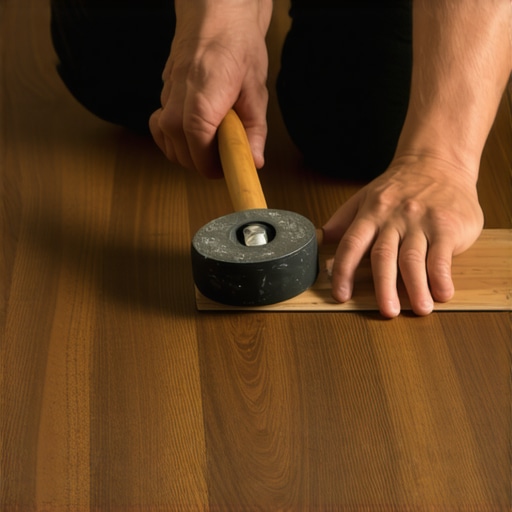
Fixing laminate gaps does not always require a full tear-out. If the locking tabs are not broken, you can often slide the planks back together. First, clean the gap thoroughly. Use a vacuum to remove every speck of dust and grit. If there is debris in the groove, the planks will never close. Next, use a floor gap fixer tool or a heavy-duty glass suction cup. Attach the suction cup to the plank that has moved. Use a rubber mallet to strike the side of the suction cup tool, driving the plank back into its original position. I sometimes apply a tiny drop of PVA wood glue to the groove before closing it. This acts as a permanent bond for that specific joint. Just be careful not to use too much. If the glue oozes out, it can create a mess on the wear layer. This repair only works if the floor is not pinned elsewhere. If the gap returns a week later, you have an underlying structural issue like a dip in the subfloor or a lack of expansion space.
- Inspect the subfloor for high and low spots using a 10-foot straightedge.
- Ensure the room humidity is maintained between 35 and 55 percent year-round.
- Check that no heavy cabinetry or fixed objects are installed on top of the planks.
- Verify that a 1/2 inch expansion gap exists under all baseboards and door casings.
- Use a specialized laminate floor glue for high-traffic end joints if gapping persists.
The myth of the waterproof click lock
Waterproof laminate marketing has confused a lot of people. While the surface might be non-porous, the joints are still susceptible to moisture. If you mop with too much water, that liquid seeps into the end joints. This causes the HDF core to swell at the edges. This is called peaking. When the edges swell, they push against each other. When the floor eventually dries out and the swelling goes down, the joint often remains loose. The mechanical lock has been deformed by the pressure of the swelling. This is why you see gaps in front of showers or kitchen sinks. It is not that the floor moved; it is that the floor was damaged by water. If you are putting laminate in a moisture-prone area, you must seal the perimeter with 100% silicone caulk to prevent water from getting under the floor and into the core from below.
“Deflection is the silent killer of click-lock flooring systems; if the subfloor moves, the joints will eventually fail.” – TCNA Installation Handbook Concept
The chemistry of the friction fit
The coefficient of thermal expansion for laminate is higher than most people realize. In a sun-drenched room, the surface temperature can reach 100 degrees Fahrenheit. This heat softens the resins in the core and causes the material to expand. When the sun goes down and the temperature drops, the floor shrinks. This daily thermal cycling puts constant stress on the end joints. If the mil-thickness of the wear layer is high, it adds some rigidity, but the core is what does the heavy lifting. Choosing a laminate with a density of at least 850 kg/m3 is vital for long-term stability. Lower density products are more prone to “creeping,” where the planks slowly migrate away from the center of the room. This is why cheap laminate from big-box stores always seems to gap more than professional-grade products. You get what you pay for in the resin content.
The importance of acclimation and environment control
Acclimating laminate flooring is not a suggestion. It is a requirement. You need to stack the boxes in the room where they will be installed for at least 48 hours. Cross-stack them to allow airflow. This allows the moisture content of the HDF to match the ambient humidity. If you take flooring from a cold, damp warehouse and install it immediately in a dry, heated house, the planks will shrink. That shrinkage will manifest as gaps at the ends. It is basic science. I have seen guys lose an entire day of profit because they had to go back and fix a gapping floor that they rushed to install. Don’t be that guy. Use a hygrometer to monitor the room and a moisture meter to check the subfloor. If the concrete slab is throwing off too much moisture, you need a 6-mil polyethylene vapor barrier. Without it, the bottom of the plank will swell while the top stays dry, causing the plank to cup and the end joints to pop open.