
I once walked into a house where a $15,000 wide-plank walnut floor was cupping so bad it looked like a potato chip because the installer didn’t check the crawlspace humidity. It was a tragedy written in timber. The homeowner was frantic, thinking the wood was defective. It wasn’t. The wood was just doing what wood has done for millions of years. It was breathing. I spent twenty-five years on my knees with a moisture meter and a level, and if there is one thing I have learned, it is that wood never stops moving. You might think your floor is a static surface, but at a molecular level, it is a living, gasping entity that reacts to every change in the air around it. When the temperature drops and the furnace kicks on, the drama begins. I smell the WD-40 on my hands and the oak dust in my hair as I write this, because I want you to understand the structural reality of the surface you walk on every single day.
The hidden anatomy of a shrinking board
Hardwood floors shrink in winter because indoor heating drops relative humidity levels, causing wood cells to release bound water and contract. This physical reaction is inevitable in solid wood species when indoor air falls below thirty percent humidity. Maintaining a consistent environment with a humidifier is the only way to stabilize plank dimensions. Wood is hygroscopic. That is a fancy way of saying it acts like a sponge. Inside every plank are millions of tiny cells that once transported sap. Even after the wood is kiln-dried and turned into flooring, those cells retain the ability to absorb and release moisture from the atmosphere. When the summer humidity is high, the cells swell. When the dry winter air arrives, the air acts like a vacuum, sucking the moisture out of the wood. The result is a physical reduction in the width of the plank. This is not a defect. It is physics. If you have solid 3/4 inch oak, you are going to see gaps. It is the law of the forest brought into your living room.
“A floor is only as good as the subfloor beneath it; deflection is the enemy of every joint.” – Master Flooring Axiom
The molecular dance of cellulose and steam
To stop hardwood from shrinking, you must manage the Equilibrium Moisture Content by keeping indoor relative humidity between thirty-five and fifty-five percent. When the air becomes too dry, the wood loses its internal balance and the fibers pull apart at the seams. A whole-house humidifier is the most effective tool to counteract this seasonal movement. Most people think wood is solid, but it is actually a bundle of cellulose fibers. These fibers are held together by lignin. When the moisture leaves, the distance between these fibers decreases. This happens primarily across the grain. This is why your planks get thinner but not significantly shorter. If you installed five-inch wide planks, a tiny one percent change in moisture content can result in a visible gap. Multiply that by forty rows of flooring across a room, and you have a massive amount of cumulative movement. This is why I always tell people to avoid wide planks if they live in a climate with extreme seasonal swings unless they are prepared to treat their HVAC system like a laboratory environment.
| Wood Species | Janka Hardness Rating | Shrinkage Coefficient | Acclimation Time |
|---|---|---|---|
| Red Oak | 1290 | Medium | 7 to 10 Days |
| White Oak | 1360 | Medium-High | 10 to 14 Days |
| Black Walnut | 1010 | Low-Medium | 10 to 14 Days |
| Hickory | 1820 | High | 14 to 21 Days |
| Hard Maple | 1450 | High | 10 to 14 Days |
Why your subfloor is lying to you
Subfloor moisture levels must be within four percent of the hardwood flooring moisture levels before installation to prevent long-term structural failure. If a subfloor is too wet or too dry, it will eventually force the finish floor to warp or gap regardless of the indoor humidity. Professional installers use pin-style meters to verify these levels across the entire surface. I have seen guys skip the leveling compound and try to hide a dip with a thick underlayment. It never works. While most people want the thickest underlayment, too much cushion actually causes the locking mechanisms on laminate or LVP to snap under pressure. For hardwood, the subfloor is the foundation of the house. If that plywood is holding onto moisture from a rainy construction phase, it will eventually release that vapor into your new walnut planks. That is how you get cupping. The bottom of the board expands while the top stays dry. It is a slow-motion car crash that ends with a floor that looks like a washboard.
The 1/8 inch that ruins everything
Expansion gaps at the perimeter of a room are required by the National Wood Flooring Association to allow for the natural movement of wood planks. If a floor is installed tight against a wall, the wood will have nowhere to go when it expands, leading to buckling and terminal structural damage. A minimum gap of one-half inch is standard for most solid wood installations. People see a gap and they freak out. They want to fill it with putty or caulk. Do not do it. Filling a winter gap with hard wood filler is a recipe for disaster. When the summer comes and the wood tries to expand again, that filler will act like a wedge. It will either crush the edges of your boards or it will pop out and leave a jagged mess. The floor needs to breathe. Those gaps are the lungs of the system. If you cannot stand the sight of them, you need to fix the air, not the wood. You have to understand that a floor is a mechanical system, not a painting.
“Wood flooring will perform best when the environment is controlled to stay within a relative humidity range of 30 to 50 percent.” – NWFA Technical Publication
Humidifiers are the life support for your floor
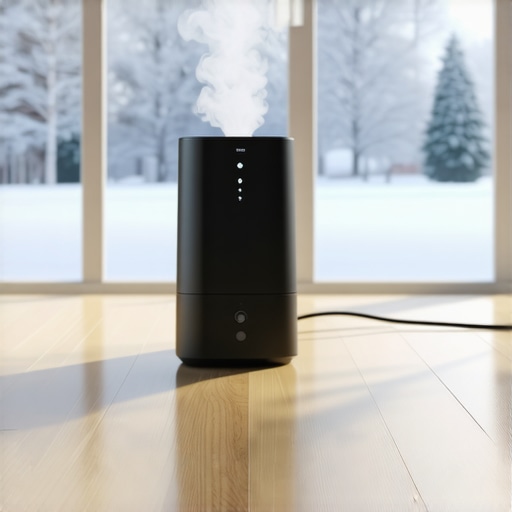
Installing a steam humidifier is the gold standard for protecting expensive hardwood floors from winter shrinkage and cracking. Unlike bypass humidifiers, steam units operate independently of the furnace and can maintain precise humidity levels even in the coldest months. This protects the wood from reaching the fiber saturation point where permanent damage occurs. You have to look at your humidifier as part of your flooring budget. If you spend twenty grand on a floor, spending two grand on a high-end steam humidifier is just insurance. It keeps the wood from checking. Checking is when the wood actually splits along the grain because the stress of drying is too intense. Once a board checks, there is no fixing it. You are looking at a full board replacement which means cutting into the floor, pulling up the tongues, and trying to glue in a new piece that will never quite match the original patina. Prevention is the only sane path.
The moisture meter is your only friend
Daily monitoring of indoor climate conditions is the only way to ensure the longevity of a hardwood floor installation. Using a hygrometer allows homeowners to adjust their humidification settings before the wood begins to show signs of stress or gapping. Early intervention prevents the mechanical stress that leads to squeaks and loose fasteners. I never go onto a job site without my Tramex or Delmhorst meter. If you own a hardwood floor, you should own a cheap digital hygrometer. Put it on a shelf. If you see it dip below thirty percent, turn up the moisture. If you see it climb above sixty percent, turn on the AC or a dehumidifier. It is that simple. You are the steward of that wood. If you ignore the environment, the environment will destroy your investment. Wood is patient, but it is also relentless. It will win every fight you pick with it.
- Check the relative humidity daily using a calibrated digital hygrometer.
- Maintain a consistent temperature between 60 and 80 degrees Fahrenheit.
- Inspect the perimeter expansion gaps to ensure they are not blocked by debris.
- Use only manufacturer-approved cleaning solutions to avoid stripping the protective oils.
- Avoid using steam mops which can force moisture into the grain and cause swelling.
- Ensure the humidifier filter is changed at the start of every heating season.
The ghost in the expansion gap
Gaps that appear in winter and disappear in summer are considered normal seasonal movement and do not indicate a failure of the product or the installer. These gaps are a sign that the wood is reacting naturally to its environment and will resolve once the humidity levels return to their baseline. Attempting to repair these gaps during the dry season will result in floor damage during the humid months. I have had clients call me in January crying about their floors. I tell them to wait until May. Usually, by the time the lilacs are blooming, those gaps have vanished like they were never there. If you try to fix a seasonal gap, you are fighting nature. You will lose. The only time to worry is if the gaps stay open in the middle of a humid July. That means the wood was never acclimated properly in the first place. Acclimation is the process of letting the wood sit in the room for two weeks so it can reach equilibrium with the house. Most builders skip this. They pull the wood off a cold truck and nail it down immediately. That is a crime. That is why floors fail. If you want a floor that lasts a century, you have to respect the clock and the chemistry. [{“@context”:”https://schema.org”,”@type”:”Article”,”headline”:”Why Your Hardwood Planks Shrink in Winter and the Humidifier Fix”,”author”:{“@type”:”Person”,”name”:”Master Floor Architect”},”datePublished”:”2023-10-27″,”description”:”Expert analysis on why hardwood floors gap in winter and how humidification prevents structural damage.”,”articleSection”:”Flooring Engineering”}]