
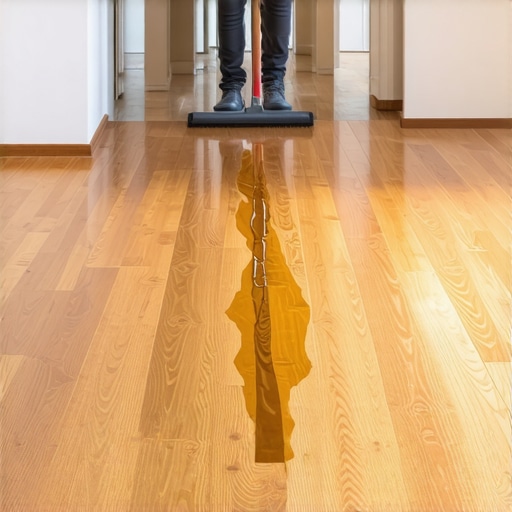
Why You Should Never Mop Your Way Out of a Room with Hardwood
The smell of damp oak is the smell of failure. Most people treat their floors like a plastic countertop, but they are wrong. I once walked into a house where a $15,000 wide-plank walnut floor was cupping so bad it looked like a potato chip because the installer didn’t check the crawlspace humidity. The homeowner was mopping it twice a week with a soaking wet bucket. She thought she was being clean. She was actually waterboarding her investment. Wood is alive. It breathes. It reacts to every molecule of H2O you drop on it. When you mop your way out of a room, you are likely leaving a trail of excessive moisture that sits in the grooves and migrates into the core. This is where the disaster starts. It is not about getting stuck in a corner. It is about the structural integrity of the cell walls within the wood fiber itself. My hands are stained with wood dye and my knees tell the story of three decades on the slab. I know what water does to wood. It is an act of war.
The physics of wood cell saturation
Wood cells act like microscopic straws that pull moisture from the surface deep into the grain through capillary action. When you apply standing water to hardwood floors, you initiate a chemical process called hygroscopic expansion. This expansion is uneven. The top of the board swells while the bottom remains dry. This creates the dreaded cup. Hardwood is a hydraulic force. It can lift walls. It can snap fasteners. You need to understand the Equilibrium Moisture Content or EMC. This is the balance point where wood neither gains nor loses moisture. Most homes should sit between 6 and 9 percent moisture content. If your mop adds enough liquid to push that to 12 percent, you are looking at a permanent structural shift. The glue bond will fail. The finish will delaminate. You will be left with a floor that clicks and groans. It will buckle. The microscopic reality of a floor is a battle against the atmosphere.
“A floor is only as good as the subfloor beneath it, deflection is the enemy of every joint.” – Master Flooring Axiom
The ghost in the expansion gap
Every professional hardwood installation requires a perimeter expansion gap of at least one half inch to allow for seasonal movement. When you mop and allow water to seep toward the baseboards, you fill that gap with liquid. This water sits. It has nowhere to go. It begins to rot the bottom of the drywall and the sill plate of your framing. I have seen entire suburban developments with mold blooming behind the shoe molding because people used too much water on their floors. The expansion gap is the lungs of your floor. If you drown it, the wood suffocates. Wood moves across the grain. A three inch wide board can move as much as an eighth of an inch between summer and winter. If you lock that board in place with moisture and dirt, it has no choice but to push. It will pop your transitions. It will crack your grout in the kitchen. It is a mechanical failure waiting to happen.
Why your subfloor is lying to you
A subfloor may look flat to the naked eye but it often contains hidden dips and ridges that trap moisture. Most guys skip the leveling compound. They think the underlayment will hide the dip. It won’t. I spent three days grinding concrete on a job last month just so the floor wouldn’t click like a castanet. If your subfloor has a dip of more than 3/16 of an inch over a ten foot span, your hardwood will flex. This flex creates a bellows effect. Every time you step on the floor, it sucks air and moisture from the environment and pumps it back out. If you mop over these areas, the water is vacuumed into the joints. This is why you see dark edges on old floors. It is not dirt. It is mold and oxidation caused by the bellows effect of an uneven subfloor. You cannot fix a bad subfloor with a mop. You fix it with a grinder and a level.
Comparative analysis of surface durability
| Material Type | Janka Hardness | Moisture Tolerance | Acclimation Time |
|---|---|---|---|
| White Oak | 1360 | Low | 7 to 14 Days |
| Brazilian Cherry | 2350 | Moderate | 14 to 21 Days |
| Engineered Maple | 1450 | High | 48 Hours |
| Luxury Vinyl Plank | N/A | Maximum | 0 to 24 Hours |
The chemistry of polyurethane and water tension
Modern floor finishes are designed to repel liquid but they are not waterproof membranes like you find in showers. Polyurethane is a plastic resin. Over time, micro-scratches from foot traffic and grit break the surface tension. When you mop, water finds these microscopic fissures. It travels under the finish. This causes cloudy spots known as blushing. You are essentially lifting the skin off the wood. The bond between the finish and the wood is chemical and mechanical. Water breaks both. Once that bond is gone, the only fix is a full sand and finish. That means thousands of dollars and sawdust in your vents for months. People think they are cleaning, but they are actually solvent stripping their own home. Use a microfiber pad and a spray bottle. Stop the bucket madness. [IMAGE_PLACEHOLDER]
Why laminate and grout are different beasts
Laminate flooring uses a fiberboard core that is essentially compressed sawdust and glue which reacts violently to moisture. While hardwood might cup, laminate will simply disintegrate. The edges will peak and the decorative paper will peel away. If you have tile in your kitchen, the grout is another story. Grout is porous. It is a cementitious product. If you mop your hardwood and then drag that dirty water onto your grout, you are dyeing your grout lines gray and brown. You are also feeding the bacteria in the shower area if the floor transitions are not sealed correctly. Every surface has a specific gravity and a specific porosity. Treating them all with the same mop is a recipe for a ruined home. You need to respect the materials.
The 1/8 inch that ruins everything
Small variances in height at transitions can lead to structural failure of the locking mechanisms in floating floors. If you mop heavily at the threshold, the water lubricates the joints. This allows for more movement than the manufacturer intended. Eventually, the tongue snaps. Now you have a floating floor that is actually sinking. I see this most in doorways. The friction of the mop head also pushes grit into these joints. It is like sandpaper in the gears of a machine. You are grinding your floor to death while trying to keep it shiny. It is an irony that costs homeowners millions every year. A floor should be dry. A floor should be stable. A floor should be respected as an engineered assembly.
- Check your moisture meter before and after any cleaning routine.
- Inspect the expansion gap for debris or signs of water staining.
- Verify that your transition strips are not pinching the floor.
- Ensure your subfloor is within the 1/8 inch tolerance.
- Avoid steam mops as the heat forced moisture deeper into the wood.
“Wood is hygroscopic; it changes dimensions depending on the moisture content of the surrounding air.” – National Wood Flooring Association
The molecular reality of adhesive failure
Many installers use water-based adhesives that can be re-emulsified if the floor is subjected to constant moisture from mopping. This means the glue turns back into liquid. Your floor is no longer attached to the house. It is just sitting there. This is especially dangerous over concrete slabs. Concrete is a sponge. It holds moisture. If you add water from the top and the slab adds moisture from the bottom, the adhesive has no chance. It turns into a sticky mess that smells like sour milk. I have pulled up floors where the glue was still wet five years after installation because of poor maintenance habits. You cannot outrun physics. You cannot mop your way to a better floor. You can only maintain what is already there through dry methods and humidity control. Keep your home between 30 and 50 percent humidity. Keep your mop in the closet. Your wood will thank you for it.