
I once walked into a house where a $15,000 wide-plank walnut floor was cupping so bad it looked like a potato chip because the installer didn’t check the crawlspace humidity. It was a disaster that started with a few marks and ended with a complete tear-out. Most homeowners freak out when they see black streaks across their oak or maple, thinking they need to bring in a drum sander. You do not. I have spent 25 years looking at floor finishes through a magnifying glass, and I can tell you that a scuff is rarely a wound. It is a deposit. It is rubber or plastic from a shoe sole that has been heat-transferred onto your topcoat. If you treat your floor like a structural asset rather than a rug, you will realize that maintaining the integrity of the polyurethane is more important than the temporary eyesore of a mark left by a sneaker.
The science of rubber transfer
Black scuff marks are superficial deposits of carbon-black rubber or plastic polymers transferred via friction-generated heat onto the surface of the floor finish. These marks do not penetrate the wood fibers. Instead, they bond mechanically to the microscopic peaks and valleys of the polyurethane or aluminum oxide coating. Removing them requires a method that breaks this bond without dissolving the protective chemical layer that keeps moisture out of the wood cells below.
The physics of friction and the tennis ball
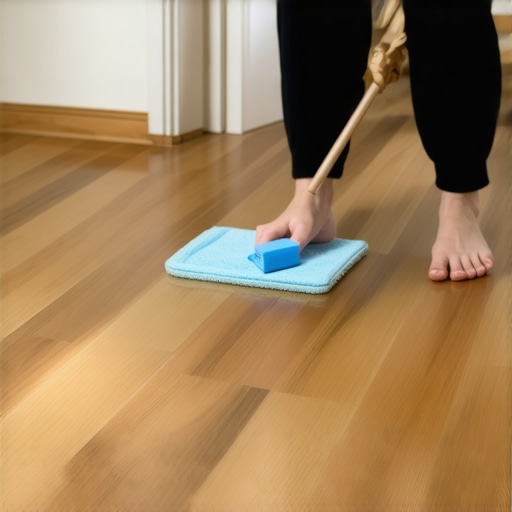
Using a tennis ball to remove scuff marks relies on the high coefficient of friction provided by the felt fibers to grab rubber residue. This method is effective because the texture of the tennis ball is more aggressive than the rubber mark but softer than the cured floor finish. By cutting a small X in the ball and placing it on the end of a broom handle, you can apply targeted pressure to the mark, lifting the carbon deposit away from the wood without bending your knees or using harsh chemicals that could cloud the finish. It is a mechanical solution to a mechanical problem.
“A floor is only as good as the subfloor beneath it; deflection is the enemy of every joint.” – Master Flooring Axiom
Chemical solvents and the danger of finish delamination
Mild solvents like isopropyl alcohol or mineral spirits can dissolve the bond of a scuff mark if the mechanical approach fails. However, you must understand the chemistry of your specific floor. A site-finished floor using a water-based polyurethane is more sensitive to certain chemicals than a factory-finished plank with a UV-cured aluminum oxide coating. Always test a small area. If the finish turns cloudy, you are dissolving the resin. Use a microfiber cloth dampened, not soaked, and rub with the grain of the wood. The goal is to solubilize the rubber without penetrating the wood pores. If moisture reaches the cellular structure of the timber, you risk localized swelling and finish failure.
Why your subfloor is lying to you
Most guys skip the leveling compound. They think the underlayment will hide the dip. It won’t. I spent three days grinding concrete on a job last month just so the floor wouldn’t click like a castanet. When a subfloor is not level, the planks deflect every time you walk on them. This movement creates micro-friction. When you scuff a floor that has significant deflection, you are often driving that rubber deeper into the finish because the wood is giving way under the pressure. A stable, rigid subfloor ensures that the finish remains a hard, non-yielding surface that resists the mechanical bonding of rubber shoe soles. If your floor feels bouncy, your scuff marks will always be harder to clean.
The 1/8 inch that ruins everything
Precision in floor maintenance is measured in fractions of an inch, specifically the thickness of the wear layer. A typical engineered hardwood might only have a 2mm or 3mm wear layer. If you use an abrasive pad like a Magic Eraser too aggressively, you are shaving microns off that wear layer. Do this enough times and you will hit the core material. Once you reach the plywood or HDF core, the floor is structurally compromised. You must use the softest possible tool for the job. A pencil eraser is often enough to lift a scuff mark because it is designed to grab graphite and carbon without tearing paper. Your floor finish is essentially the paper in this scenario.
| Wood Species | Janka Hardness Rating | Scuff Resistance Level |
|---|---|---|
| Brazilian Cherry | 2350 | Very High |
| Hickory | 1820 | High |
| White Oak | 1360 | Medium |
| Black Walnut | 1010 | Low |
| Douglas Fir | 660 | Very Low |
Regional humidity and finish brittleness
The climate in your region dictates the physical state of your floor finish. In the swampy humidity of Houston, wood expands and the finish can become slightly more compliant, sometimes allowing scuffs to embed more deeply. Conversely, in the dry heat of Phoenix, the lack of moisture can make older finishes brittle. In a dry climate, rubbing too hard on a scuff mark can cause the finish to flake or crack. This is why acclimation is not just for the wood; it is for the chemistry of the entire installation. You should always aim for a consistent indoor humidity between 30 and 50 percent to keep the finish at its peak performance level. Brittle finishes are prone to scratching, while soft, humid finishes are prone to scuffing.
“Wood is hygroscopic, meaning it constantly gains or loses moisture to stay in equilibrium with its environment.” – NWFA Technical Guidelines
The hidden cost of kitchen grease
In many homes, scuff marks are exacerbated by a thin layer of aerosolized cooking oils that settle on the floor. This grease acts as an adhesive for rubber marks. If you find that the tennis ball or eraser is just sliding over the mark, you likely have a surfactant issue. A mixture of a few drops of pH-neutral dish soap in a quart of distilled water is the only solution I trust. Avoid vinegar. The acetic acid in vinegar will eventually eat the sheen off your polyurethane, leaving the floor looking dull and lifeless. You want a cleaner that breaks the surface tension of the grease without attacking the plastic bonds of the floor coating.
Master floor maintenance checklist
- Inspect the mark to ensure it is a scuff (deposit) and not a scratch (indentation).
- Dry-rub the mark with a clean microfiber cloth to check for easy removal.
- Use a clean tennis ball on a handle for mechanical lifting of the rubber.
- Apply a small amount of specialized hardwood floor cleaner if the mark persists.
- Use a pencil eraser for precision work on stubborn spots.
- Wipe the area with a dry cloth to remove any residue from the cleaning agent.
- Check the room humidity to ensure the floor is not under environmental stress.
The ghost in the expansion gap
Many homeowners overlook the importance of the expansion gap at the perimeter of the room. If your floor is pinned against the drywall, it cannot move. This lack of movement creates internal stress in the planks. When you apply pressure to clean a scuff mark on a stressed floor, you are more likely to cause a finish fracture. A floor needs to breathe. That 1/4 inch or 1/2 inch gap hidden under your baseboards is what allows the wood to expand and contract without compromising the surface tension of the finish. If the floor is locked, the finish is always under tension, making it a magnet for permanent damage during what should be a simple cleaning process.