
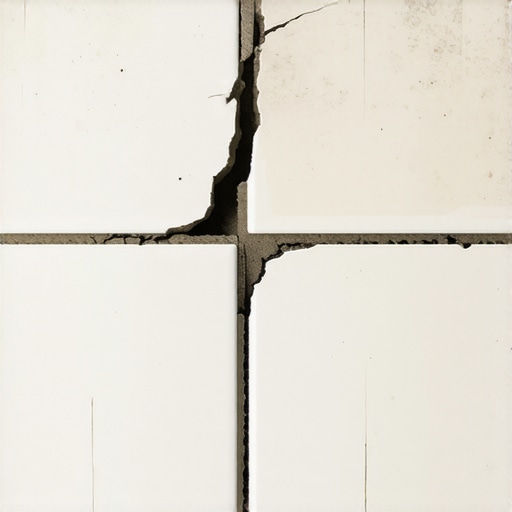
I spent three days grinding concrete on a job last month just so the floor wouldn’t click like a castanet. Most guys skip the leveling compound. They think the underlayment will hide the dip. It won’t. I have spent twenty-five years on my knees with a moisture meter and a six-foot level, and I can tell you that a straight-line crack in your tile is a crime scene. It is not an accident. It is a predictable failure of physics. When you see a crack that marches across your floor in a perfect line, ignore the tile. The tile is just the messenger. The real culprit is the substrate. I have seen fifteen thousand dollar wide-plank walnut floors cup like potato chips and porcelain tile snap because a builder wanted to save eighty bucks on a bag of self-leveler. We are going to look at the mechanics of why your floor is failing and how the structural reality of your home dictates the life of your grout and your tile.
The structural ghost in your foundation
A straight line crack in tile flooring usually indicates a reflective crack originating from the subfloor joint or a control joint in the concrete slab. When the house moves, the tile is forced to move with it. Since tile is a rigid material with zero elasticity, it snaps at the weakest point, which is always directly above the underlying seam. I call this the structural ghost. You cannot see the seam after the floor is laid, but the tile reveals exactly where the plywood sheets meet or where the concrete was cut to allow for shrinkage. If the installer did not use an uncoupling membrane, the tile is essentially glued to two different moving parts. When those parts move in opposite directions, the tile breaks. It will buckle. It will fail. Every single time. This is why the TCNA (Tile Council of North America) has strict guidelines about movement joints. You cannot simply bridge a joint and hope for the best. You are fighting the settling of the foundation and the expansion of the earth itself.
“A floor is only as good as the subfloor beneath it; deflection is the enemy of every joint.” – Master Flooring Axiom
Deflection and the physics of the snap
Deflection refers to the vertical movement of your subfloor under a load, and it is the primary reason for tile failure on wooden structures. If your joists are spaced too far apart or if your subfloor is too thin, the floor will bounce when you walk on it. Ceramic tile requires a deflection rating of L/360, while natural stone requires L/720. This means the floor should not bend more than 1/360th of its span. Most modern builder-grade homes are built to the absolute minimum code. They use laminate or carpet to hide the fact that the subfloor is flexible. When you try to put a rigid product like tile over a bouncy floor, the grout is the first thing to go. It turns into powder. Then, the tile follows. I have seen guys try to fix this by adding more screws. Screws are not enough. You need the structural stiffness of a second layer of plywood or a cementitious backer board that is properly thin-set to the subfloor. Without that bond, you are just floating a heavy rock on a sponge.
The mistake of the uncoupled membrane
An uncoupling membrane acts as a shear-stress release layer that prevents the movement of the subfloor from transferring to the tile surface. This is the technology that most discount installers skip because of the cost. Products like Ditra or various sheet membranes allow the substrate to move independently of the tile. Imagine two pieces of paper glued together. If you pull one, the other moves. Now imagine a layer of sand between them. You can move the bottom paper without the top one shifting. That is what an uncoupling membrane does at a molecular level. It creates a tiny void where horizontal movement can happen without snapping the bond of the thin-set. If your crack is perfectly straight and runs from one wall to the other, I can almost guarantee there is no membrane under there. The installer likely used a liquid-applied waterproof coating in the showers but ignored the main floor. That is a recipe for disaster in any climate with seasonal humidity shifts.
| Subfloor Material | Expansion Rate | Deflection Risk | Required Treatment |
|---|---|---|---|
| Concrete Slab | Low | Low | Control Joint Bridging |
| Plywood (CDX) | High | Medium | Underlayment Grade Plywood |
| OSB (Advantech) | Medium | High | Uncoupling Membrane |
| Joist Spacing 24″ OC | Extreme | Critical | Structural Reinforcement |
The chemistry of the bond failure
Thin-set mortar is a complex mixture of portland cement, graded sand, and polymer additives designed to create a mechanical and chemical bond. When a crack appears, it is often because the bond was too weak or the thin-set dried too quickly. If the concrete slab was too dry, it sucked the moisture out of the thin-set before the crystals could form a bridge into the pores of the tile. This is called a burnt bond. On the other hand, if the installer used a cheap, unmodified thin-set on a plywood subfloor, there was never a chance. Wood and cement do not naturally like each other. You need the polymers to act as a glue. I see this a lot in laundry rooms and showers where the moisture levels fluctuate. The wood expands as it drinks in the humidity, and the rigid cement just lets go. You end up with a hollow sound when you tap the tile. That hollow sound is the sound of a floor that is already dead.
How hardwood floors handle stress differently
Hardwood floors are organic and hygroscopic, meaning they expand and contract in response to environmental moisture. Unlike tile, which snaps, hardwood floors will cup, crown, or gap. If you have hardwood floors adjacent to a cracked tile area, look at the transition. Often, the same subfloor issues that crack tile will cause hardwood to squeak or pull away from the baseboards. I have walked into homes where the laminate was bubbling at the seams because the concrete underneath was pushing up moisture. People think laminate is a catch-all, but it is just pressed sawdust and glue. If your subfloor is uneven enough to crack a tile, it is uneven enough to break the locking mechanisms on your laminate. I always tell clients that if they want a floor that lasts fifty years, they need to stop looking at the color of the wood and start looking at the moisture content of the slab. In places like the Midwest, the winter air will shrink your boards until you can see the tongues. In the swampy humidity of Houston, solid wood is a death wish; you need engineered cores to survive the vapor pressure.
“Standard subfloor thickness of 19/32 inch is rarely sufficient for large format tile without additional reinforcement.” – TCNA Handbook Summary
The hidden danger of the kitchen island weight
Heavy cabinetry and kitchen islands can pin a floating floor or a tile assembly to the subfloor, preventing natural expansion. This is a common cause of straight-line cracks that appear near the perimeter of an island. The floor wants to move towards the walls as the temperature rises, but the three-hundred-pound granite island is holding it in place. The stress builds up until the tile snaps at the nearest weak point. This is why we leave expansion gaps under the baseboards. I have seen homeowners caulk those gaps shut because they don’t like the look. They are literally suffocating their floor. You need that 1/4 inch of space. It is the breathing room that keeps the whole system from imploding. If you are installing laminate, this is even more vital. If you lock a floating floor under an island, it will buckle in the center of the room like a mountain range.
The microscopic reality of grout failure
Grout is the weakest link in any tile installation and serves as a sacrificial indicator of structural movement. When the house shifts, the grout will crack before the tile does. If you see fine, hairline cracks in your grout lines, that is the house telling you it is moving. Many people try to fix this by digging out the grout and putting in new stuff. That is like putting a band-aid on a broken leg. The movement is still there. I recommend using a high-quality epoxy grout or a pre-mixed urethane grout in high-stress areas. These products have a tiny bit of flexibility compared to standard cement grout. However, even the best grout cannot save a floor that has a 1/8 inch dip in the subfloor. I have seen people try to use grout to level the floor as they go. That is a hack move. The grout will eventually shrink and pull away from the tile, leaving a gap for water to seep into. In showers, this leads to rot in the wall studs and a much more expensive repair down the road.
A checklist for a floor that lasts forever
- Check subfloor deflection using the L/360 formula for ceramic and L/720 for stone.
- Ensure the concrete slab is fully cured for at least 28 days before installation.
- Use a moisture barrier or an uncoupling membrane like Ditra for all plywood substrates.
- Verify that the thin-set is appropriate for the tile type and substrate material.
- Leave a minimum 1/4 inch expansion gap at all vertical obstructions and perimeters.
- Never bridge a control joint in concrete without a proper expansion joint or membrane.
- Acclimate all wood and laminate products to the room temperature for at least 72 hours.
- Grind down high spots and fill low spots in the concrete to within 1/8 inch over 10 feet.
The final verdict on straight line cracks
If you have a crack that looks like it was drawn with a ruler, you are looking at a structural seam that was not handled correctly. It will not get better on its own. You can replace the broken tiles, but if you don’t address the joint underneath, the new tiles will crack in the exact same spot within a year. The only real fix is to pull up the affected area, install a bridge or a membrane, and then relay the tile. It is a pain in the neck, and it is expensive. But it is the only way to beat the physics of a moving house. I tell my apprentices that we aren’t just laying tile; we are building a structural skin. If the skeleton is broken, the skin will tear. Stop buying the cheapest thin-set at the big-box store. Stop skipping the floor prep. Spend the extra day with the grinder and the level. Your knees and your reputation will thank you when that floor is still solid twenty years from now. A floor shouldn’t just look good when I leave. It should look good when the next guy moves in.