
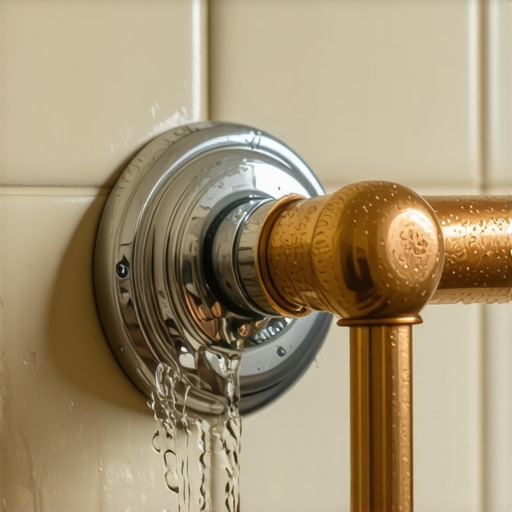
I spent three days grinding concrete on a job last month just so the floor wouldn’t click like a castanet, only to find the real disaster hiding in the adjacent bathroom. I once walked into a house where a $15,000 wide-plank walnut floor was cupping so bad it looked like a potato chip because the installer didn’t check the crawlspace humidity. But this time, it was a slow, rhythmic drip behind a shiny chrome plate. The homeowner thought the floor was just expanding. I knew better. I could smell the damp OSB from the hallway. A shower valve leaking behind the escutcheon plate is a silent assassin for your flooring. It is not just a plumbing nuisance. It is a structural engineering failure that bypasses every cosmetic defense you have installed. When that water gets behind the tile and hits the subfloor, the chemistry of your adhesives and the physics of your wood fibers change forever.
The hidden rot in your bathroom wall
A shower valve leaks behind the escutcheon plate because of failed caulking, degraded gaskets, or improper valve depth during the rough-in phase. When the seal between the metal plate and the tile surface fails, gravity pulls water directly into the wall cavity. This moisture bypasses the waterproofing membrane and saturates the stud bay, eventually pooling on the subfloor and migrating into adjacent rooms where it destroys hardwood floors and laminate. Most people think the tile is the barrier. It is not. The tile is the skin, but the seal at the valve is the joint that keeps the skeleton dry. If that joint fails, the hydrostatic pressure of your daily shower head becomes a drill that pushes water into the one place it can never dry out.
The physics of the capillary crawl
Water does not just sit in one spot. It moves through a process called capillary action. In the context of a leaking shower valve, the water travels down the vertical wood studs. If those studs are spruce, pine, or fir, they have a high porosity. The moisture content of a standard stud should be around 8 percent to 12 percent. When a leak occurs behind the escutcheon, that moisture content can spike to 30 percent or higher within days. This is where the flooring disaster starts. The water hits the bottom plate of the wall and then spreads horizontally across the subfloor. If you have 3/4 inch plywood or OSB, the wood fibers begin to swell. The resin bonds in OSB are particularly vulnerable. They are designed to be water resistant during a brief rainstorm on a job site, not for a persistent 24 hour drip. Once those resins fail, the subfloor loses its structural integrity. You will notice a soft spot in the floor before you ever see a drop of water on the bathroom tile.
“A floor is only as good as the subfloor beneath it; deflection is the enemy of every joint.” – Master Flooring Axiom
Why your grout is failing to stop the flood
Grout is essentially a rigid sponge. Even if you use a high-quality polymer-modified grout, it is still a cementitious product. It has a specific porosity that allows vapor to pass through. When water leaks behind the escutcheon plate, it saturates the thin-set mortar bed. This creates a reservoir of moisture that stays trapped between the tile and the backer board. The grout cannot breathe. Over time, the moisture causes the grout to soften and crack. If you see dark lines in your grout that do not disappear after the bathroom dries, you have a saturation problem. This is not a cleaning issue. This is a physics issue. The mineral salts in the water, known as efflorescence, will begin to migrate to the surface of the grout, leaving a white, chalky residue. This is the signal that the chemistry of your shower wall is failing from the inside out.
Hardwood floors and the moisture wick
If your bathroom is adjacent to a hallway with solid oak or walnut, that leaking valve is a ticking bomb. Hardwood is a hygroscopic material. It wants to reach an equilibrium moisture content with its environment. When the subfloor beneath the hardwood becomes saturated from a valve leak, the bottom of the wood planks absorbs that water. The cells of the wood expand. Because the top of the plank is finished with polyurethane or oil, it cannot expand at the same rate. This differential in expansion causes cupping. The edges of the boards lift up, creating a U-shape. You cannot sand this out. If you sand a cupped floor before it is bone dry, you will end up with crowning once the moisture leaves. The Janka hardness of the wood does not matter here. Whether it is Brazilian Cherry or soft Pine, the physics of cellular expansion remains the same.
| Material | Janka Hardness | Moisture Tolerance | Failure Mechanism |
|---|---|---|---|
| Solid White Oak | 1360 | Low | Cupping and Buckling |
| Engineered Oak | 1360 | Moderate | Veneer Delamination |
| Laminate | N/A | Very Low | Core Swelling |
| Luxury Vinyl Plank | N/A | High | Mold Growth Underneath |
| Porcelain Tile | N/A | High | Adhesive Shear Failure |
Laminate floors are a sponge in disguise
Many homeowners choose laminate because they think it is durable. While the wear layer is tough, the core is usually high-density fiberboard. This is essentially compressed sawdust and glue. When water from a leaking shower valve travels under the baseboards and hits the edge of a laminate plank, the fiberboard acts like a wick. It can expand up to 25 percent of its original thickness. Once a laminate core has puffed up, it is done. There is no recovery. The locking mechanisms, those delicate tongues and grooves, will snap under the pressure of the expansion. This is why I tell people to never trust the word waterproof on a box of laminate. The surface might be waterproof, but the system is not. A leak behind a valve will find the one vulnerable spot in a laminate floor, the perimeter expansion gap, and ruin the entire installation.
The 1/8 inch that ruins everything
In the world of tile and flooring, 1/8 of an inch is the difference between a professional job and a failure. When a plumber sets the rough-in valve, they often don’t account for the thickness of the tile and the backer board. If the valve is set too deep, the escutcheon plate will not sit flush. This creates a gap. Some installers try to fill this gap with an entire tube of caulk. This is a mistake. Caulk is a seal, not a structural filler. Over time, the caulk will shrink and pull away from the tile. Water then runs down the wall, hits that 1/8 inch gap, and disappears behind the plate. You need a solid gasket and a bead of high-quality silicone around the top three-quarters of the plate. You must leave the bottom open so that if a leak does occur, the water has a way to exit onto the floor where you can see it, rather than being trapped in the wall.
- Check the perimeter of the escutcheon for cracked or missing caulk.
- Inspect the grout lines directly below the valve for discoloration or softening.
- Look for cupping in wood floors in the rooms sharing a wall with the shower.
- Verify that the valve handle has a functioning rubber gasket behind it.
- Test the subfloor for deflection or bounciness near the bathroom entrance.
The chemical reality of modified thin-set
Thin-set mortar is not a waterproof barrier. It is an adhesive designed to provide shear strength. When it is constantly exposed to water from a leaking valve, the chemical bonds can begin to weaken. Most modern thin-sets are polymer-modified, meaning they have latex or acrylic additives to increase flexibility and bond strength. However, these polymers can re-emulsify if they are submerged in water for extended periods. This leads to a total bond failure. If you can pop a tile off the wall with a putty knife and the thin-set is wet and crumbly, the leak has been happening for months. This moisture doesn’t just stay in the mortar. It moves into the wall studs and down to the floor joists, inviting carpenter ants and termites who love wet, softened wood.
Summary of structural findings
You have to treat the shower valve as a primary penetration point in a structural envelope. If you ignore a leak behind the escutcheon, you are choosing to replace your floors in two years. The cost of a tube of silicone and a new gasket is nothing compared to the cost of pulling up 500 square feet of hardwood. Use your moisture meter. Check the walls. Do not let a chrome plate hide a disaster that is eating your home from the inside out. Flooring is a performance surface, and that performance depends entirely on keeping the subfloor dry. Stop the water at the source before the physics of expansion takes over and ruins your investment.