
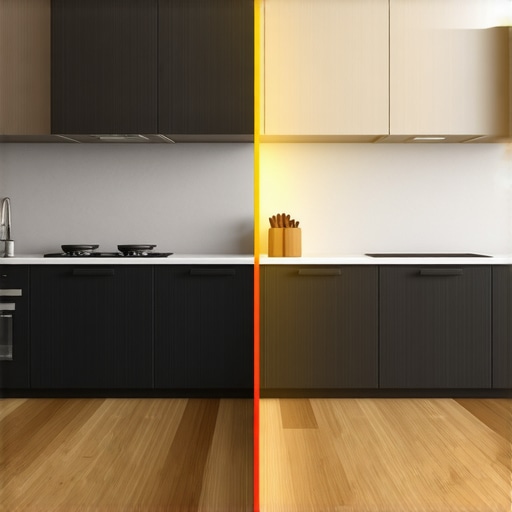
Choosing a kitchen floor requires a shift in perspective from aesthetics to structural engineering. For years, the industry pushed solid hardwood as the gold standard for every room, but the physics of a kitchen environment often contradict the biological reality of timber. We finally made the switch to high-end laminate, not because we wanted a cheaper option, but because we needed a surface that could survive the mechanical and chemical stresses of a modern cooking space. This was a decision driven by moisture vapor transmission rates and the sheer durability of resin-infused wear layers.
The kitchen island mistake that kills floors
Homeowners always ask why their waterproof vinyl or laminate is buckling in the center of the room. Usually, it is because they locked the floor under a heavy kitchen island, killing the floor’s ability to breathe and move. I once walked into a house where a $15,000 wide-plank walnut floor was cupping so bad it looked like a potato chip because the installer didn’t check the crawlspace humidity and then pinned the planks under a massive granite island. A floating floor is a dynamic system. It expands and contracts with the changing seasons. When you place a 600-pound cabinet on top of a floating laminate or hardwood system, you create a fixed point. When the rest of the floor tries to move, that fixed point causes the locking mechanisms to shear or the boards to peak. In our kitchen, we learned to install the cabinets first and float the laminate around them, using proper transition strips hidden under the toe kicks to allow for the natural physics of expansion.
Why cellulose structure makes hardwood a kitchen liability
Hardwood is a hygroscopic material that naturally attracts and retains water molecules within its cellular walls. In a kitchen, where humidity fluctuates between boiling pots and open dishwashers, hardwood cells expand unevenly, leading to permanent structural damage. If you look at wood under a microscope, you see a series of long, hollow tubes called tracheids and vessels. These tubes move water in a living tree. Even after the tree is milled into a 3/4 inch plank, those tubes remain active. When your dishwasher leaks even a few ounces of water, those cellulose fibers drink the liquid. This causes the bottom of the board to expand faster than the top, a phenomenon known as cupping. In our kitchen, the constant battle with grout lines in tile or the fragility of wood became a maintenance nightmare. High-end laminate replaces this organic vulnerability with a high-density fiberboard core that is saturated with wax and resins, making it nearly inert to the moisture spikes common in a cooking environment.
The engineering inside a modern laminate plank
High-end laminate is an engineered composite consisting of a wear layer, a decorative image, a high-density fiberboard core, and a balancing backing. The wear layer usually contains aluminum oxide, one of the hardest minerals on earth, to resist scratching. We opted for a 12mm thick plank because the vertical stability of the locking joint is directly proportional to the thickness of the core. When you walk on a thin 7mm or 8mm laminate, the joint flexes. Over 10,000 footfalls, that micro-flexing leads to structural fatigue and eventually the tongue snaps off the groove. By choosing a 12mm product with an AC5 rating, we ensured the floor could handle the impact of a dropped cast-iron skillet. The chemistry of the melamine resin used to bond these layers is what creates the waterproof barrier. This is not the cheap, papery laminate of the 1990s. This is a multi-layered defense system designed to withstand the hydrostatic pressure of a standing spill.
“A floor is only as good as the subfloor beneath it; deflection is the enemy of every joint.” – Master Flooring Axiom
The 1/8 inch that ruins everything
Subfloor flatness is the most overlooked aspect of flooring installation, yet it is the primary cause of clicking and joint failure. Most manufacturers require a floor to be flat within 1/8 inch over a 10-foot radius. Most guys skip the leveling compound. They think the underlayment will hide the dip. It won’t. I spent three days grinding concrete on a job last month just so the floor wouldn’t click like a castanet. If there is a hollow spot under your laminate, the joint will act like a hinge every time you step on it. This constant movement eventually wears down the locking profile until the gap opens up. Once the gap opens, water gets in, and the HDF core swells. We spent nearly as much time on floor prep as we did on the installation. We used a self-leveling underlayment to fill the birdbaths in the concrete slab, ensuring that every square inch of our new laminate was supported by a solid, flat plane.
Comparing surface durability and impact resistance
| Metric | Solid White Oak | High-End Laminate (AC5) |
|---|---|---|
| Janka Hardness | 1,360 lbf | N/A (Surface Hardness) |
| Moisture Resistance | Low (Natural Fiber) | High (Resin Infused) |
| Installation Type | Nail/Glue | Floating Click-Lock |
| Kitchen Suitability | Poor | Excellent |
The ghost in the expansion gap
An expansion gap is a mandatory 3/8 inch space left around the perimeter of the room to allow the floor to move without hitting the walls. Without this gap, the floor will tent and buckle as it reacts to humidity. People hate the look of quarter-round molding, but it is a vital engineering requirement. In our kitchen, we undercut the door jambs and the baseboards to hide this gap, giving the appearance of a floor that runs right to the edge while still providing the room it needs to breathe. We also accounted for the regional climate. In the humid summers of the South, the air is thick with moisture. In the dry winters of the North, the heat runs constantly. These shifts cause the floor to grow and shrink. If you don’t provide that ghost space at the edge, the internal pressure of the floor will eventually find a weak point and create a visible peak in the middle of your kitchen.
Managing the vapor pressure from your concrete slab
Concrete slabs are porous and constantly emit moisture vapor, even years after they have been poured. A 6-mil poly vapor barrier is the minimum requirement to prevent this vapor from reaching the underside of your floor. We performed a calcium chloride test on our slab before installation. This test measures the weight of water vapor being released from the concrete. If the rate is too high, the moisture will collect under the laminate and create a breeding ground for mold. We used a premium underlayment that combined sound-dampening foam with a vapor barrier. This dual-purpose layer prevents the clicky sound often associated with laminate while shielding the core from the relentless upward pressure of ground moisture. This is especially vital in kitchens where the slab is often near plumbing lines that can further increase the local humidity of the subfloor.
The myth of the waterproof label
A waterproof label on a box of laminate refers to the surface’s ability to repel liquid, not the ability of the subfloor to handle a flood. No floating floor is truly waterproof if water reaches the expansion gaps at the perimeter. We must be honest about what waterproof means. It means you have a window of time, perhaps 24 to 72 hours, to clean up a spill before the liquid penetrates the joints. If your refrigerator waterline bursts while you are on vacation, no laminate or hardwood will survive. However, for the daily reality of ice cubes melting on the floor or a spilled pot of pasta water, high-end laminate offers a level of security that hardwood simply cannot match. We treated every joint with a seam sealer during installation to add an extra layer of protection, creating a hydrophobic barrier that keeps the water on top of the melamine wear layer where it belongs.
“Wood flooring must be acclimated to the environment in which it will live; skip this step and you invite disaster.” – NWFA Standard Guidelines
- Acclimate planks for 48 to 72 hours in the kitchen.
- Test subfloor for moisture content using a pin-less meter.
- Ensure subfloor flatness to 1/8 inch over a 10 foot radius.
- Leave a mandatory 3/8 inch expansion gap at all walls.
- Use a high-quality 2mm underlayment with an attached vapor barrier.
- Undercut door jambs to allow for movement.
- Do not install heavy cabinetry on top of the floating planks.
The final verdict on the kitchen plane
The transition from hardwood to laminate was not a downgrade in quality, but an upgrade in performance. By understanding the molecular structure of the materials and the physics of the installation, we created a kitchen floor that looks like natural oak but performs like an industrial surface. The key was the technical precision of the prep work. We addressed the vapor pressure from the slab, the flatness of the subfloor, and the mechanical requirements of the expansion gaps. The result is a floor that doesn’t creak, doesn’t cup, and can handle the heavy traffic of a busy home. For anyone considering this swap, focus on the AC rating and the core thickness. Those are the metrics that will determine if your floor lasts twenty years or five. In the end, the kitchen is a workspace, and its floor should be built with the same engineering rigor as the appliances that sit upon it.