
The subfloor secret that ruins luxury installations
I spent three days grinding concrete on a job last month just so the floor wouldn’t click like a castanet. Most guys skip the leveling compound and they think the underlayment will hide the dip. It won’t. I was looking at a high-end laminate job where the previous installer had just slapped the boards over old, crumbly multi-purpose adhesive. Within six months, the friction between the new underlayment and the old ridges created a constant, maddening squeak. Every step sounded like a door hinge in a horror movie. The homeowner was furious. I had to tear up $8,000 worth of material just to get back to the concrete. That is the reality of subfloor prep. If you do not respect the slab, the slab will destroy your finish floor. Removing adhesive is not just about aesthetics. It is about the structural integrity of the bond. Whether you are prepping for hardwood floors or high-end tile in showers, the substrate must be clean, dry, and flat. You are not just cleaning a floor. You are engineering a foundation. This requires an understanding of the chemistry of the bond and the physics of the removal process. Do not expect a quick fix. Expect a battle against decades of hardened petroleum resins and synthetic latex.
The concrete bond that refuses to die
Old adhesives are more than just sticky residue. They are chemical compounds that have leached into the pores of the concrete slab over decades. When you look at a concrete surface, it looks solid. Under a microscope, it is a series of peaks and valleys. Adhesives like old black cutback or yellow carpet glue fill these valleys. If you leave them there, they act as a bond breaker for your new thin-set or pressure-sensitive glue. Most homeowners want to rush into the pretty part of the job. They want to see the hardwood floors or the laminate clicking together. That is a mistake. You must understand the capillary action of the concrete. If the old adhesive is not removed, moisture rising from the slab can react with the old residue. This creates a chemical soup that can bubble up and delaminate your new floor. It can also cause odors that will haunt the house for years. This is why we focus on the molecular level of the slab. We are looking for a CSP (Concrete Surface Profile) of 1 or 2 for most applications. This means the concrete should feel like 100-grit sandpaper. If it feels like smooth glass or a sticky mess, you are not ready for the next step.
“A floor is only as good as the subfloor beneath it; deflection is the enemy of every joint.” – Master Flooring Axiom
The chemistry of old school black mastic
If you find black, tar-like substance under old tile, you are likely dealing with cutback adhesive. This stuff is a relic from an era where we did not care about indoor air quality. Before 1984, many of these adhesives contained asbestos fibers for reinforcement. You do not just go in there with a scraper and start flinging dust. You must be smart. Asbestos is only dangerous when it is friable, meaning it is airborne. Mechanical grinding is the worst thing you can do to black mastic unless you have a high-end HEPA vacuum system and a death wish. The chemistry of cutback is based on asphalt and petroleum. It is hydrophobic. It resists water, which is why it was so popular in basements and wet areas. However, modern modified thin-sets will not stick to it. If you try to thin-set over it, the bond will fail. You have two choices. You can chemically remove it using a soy-based stripper that liquefies the asphalt, or you can use a specialized primer designed to bridge the gap. But even with a primer, you need to remove the high spots. You need to get the floor flat to within 1/8 inch over a 10-foot radius. That is the industry standard. Anything less is just lazy.
Mechanical vs chemical removal strategies
Choosing your weapon is the most important part of the process. Mechanical removal involves physical force. We are talking about floor scrapers, chipping hammers, and diamond grinders. This is the fastest way to get to bare concrete. However, it creates an incredible amount of dust. This dust is not just dirt. It is crystalline silica. If you breathe that in, it stays in your lungs forever. You need a vacuum that can keep up with the grinder. Chemical removal is different. It uses solvents to break the molecular bonds of the adhesive. It is quieter and dust-free. But it is messy. You end up with a slurry of toxic goo that you have to scrape up and dispose of. Also, chemicals can soak into the concrete. If you do not neutralize the floor after using a stripper, the new adhesive might react with the residue and fail to cure. This is a common point of failure in luxury vinyl plank installations. People use a citrus stripper, don’t wash the floor properly, and then wonder why their $5.00 per square foot LVP is sliding around. It is a chemical reaction that you could have avoided with a simple water and vinegar wash. Surface prep is about the details that no one sees but everyone feels.
| Method | Speed | Dust Level | Substrate Damage | Best Use Case |
|---|---|---|---|---|
| Hand Scraping | Very Slow | Low | Low | Small patches of carpet glue |
| Diamond Grinding | Fast | High | Moderate | Large areas of hardened thin-set |
| Soy-Based Strippers | Moderate | Zero | Low | Black mastic and petroleum glues |
| Floor Scraper Machine | Fast | Low | Moderate | VCT tile and thick foam backing |
The hidden dangers of crystalline silica dust
When you grind a concrete subfloor to remove adhesive, you are creating a cloud of microscopic glass shards. That is what silica is. It is the primary component of sand and concrete. OSHA has strict rules about this for a reason. You cannot just wear a paper mask from the hardware store. You need a P100 respirator. You need to seal off the HVAC vents. You need to put the room under negative pressure. I have seen guys ruin entire houses by grinding for ten minutes without a vacuum. The dust gets into the ductwork. It gets into the carpets in other rooms. It ruins the bearings in the refrigerator fan. It is a disaster. If you are doing this yourself, rent a professional vacuum with a pulse-cleaning HEPA filter. These machines are designed to shake the filters every 30 seconds to keep the suction high. A standard shop vac will clog in three minutes. Once the filter clogs, the dust goes right out the exhaust and into your lungs. It is not worth it. The goal is to remove the adhesive while preserving the air quality of the home. Professionalism is measured by how much mess you leave behind. A clean job site is the mark of an installer who actually knows what they are doing.
“Substrate preparation is the most critical and often the most overlooked part of any flooring installation.” – TCNA Handbook
Equipment that separates the pros from the amateurs
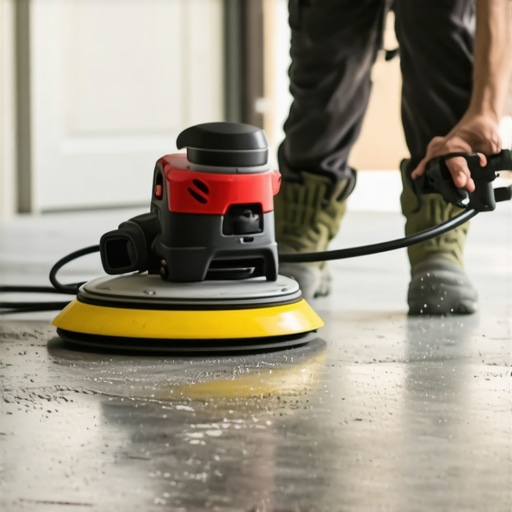
If you think a handheld 4-inch grinder is going to clear 500 square feet of old glue, you are in for a long week. You need the right tool for the scale of the job. For large residential spaces, a walk-behind floor maintainer with a Diamabrush attachment is the industry secret. These attachments have replaceable diamond segments that are designed to chew through gummy adhesives without clogging. If the glue gets hot, it melts. If it melts, it smears. A standard grinding stone will just get coated in black gunk and stop working. The Diamabrush uses a series of blades that stay cool. For corners and edges, you use a 7-inch angle grinder with a dust shroud. The shroud is non-negotiable. It connects to the vacuum and captures 95 percent of the particles. You also need a heavy-duty floor scraper with a long handle. Sometimes the best way to start is the old-fashioned way. Get the bulk of the material up with a razor-sharp blade before you ever touch a diamond tool. It saves your expensive bits and reduces the total amount of dust. This is about efficiency and cost-effectiveness. You are managing your overhead while ensuring a perfect surface for the new grout or hardwood floors.
The final prep for a flawless installation
Once the adhesive is gone, you are still not finished. You have to check the moisture content of the slab. Concrete is a sponge. It holds water. If you just stripped the floor using a wet method, the slab is saturated. You need to let it dry. Use a moisture meter. For hardwood floors, the difference between the subfloor and the wood should be no more than 4 percent for strip flooring. If the slab is over 3 pounds of moisture vapor emission, you need a moisture barrier. Then there is the flatness. Get a 10-foot straight edge. Any dip deeper than 3/16 of an inch needs a high-compression self-leveling compound. Do not use the cheap stuff. Use a cementitious leveler with a primer. If you skip the primer, the concrete will suck the water out of the leveler too fast and it will crack. This is the structural zooming I am talking about. It is a sequence of events where each step relies on the one before it. Remove the glue. Clean the dust. Prime the surface. Level the dips. Only then can you start thinking about the finish material. That is how you build a floor that lasts 50 years instead of five.
Checklist for a successful adhesive removal project
- Test for asbestos if the house was built before 1984.
- Select the removal method based on the adhesive type and scale.
- Seal off the work area with 6-mil plastic sheeting.
- Ensure you have a HEPA-rated vacuum system for all mechanical grinding.
- Remove the bulk of the material with a heavy-duty floor scraper.
- Grind or chemically strip the remaining residue to reach bare concrete.
- Wash and neutralize the floor if chemical strippers were used.
- Verify floor flatness and moisture levels before proceeding.