
The myth of the waterproof floor and the reality of HDF
Laminate flooring bubbling occurs when liquid penetrates the high-density fiberboard (HDF) core, causing the compressed wood fibers to expand through capillary action and structural swelling. Most homeowners believe that the melamine wear layer provides an impenetrable shield. This is a dangerous misconception. While the top surface is non-porous, the joints where planks meet are the Achilles heel of the entire system. I have spent twenty-five years on my knees inspecting failures, and I can tell you that a single cup of spilled water can ruin a thousand-square-foot installation if it reaches the raw core. Homeowners always ask why their ‘waterproof’ vinyl or laminate is buckling. Usually, it is because they locked it under a heavy kitchen island, killing the floor’s ability to breathe and move when moisture introduces dimensional changes. I once saw a beautiful gray oak laminate job in a kitchen where the owner had installed a heavy granite-topped island directly over the floating floor. A small leak from the dishwasher occurred, and because the floor was pinned down by the island, the expanding boards had nowhere to go but up. The floor looked like a rolling wave within forty-eight hours because the physical laws of expansion were ignored. You cannot fight physics with a pretty finish. If you have a spill, you have a ticking clock before the urea-formaldehyde resins in the core start to lose their grip on the wood fibers.
The physics of the saturated joint
Surface tension and hydrostatic pressure are the primary drivers of laminate damage after a liquid event. When water sits on a seam, gravity is not the only force at work. The narrow gap between the tongue and the groove acts as a capillary tube. This draws the liquid deep into the joint where it encounters the unprotected edges of the HDF. Once the liquid makes contact with the lignocellulosic fibers, the hydrogen bonds within the wood cells begin to attract the water molecules. This process, known as adsorption, causes the cell walls to thicken and the entire plank to increase in volume. This is why you see the edges rise first, a phenomenon we call peaking. The core is literally growing larger than the space allocated for it. Unlike solid hardwood, which might eventually dry out and return to a somewhat flat state, laminate is a composite. Once the resins have been pushed apart by the swelling fibers, they rarely return to their original compressed state. This is why immediate intervention is not just a suggestion, it is a structural necessity.
“A floor is only as good as the subfloor beneath it; deflection is the enemy of every joint.” – Master Flooring Axiom
The chemistry of the core expansion
HDF core stability is dependent on the ratio of resin to wood fiber and the pressure used during the manufacturing process. Most mid-grade laminates use a urea-formaldehyde binder. This binder is water-resistant to a point, but it is not waterproof. If the liquid is acidic, like orange juice, or contains soap, the surface tension is lowered, allowing the liquid to penetrate even faster. The mil-thickness of the wear layer does nothing to protect the joint. I have seen 12mm thick premium planks fail just as fast as 7mm discount boards because the tongue and groove profiles were not waxed or treated with a hydrophobic coating during production. When you are dealing with a spill, you are fighting the hygroscopic nature of the material. The wood fibers want the water. Your job is to make the environment so dry that the water is forced back out before the cellular walls of the wood fiber rupture.
Immediate response protocols for liquid disasters
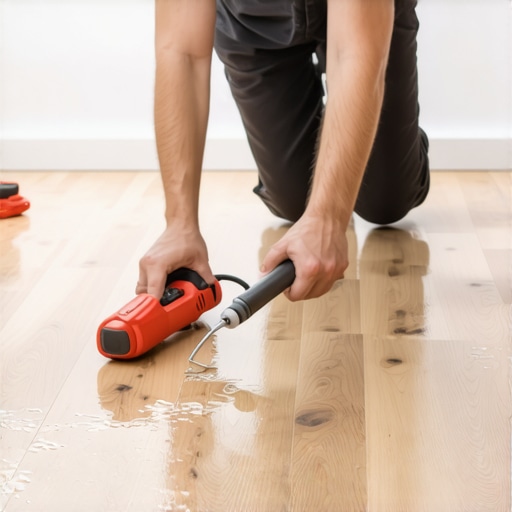
Moisture extraction must begin within seconds of the spill to prevent the liquid from migrating into the underlayment. If the water reaches the padding beneath the planks, you are no longer dealing with a surface spill; you are dealing with a reservoir. This reservoir will feed moisture into the bottom of the planks for days, ensuring a total failure. Use a high-suction wet-dry vacuum directly on the seams. Do not just wipe the floor with a towel. A towel only addresses the surface. A vacuum creates a pressure differential that can pull moisture out of the tight tolerances of the click-lock mechanism. After vacuuming, use a desiccant or a high-velocity air mover. You want to drop the local relative humidity to below thirty percent to encourage rapid evaporation. Never use a heat gun or a hair dryer on high heat, as this can cause the melamine wear layer to delaminate from the core, trading one problem for an even worse one.
| Material Type | Swell Rate (24h immersion) | Acclimation Time | Recovery Potential |
|---|---|---|---|
| Standard HDF Laminate | 12-18 percent | 48-72 hours | Low |
| Water-Resistant Laminate | <5 percent | 24-48 hours | Moderate |
| Engineered Wood (Plywood Core) | <8 percent | 72 hours | High |
| Solid White Oak | Variable | 7-14 days | High (if sanded) |
The hidden danger of the subfloor reservoir
Subfloor moisture is often the silent killer that exacerbates a surface spill. If you are on a concrete slab, the concrete itself is a sponge. When you spill water and it leaks through the seams, it hits the vapor barrier or the concrete. If your installer skipped the six-mil poly film, that water is now trapped between the laminate and the slab. This creates a microclimate of one hundred percent humidity. Even if you dry the top of the floor, the bottom of the planks will continue to soak up the trapped water. I have walked into jobs where the homeowner thought they saved the floor, only to find mold growing in the tongue and groove three weeks later. This is why I always carry a non-invasive moisture meter. If I see a reading above twelve percent on a laminate plank, I know the core is compromised. If the subfloor is plywood, the water can cause the subfloor itself to delaminate, leading to a structural instability that will make the floor squeak and click for the rest of its life.
Steps to salvage a bubbling plank
- Immediately extract all standing liquid with a high-powered vacuum.
- Apply heavy weight to the bubbling seam using sandbags or weights to attempt to compress the fibers as they dry.
- Set up a dehumidifier in the room and set it to its lowest possible setting.
- Remove the baseboards near the spill to allow the expansion gap to breathe.
- If the bubbling persists after forty-eight hours, the plank must be replaced.
The problem with the expansion gap
Perimeter expansion gaps are not optional. A floor needs a minimum of one-quarter inch, and preferably three-eighths of an inch, of space at every vertical obstruction. When a spill causes the boards to swell, they expand in width and length. If the floor is tight against a wall or a door jamb, the force of the expansion has nowhere to go. This causes buckling and tenting. I have seen entire floors lift off the subfloor because the installer didn’t leave a gap at the drywall. It is a common mistake made by DIYers who think the baseboard will not cover the gap. If your floor has bubbled and stayed up, it might be because it is gasping for air at the edges. You can sometimes save a floor by pulling the baseboards and cutting back the edges of the planks with a undercut saw to give the floor room to relax back down. It is a surgical move, but it works when the damage is marginal.
“Deflection is the silent killer of the click-lock joint; if the subfloor moves, the floor fails.” – NWFA Technical Guide
The reality of board replacement
Individual plank replacement is the final resort when the HDF core has reached the point of no return. If the bubbling has hardened and the edge of the plank is brittle, the internal structure is gone. You cannot sand laminate. You cannot wood-fill it back to its original state. You have to perform a plank surgery. This involves cutting out the center of the damaged board, carefully removing the remaining tongue and groove sections without damaging the surrounding healthy boards, and gluing in a new plank with the tongue removed. It is a tedious process that requires a steady hand and a sharp chisel. If you do not have extra boxes of the original production run, you are out of luck. Batch variation means that a box of the ‘same’ floor bought two years later will likely not match in color or locking profile. This is why I tell every client to buy ten percent extra and store it in a climate-controlled closet, not the garage.
Advanced drying techniques for the professional
Hygroscopic equilibrium is the goal. Professionals use axial fans and LGR (Low Grain Refrigerant) dehumidifiers to pull moisture out of the air and the material. If the spill was significant, we sometimes use moisture mapping to track the movement of the liquid beneath the surface. Infrared cameras can show the cooling effect of evaporating water, pinpointing exactly where the moisture is trapped under the planks. If you see a dark blue spot on the thermal image, you know there is liquid under that section of the floor. This precision allows us to focus the drying efforts or determine exactly which boards are beyond saving. The science of drying has come a long way from just opening a window and hoping for the best. We are now managing the vapor pressure of the environment to pull water out of a material that was designed to hold onto it.
Final structural considerations
Stopping a floor from bubbling after a spill is a race against the clock and the physics of wood fiber expansion. If you act within the first thirty minutes, your chances of success are high. If you wait until the next morning, you are likely looking at a replacement job. The key is to understand that the floor is a living, breathing system of wood and resin. It reacts to its environment. If you treat it with the respect its engineering requires, it will last. If you ignore the signs of moisture, the floor will eventually fail, starting at the microscopic level of the HDF fiber and ending with a ruined aesthetic in your home. Always maintain a stable indoor environment with a relative humidity between thirty-five and fifty-five percent. This minimizes the stress on the joints and gives you a buffer when the inevitable spill occurs. Flooring is not just something you walk on; it is a complex assembly that requires careful management of the air and the subfloor it sits upon.