
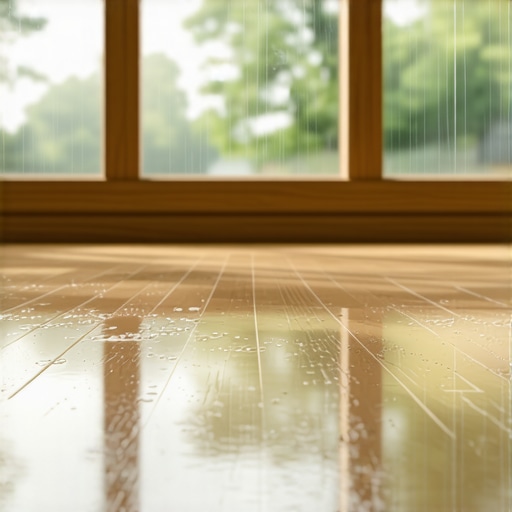
I once walked into a house where a $15,000 wide-plank walnut floor was cupping so bad it looked like a potato chip because the installer didn’t check the crawlspace humidity. The homeowner was crying while the contractor was already out of state. It was a disaster that could have been avoided with a simple moisture meter and five minutes of patience. This is the reality of hardwood. It is a living, breathing material that reacts to its environment with structural violence when ignored. Most people think a floor is just a decorative choice. They are wrong. It is a structural engineering challenge that begins in the soil beneath your home and ends in the air inside your living room.
The physics of the upward arc
Hardwood cupping occurs when the moisture content at the bottom of the plank exceeds the moisture content at the top. This hydrostatic imbalance causes the wood fibers to swell at the base, forcing the edges to rise above the center, creating a concave profile across the board width. It is a simple matter of cellular expansion. When wood cells drink water, they grow. If the bottom of the board is sitting on a damp subfloor or over a humid crawlspace, those cells expand while the top cells, exposed to the dry air of the home, remain stable or even shrink. The result is a mechanical pull that bends the board. It does not matter how many nails you used. It does not matter how much glue you spread. The force of expanding wood cells can shear through metal and crack concrete. It is relentless.
“A floor is only as good as the subfloor beneath it; deflection is the enemy of every joint.” – Master Flooring Axiom
The cellular betrayal of white oak
White oak and red oak are the most common victims of post-rain cupping because of their porous structure. These species contain vessels and tracheids that act like straws, pulling ambient moisture deep into the core of the wood through capillary action during periods of high humidity. When the rain falls, the ground saturation increases. This water does not stay in the yard. It migrates. It moves toward the low pressure area under your house. If you have a concrete slab, the water moves through the pores of the concrete in a process called moisture vapor transmission. If you have a crawlspace, the damp earth releases water vapor into the air. This vapor rises. It hits the underside of your subfloor. It passes through the plywood. Finally, it reaches the bottom of your expensive hardwood. The wood reacts. It has no choice. It is a biological imperative to expand.
Subfloors that act like sponges
Subfloor preparation requires a calcium chloride test or in-situ RH probes to ensure the moisture vapor emission rate is below three pounds per 1,000 square feet. If your installer skipped this step, they failed you. Most guys think the black paper or the thin plastic underlayment is a magical shield. It isn’t. A 15-pound felt paper is a vapor retarder, not a vapor barrier. It slows the movement of water, but it does not stop it. In a heavy rain event, the volume of moisture can overwhelm these basic layers. You need to understand the difference between Class I, II, and III vapor retarders. A Class I retarder like 6-mil polyethylene is almost impermeable. If that wasn’t installed over the dirt in your crawlspace or under your slab, you are living on a ticking time bomb. The first big storm just happens to be the fuse.
| Wood Species | Janka Hardness | Dimensional Stability |
|---|---|---|
| White Oak | 1360 | Average |
| Black Walnut | 1010 | High |
| Brazilian Cherry | 2350 | Low |
| Hickory | 1820 | Very Low |
The myth of the waterproof finish
Urethane finishes and aluminum oxide coatings provide surface protection against spills and foot traffic, but they cannot stop vapor pressure from the underside of the plank. Many homeowners believe that because they bought a high-end prefinished floor, it is immune to water. This is a dangerous lie. The finish is only on the top and the sides of the tongue and groove. The bottom of the board is usually raw wood. This creates an asymmetrical barrier. Water cannot escape through the top because of the finish, so it stays trapped in the cells of the wood. This is why cupping is often permanent if not addressed immediately. You are effectively creating a greenhouse inside the wood plank. The moisture goes in the bottom and gets stuck under the finish. You cannot dry it out with a fan. You have to fix the source.
“Wood is a hygroscopic material, meaning it constantly gains or loses moisture to reach equilibrium with its environment.” – NWFA Technical Manual
The 1/8 inch that ruins everything
Expansion gaps must be maintained at every vertical obstruction to allow the floor system to move without binding or buckling. If your installer ran the wood tight against the baseboards or the drywall, the floor has nowhere to go when it expands. When the rain increases the humidity, the wood grows. If it hits a wall, it will push back. This creates compression set. The edges of the boards crush each other. Even when the floor dries out later, those crushed edges will leave gaps. It is a permanent deformity. You need a minimum of 1/2 inch to 3/4 inch of space around the perimeter. This is why we use baseboards and shoe molding. They are not just for looks. They are there to hide the gap that allows your floor to live. If you see your floor lifting in the middle of the room after a rain, it is likely because it has run out of room at the walls.
The regional climate reality
High humidity regions like the Gulf Coast or the Pacific Northwest require engineered hardwood rather than solid wood to resist seasonal cupping. Solid wood is a single piece of timber. When it gets wet, it moves in one direction. Engineered wood is built in layers with the grain running in opposite directions. This cross-ply construction creates mechanical resistance. When one layer wants to expand, the other layer holds it back. It is much more stable. If you live in a place where it rains for three weeks straight every autumn, installing a five-inch wide solid oak plank is asking for trouble. You are fighting physics. You will lose. You need to choose a product that matches your environment. Do not buy a floor based on a photo in a magazine. Buy it based on the moisture profile of your zip code.
The moisture inspection checklist
- Check crawlspace for standing water or damp soil surfaces.
- Measure relative humidity levels inside the home to ensure they are between 30 and 50 percent.
- Verify HVAC operation and ensure the condensate drain is not leaking near the foundation.
- Inspect perimeter expansion gaps by removing a piece of baseboard.
- Use a pin-style moisture meter to check the difference between the top and bottom of the wood.
The chemistry of the bond
Adhesive selection for direct-glue installations requires a moisture-cured urethane with built-in vapor suppression properties. If you are gluing wood to concrete, the glue is your last line of defense. Cheap adhesives are water-based. They introduce moisture into the wood the moment you spread them. That is insanity. You want a high-solids urethane that creates a waterproof membrane. These adhesives are expensive. They can cost three times as much as the cheap stuff. But they are the only thing standing between your walnut floor and the wet concrete. If your installer used a bucket of glue that cost forty dollars, he just ruined your floor. Good glue costs a hundred and fifty dollars or more per bucket. It is an insurance policy in liquid form. It has the shear strength to hold the wood down even when it wants to curl. It stays flexible for decades. It is the silent hero of a quality installation.