
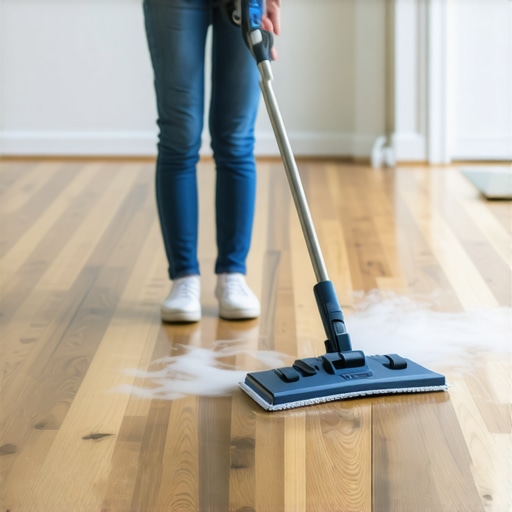
I have spent twenty five years with sawdust under my nails and a moisture meter in my pocket, and I have seen the same tragedy repeat itself hundreds of times. I once walked into a house where a $15,000 wide-plank walnut floor was cupping so bad it looked like a potato chip because the installer did not check the crawlspace humidity, and the homeowner had been trying to fix the dullness with a steam mop. They thought they were deep cleaning. In reality, they were injecting high pressure vapor directly into the heart of the wood. Wood is not a static material. It is a biological structure that remains reactive to its environment long after it has been milled into planks. When you introduce a steam mop to this environment, you are not just cleaning, you are initiating a series of physical and chemical reactions that will eventually lead to total floor failure. This article explains why the physics of steam and the chemistry of wood finishes are fundamentally incompatible.
The physics of vapor penetration in wood fiber
Steam mops use pressurized water vapor to break down dirt, but this gas state allows H2O molecules to penetrate the microscopic cellular structure of hardwood floors in ways liquid water cannot. While liquid water has surface tension that often keeps it on top of a well maintained finish, steam is a gas with high kinetic energy. This energy allows it to find every microscopic void, every expansion gap, and every hairline fracture in the polyurethane coating. Once the vapor enters the wood, it reverts to liquid form, becoming trapped within the cell walls of the timber. This increases the moisture content of the wood far beyond the Equilibrium Moisture Content (EMC) recommended by the National Wood Flooring Association. Unlike a damp mop which stays on the surface, steam forces moisture into the tracheids and vessels of the wood, causing the fibers to swell from the inside out. This internal pressure leads to a condition called checking, where the wood grain actually splits apart under the strain of rapid expansion and contraction.
“A floor is only as good as the subfloor beneath it; deflection is the enemy of every joint.” – Master Flooring Axiom
Why warranties exclude steam mop damage
Most major hardwood manufacturers specifically state in their warranty documentation that the use of steam cleaning devices will void all coverage for finish failure and structural integrity. Manufacturers understand that the heat generated by these devices, often exceeding 212 degrees Fahrenheit, exceeds the glass transition temperature of many residential floor finishes. When the finish reaches this temperature, it softens. The simultaneous application of high pressure vapor then causes the finish to delaminate or peel away from the wood surface. If you see your floor turning a cloudy white color after using a steam mop, you are witnessing the finish lifting and moisture becoming trapped between the wood and the protective coating. No amount of buffing can fix this. The only solution is a complete sand and refinish, which can cost thousands of dollars. The industry standards are clear: steam has no place on an organic, hygroscopic surface like oak, maple, or walnut.
The hidden danger of subfloor saturation
The most insidious damage caused by steam mops occurs out of sight beneath the planks where trapped moisture can rot the subfloor and promote mold growth. When steam is forced into the tongue and groove joints of a hardwood floor, it travels downward toward the subfloor, whether that is plywood, OSB, or a concrete slab. In engineered wood flooring, this steam can attack the glue bond between the top wear layer and the plywood core. I have seen countless floors where the lamella has completely detached because the adhesive was cooked by repeated steam applications. Furthermore, if your subfloor is OSB, the moisture will cause the edges of the subfloor panels to swell. This creates a permanent ridge that will telegraph through your hardwood, making the floor look uneven and causing it to creak or pop when walked upon. You are essentially creating a terrarium beneath your feet, which is the perfect breeding ground for fungal spores.
| Cleaning Method | Moisture Level | Thermal Impact | Risk Rating |
|---|---|---|---|
| Dry Microfiber | Zero | None | Low |
| Damp Mop (Mist) | Low | None | Medium-Low |
| Steam Mop | Extreme (Vapor) | High (212°F+) | Critical |
| Bucket and Mop | High (Liquid) | None | High |
Wood species and their reaction to thermal shock
Different wood species react to the thermal shock of steam cleaning with varying degrees of violence depending on their density and Janka rating. A dense wood like Brazilian Cherry or Ipe has very tight pores and may show damage slower than a softer wood like Pine or Douglas Fir, but the damage is still occurring. The thermal shock happens when the hot steam hits the relatively cool wood, causing a rapid expansion of the surface fibers while the core of the plank remains stable. This differential expansion is what causes the floor to cup or crown. Cupping occurs when the bottom of the board is wetter than the top, while crowning happens when the top has been saturated and the edges are forced downward. In my experience, even the toughest White Oak cannot withstand the repeated punishment of steam. The lignin, which acts as the natural glue holding wood fibers together, can soften under extreme heat, leading to a loss of structural rigidity in the plank itself.
“Wood flooring will perform best when the environment is controlled; moisture is the primary catalyst for all wood flooring failures.” – NWFA Technical Guidelines
Better ways to clean your investment
Proper hardwood maintenance requires a minimalistic approach to moisture that focuses on pH neutral cleaners and dry mechanical action rather than heat. You do not need to sanitize a floor to keep it clean. The goal should be to remove abrasive grit, such as sand or dirt, which acts like sandpaper under your shoes. A vacuum with the brush roll turned off or a dry microfiber dust mop is the most effective tool in your arsenal. When you do need a deeper clean, use a spray bottle to lightly mist a dedicated hardwood floor cleaner onto a microfiber pad. This ensures that you are only using the absolute minimum amount of liquid required to lift the soil without ever allowing liquid to sit in the joints. Never use vinegar or ammonia, as these acids will eat away at the finish over time, making it look dull and inviting you to use more steam in a futile attempt to restore the shine.
- Sweep or vacuum daily to remove abrasive particles
- Use walk off mats at every exterior entrance
- Maintain indoor relative humidity between 30 and 50 percent
- Never allow liquid spills to sit for more than a few minutes
- Trim pet nails to prevent deep scratches in the wear layer
- Avoid all cleaning products that contain wax or oils
The myth of the waterproof seal
There is no such thing as a truly waterproof hardwood floor because the joints between the planks remain open to the movement of air and moisture. Even if a floor is site finished with multiple coats of high quality polyurethane, the wood will still expand and contract with the seasons. This movement creates micro cracks in the finish at every joint. Steam finds these cracks instantly. Many people buy engineered floors marketed as waterproof, but this usually only refers to the core material or the top finish, not the entire assembly. The moment you introduce pressurized steam, you are bypassing every defense the floor has. I have spent years explaining to homeowners that their floor is a living thing. It breathes. If you choke it with steam, it will eventually fail. The 1/8 inch gap at your baseboards is there for a reason, and if you fill that expansion space with moisture, the floor will have nowhere to go but up.
[image_placeholder_1]