
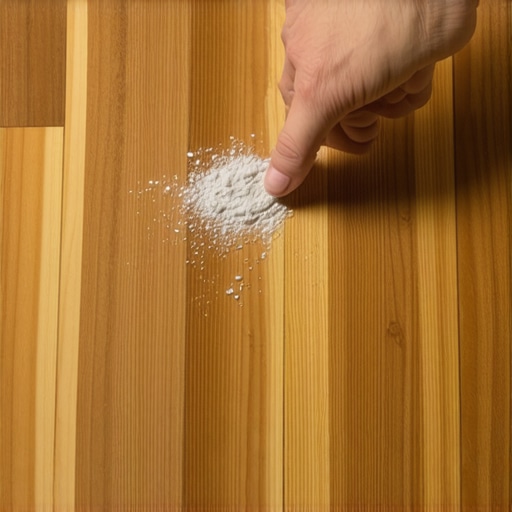
The ghost in the expansion gap
I once walked into a house where a $15,000 wide-plank walnut floor was cupping so bad it looked like a potato chip because the installer didn’t check the crawlspace humidity. The homeowner was frantic, hearing every step like a gunshot through the house. When wood is under that kind of stress, it does not just sit there. It groans. It shifts. It creates friction. A floor is not a static object. It is a living, breathing mechanical assembly that responds to the barometric pressure and the relative humidity of your living room. When you hear a squeak, you are hearing the sound of two pieces of cellulose fiber rubbing against each other or a steel fastener. Graphite powder is often the first line of defense for a professional because it addresses the physics of that friction without introducing moisture into the wood cells.
Why your floor is screaming at you
Hardwood floor squeaks are caused by friction between floorboards, subfloor materials, or loose nails that have lost their grip. When the wood undergoes seasonal shrinkage, the tight fit of the tongue and groove is compromised. This creates a tiny gap where the boards can move vertically under the weight of a footstep, rubbing against the adjacent board or the fastener. To silence this, you must introduce a dry lubricant that can penetrate the tight tolerances of the joint and coat the fibers in a slippery layer of carbon.
Understanding the molecular reality of your floor is the only way to fix it properly. Wood is an anisotropic material, meaning its properties change depending on the direction of the grain. When I walk onto a job site, I smell the oak dust and the old floor wax, and I can tell you if the floor was installed over a wet slab. If the subfloor is moving, no amount of powder will help. But if the issue is simple seasonal movement, graphite is king. Graphite is a crystalline form of carbon where the atoms are arranged in hexagonal sheets. These sheets slide over each other with almost zero resistance. When you puff this powder into a floor joint, you are essentially installing millions of microscopic ball bearings between the boards.
“A floor is only as good as the subfloor beneath it; deflection is the enemy of every joint.” – Master Flooring Axiom
The chemistry of carbon lubrication
Graphite powder works as a dry lubricant because its molecular structure allows for easy shearing between layers. Unlike oils or sprays that can stain wood or attract dust, graphite remains stable and does not soak into the grain to cause swelling. It is a mineral based solution that addresses the mechanical rubbing at the contact points of the tongue and groove system without altering the chemical balance of the wood finish. It is the cleanest way to handle a friction based noise in site finished or prefinished hardwood.
I have seen guys try to use WD-40 or vegetable oil on a squeak. That is a disaster waiting to happen. Oil will penetrate the wood, making it impossible to ever refinish that floor in the future because the new polyurethane will not bond to the oily residue. Graphite is different. It is an inert mineral. While it is messy if you drop a whole bottle, a controlled application into the groove is a surgical strike. You are looking for 100 percent natural micro-fine graphite. The particles need to be small enough to fall into the gaps that are often less than 1/100th of an inch wide. If the powder is too coarse, it will just sit on top and do nothing but ruin your socks.
The 1/8 inch that ruins everything
Subfloor deflection and the lack of a proper expansion gap are the primary mechanical failures that lead to permanent floor noise. If the floor was pinned against a wall without a 1/2 inch gap, the boards have nowhere to go when they expand in the summer. They will arch up, pulling the nails away from the joists. This creates a permanent void where the board will always click and squeak regardless of how much lubricant you apply to the surface joints.
You have to be a detective. I spend more time on my hands and knees with a stethoscope than I do with a hammer. You need to find exactly where the wood is rubbing. Is it board against board, or is it the board against the subfloor? If it is the subfloor, you might be looking at a structural issue with the joist spacing. If your joists are 24 inches on center and the builder used 5/8 inch plywood, that floor is going to bounce. That bounce is what kills the nail hold. When the nail pulls out just a fraction of an inch, it becomes a piston. Every time you step on it, the nail slides in and out of the hole in the plywood, making a distinct metal on wood screech.
| Lubricant Type | Longevity | Finish Safety | Best Use Case |
|---|---|---|---|
| Graphite Powder | High | Excellent | Tight tongue and groove joints |
| Talcum Powder | Low | Good | Temporary fix for light squeaks |
| Paraffin Wax | Medium | Fair | Surface friction on stair treads |
| WD-40 (Liquid) | Zero | Destructive | Never use on hardwood floors |
Steps to silence the wood
Silencing a floor with graphite requires a systematic approach of application, vibration, and cleaning. You cannot just sprinkle it like salt. You must work the powder deep into the groove where the friction is actually occurring. This usually involves walking on the area to flex the boards, which pulls the powder down through the capillary action of the moving joint. Once the sound is gone, the excess must be removed immediately to prevent tracking through the house.
- Identify the exact board by walking slowly and marking the spot with blue painter tape.
- Clean the joint thoroughly using a vacuum with a HEPA filter to remove any grit or pet hair.
- Apply a small amount of graphite powder directly over the seam between the boards.
- Place a rag over the area and step on it repeatedly to work the powder into the joint.
- Use a soft bristled brush to push any remaining powder into the crack.
- Vacuum the surface again and wipe with a damp (not wet) cloth to ensure no black residue remains.
“The National Wood Flooring Association emphasizes that proper environmental control is the first step toward floor stability. Excess moisture causes wood to expand beyond its design limits.” – NWFA Technical Guidelines
Limits of the dry lubricant approach
Graphite will not fix a floor that has a broken tongue or a completely detached subfloor. If the board moves more than 1/16th of an inch vertically, you are dealing with a structural failure that requires mechanical fastening. This might mean driving a trim screw through the face of the board or using a specialized subfloor tightening kit that pulls the plywood up to the joist from below. Graphite is for the friction of tight wood, not the movement of loose timber.
While most people want the thickest underlayment, too much cushion actually causes the locking mechanisms on LVP to snap under pressure. The same logic applies to hardwood. If you have a thick, spongy underlayment under a floating hardwood floor, the entire floor is moving too much. Graphite is a localized treatment. It is not a cure for a bad installation job. If I go into a house and every single board is squeaking, I am not reaching for the powder. I am looking at the HVAC system. If the house is at 10 percent humidity, the wood is starving for moisture and shrinking to the point of failure.
Regional humidity and the swelling grain
If you live in a place with swampy humidity like Houston, your wood is always trying to expand. The pressure in those joints is immense. Graphite might help, but you really need a dehumidifier. In the dry heat of Phoenix, the wood will shrink until the gaps are wide enough to see the subfloor. In those cases, the graphite will just fall through to the crawlspace. You have to time your repairs. I tell people to wait for the middle of the season. Do not fix a squeak in the middle of a record breaking drought or a monsoon. You want to treat the floor when it is at its average equilibrium moisture content.