
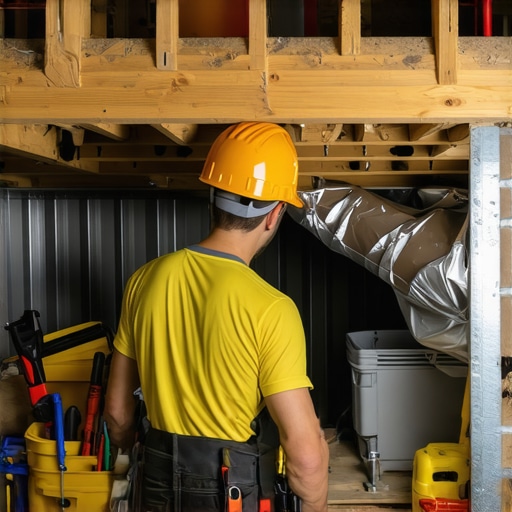
I have spent twenty five years with sawdust under my nails and the smell of WD-40 on my clothes. My knees tell the story of every subfloor I failed to level and every moisture barrier I insisted on doubling up. I once walked into a house where a $15,000 wide-plank walnut floor was cupping so bad it looked like a potato chip because the installer didn’t check the crawlspace humidity. The homeowner was in tears. The contractor was busy pointing fingers at the mill. I walked down into the crawlspace and found nothing but bare, wet dirt breathing right into the underside of the plywood. It was a structural failure masquerading as an aesthetic disaster. Flooring is not just a cosmetic choice. It is a performance surface that must survive the physics of your home. If you ignore the invisible ocean sitting beneath your floor joists, your expensive hardwood or trendy laminate will fail. It is not a matter of if, but when. This is the reality of building science in the modern world.
The invisible ocean beneath your feet
Crawlspace moisture migration happens when groundwater evaporation and hydrostatic pressure force water vapor through porous subfloors like plywood or OSB. This vapor drive is relentless and will saturate solid hardwood or laminate cores, leading to dimensional instability and adhesive failure. You must address the relative humidity of the crawlspace before a single plank is laid. Most guys think a little bit of dirt under the house is fine as long as it looks dry. It is never dry. The earth is a giant reservoir of water. Through a process called capillary action, moisture climbs up through the soil and turns into a gas. This gas hits your subfloor and gets trapped. If you have a finished floor on top that does not breathe, like a luxury vinyl plank with a heavy wear layer, that moisture has nowhere to go. It sits there and rots your joists or grows a colony of mold that will make your family sick. You are essentially living on top of a swamp and the only thing protecting you is a thin layer of wood and whatever chemical finish was applied at the factory.
Why your subfloor is lying to you
Subfloor moisture testing requires a calibrated pin-meter to reach the core of the orientated strand board or plywood decking. Surface readings are often false negatives because the top layer of the wood has acclimated to the HVAC system while the underside remains saturated. You must achieve a moisture content within 2 to 4 percent of your finish flooring. I see it every week. A guy walks in with a cheap moisture meter he bought at a big box store, pokes the top of the plywood, and thinks he is good to go. He is not. You have to get deep into the wood. Wood is hygroscopic. It is like a stack of straws that wants to suck up every bit of liquid it can find. When the bottom of the board is wetter than the top, the bottom expands. This causes the edges of the planks to lift, a phenomenon we call cupping. If the top is wetter than the bottom, you get crowning. Both will ruin your investment. You need to know the exact percentage of moisture in that subfloor at ten different spots in every room. If the crawlspace is not encapsulated or at least covered with a heavy vapor barrier, those numbers will change the second a rainstorm hits.
“A floor is only as good as the subfloor beneath it; deflection is the enemy of every joint.” – Master Flooring Axiom
The physics of the stack effect
The stack effect in a home creates negative pressure in the lower levels, pulling moist air from the crawlspace up through the subfloor gaps and into the living environment. This airflow carries mold spores and organic volatiles, which can degrade flooring adhesives and cause grout cracking in tile installations. Think of your house like a chimney. Hot air rises and exits through the attic. This creates a vacuum at the bottom of the house. It sucks the air out of the crawlspace and right through your floor. If you have hardwood floors, that air is moving through the tiny gaps between the boards. If you have tile, it is pushing against the thin-set. This is why you see grout lines starting to powder and fail in houses with wet crawlspaces. The moisture is literally trying to blow the grout out of the joints. It is a constant pressure that never stops. You can buy the most expensive flooring in the world, but if you do not stop the stack effect by sealing your subfloor penetrations and addressing the crawlspace, you are just throwing money into a hole in the ground.
The myth of the waterproof barrier
A 6-mil polyethylene vapor barrier is the absolute minimum standard for ground cover in a crawlspace environment, but 10-mil or 20-mil reinforced liners are superior for long-term moisture control. These barriers must be lapped and taped at the seams to prevent moisture bypass that can ruin laminate flooring or engineered wood. People hear the word waterproof and they think they are safe. They buy waterproof LVP and think they can ignore the crawlspace. That is a lie. While the vinyl itself might not warp, the moisture trapped under it will turn into a stagnant pool of filth. It will eat the adhesive. It will smell like a wet dog. I have pulled up floors that were only two years old and found the entire underside covered in black spots. The floor looked fine from the top, but the structure was being eaten from the bottom up. You need a real barrier. I am talking about a heavy, multi-ply plastic that you can crawl on without tearing. You need to run it up the piers and tape it to the foundation walls. This is not about aesthetics. This is about chemistry and protecting the structural integrity of your home.
| Flooring Type | Moisture Tolerance | Acclimation Time | Expansion Gap Required |
|---|---|---|---|
| Solid White Oak | Very Low | 10 to 14 Days | 3/4 Inch |
| Engineered Hickory | Medium | 3 to 5 Days | 1/2 Inch |
| SPC Luxury Vinyl | High | 48 Hours | 1/4 Inch |
| Laminate Wood | Low | 48 Hours | 3/8 Inch |
The 1/8 inch that ruins everything
Subfloor flatness is just as vital as moisture control, as a 1/8 inch deviation over a 10 foot span can cause locking mechanism failure in click-lock floors. When moisture softens the subfloor material, these dips become more pronounced, leading to audible clicking and joint separation. I spent three days grinding concrete on a job last month just so the floor wouldn’t click like a castanet. If you are over wood joists and they are sagging because of crawlspace rot, your new floor is doomed. You can’t just slap some underlayment down and hope for the best. Underlayment is not a structural fix. It is a cushion. If you have too much cushion, the joints on your LVP will snap when you walk on them. The floor needs to be flat, dry, and stiff. If you walk across the room and the china in the cabinet rattles, your subfloor has too much deflection. You might need to sister some joists or add a center beam in that crawlspace before you even think about picking out a stain color.
Hardwood floors and the cupping catastrophe
Solid hardwood is a living material that responds to ambient humidity by expanding and contracting across its grain structure. When the bottom of a plank absorbs crawlspace moisture, it expands faster than the top, creating a u-shaped cup that cannot be sanded out until the moisture equilibrium is restored. If you try to sand a cupped floor while it is still wet, you will end up with a crowned floor once it finally dries out. You have to wait. Sometimes you have to wait months. You have to put dehumidifiers in the crawlspace and fans in the living room. You have to treat the wood like it is in intensive care. Most people don’t have that kind of patience. They want it fixed now. But you can’t fight physics. If the cells of the wood are engorged with water, they are physically larger. You have to let that water evaporate slowly. If you force it, the wood will split and crack. It is a slow, painful process that could have been avoided with a $200 roll of plastic and a afternoon of work under the house.
“Crawlspaces must be ventilated or unventilated and thermally isolated; ground cover is non-negotiable for wood subfloors.” – NWFA Technical Guidelines
Regional climate logic and the crawlspace trap
In the humid Southeast, a vented crawlspace is often a moisture factory, as warm, wet air enters the cool space and condenses on the joists. In these regions, encapsulation with a dedicated dehumidifier is the only way to safely install solid hardwood floors or showers with cement board underlayments. If you live in a place like Charleston or Houston, your crawlspace is probably sweating. That sweat is dripping onto your subfloor. You can’t just open the vents and hope the wind dries it out. The wind is just bringing in more wet air. You have to seal it up. You have to turn that crawlspace into a conditioned part of your home. It sounds expensive because it is. But it is cheaper than replacing your floors every five years. On the flip side, if you are in the high desert of Santa Fe, your problem is the opposite. The air is so dry it will suck the moisture right out of the wood and leave you with gaps big enough to drop a nickel through. You have to balance the environment. Your house is an ecosystem.
Pre-installation crawlspace audit checklist
- Inspect the ground for 100% coverage with at least 6-mil polyethylene.
- Check for standing water or signs of periodic flooding near the footings.
- Test the moisture content of the rim joists and subfloor at 20 different locations.
- Verify that all plumbing leaks from showers or kitchens are repaired.
- Ensure that downspouts are carrying water at least 5 feet away from the foundation.
- Measure the relative humidity and compare it to the target room conditions.
- Look for white efflorescence on brick or concrete piers as a sign of moisture wicking.
The ghost in the expansion gap
Every floating floor installation requires a perimeter expansion gap to allow for the natural movement of the material as seasonal humidity changes. If you pinch the floor against a wall or a heavy kitchen island, the built-up tension from crawlspace vapor will cause the floor to buckle and peak at the weakest point. Homeowners always ask why their waterproof vinyl is buckling. Usually, it is because they locked it under a heavy kitchen island, killing the floor’s ability to breathe. The floor wants to move. It is a giant sheet of plastic or wood that is growing and shrinking every single day. If you don’t give it space, it will find space. It will lift up off the subfloor and create a bubble. Or it will pull the tongue right out of the groove. You need that gap. Cover it with baseboard or shoe molding, but never, ever fill it with caulk or push the boards tight against the plate. It needs to float. It needs to survive the invisible forces acting on it from below.
Final assessment of structural integrity
You have to respect the craft. You have to respect the materials. If you treat your floor like a piece of furniture that just sits there, you are going to be disappointed. Your floor is the most used part of your house. It takes the most abuse. It handles the most weight. And it is constantly under attack from the moisture in your crawlspace. Take the time to crawl under the house. Get dirty. Check the dirt. Check the joists. If you do the work on the front end, your floor will last a lifetime. If you cut corners, I will be the guy you call in three years to tell you that your beautiful walnut floor is junk. I don’t like giving that news. I’d rather see you do it right the first time. Keep your subfloor dry, keep your crawlspace sealed, and keep your moisture meter handy. That is the only way to win the war against the invisible ocean.