
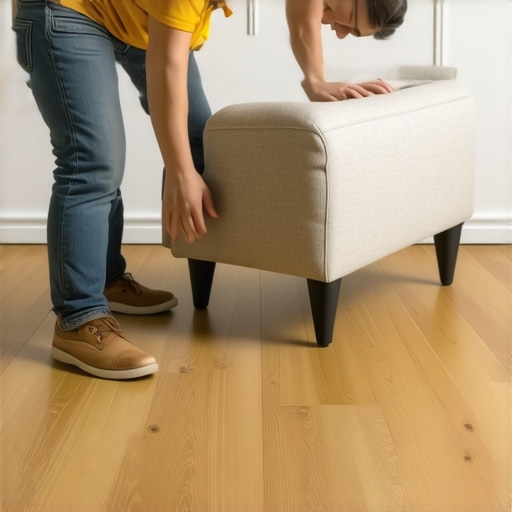
I smell like WD-40 and fresh oak dust because I just spent twelve hours fixing a disaster that should have never happened. Last Tuesday, I walked into a rental property where the homeowner decided to move a heavy oak dresser across a floating laminate floor. They didn’t lift it. They dragged it. Now, that fifteen thousand dollar floor is ruined. The homeowner asked why their waterproof vinyl or laminate was buckling at the seams. It is a common story. People think that just because a floor is rated for high traffic, it can handle the lateral shear of a three hundred pound wardrobe. It cannot. Usually, it is because they locked the floor under a heavy kitchen island or dragged a couch, killing the floor’s ability to breathe and snapping the brittle locking mechanisms that hold the whole system together. I have spent twenty five years on my knees with a moisture meter and a level, and I can tell you that a floor is not a decoration. It is a structural engineering challenge. If you treat it like a sidewalk, it will fail you. This guide will explain the physics and chemistry of why dragging furniture is a death sentence for your click-lock system.
The snapping point of a floating system
Click-lock laminate floors rely on mechanical tension and floating installation principles where individual planks are joined by a tongue and groove system without being glued or nailed to the subfloor. When you drag furniture, the lateral shear force exceeds the PSI rating of the HDF core, causing the thin locking profile to snap or delaminate. This creates permanent gaps that allow moisture to penetrate the core, leading to swelling and eventual floor failure. You cannot simply glue these pieces back together once the mechanical bond is broken. The physics of a floating floor require it to move as a single unit. When you pin one end down with a heavy object and push, you are asking a piece of compressed sawdust and resin to withstand hundreds of pounds of horizontal pressure. It is not designed for that. Unlike solid hardwood floors that are nailed into the joists, laminate sits on a thin layer of foam. This foam provides a cushion, but it also allows for vertical deflection. When you drag a heavy leg across the surface, that deflection increases the friction, making the tongue act as a lever. It snaps. It is a clean break that ruins the integrity of the entire room.
Locking mechanisms and the geometry of failure
To understand why dragging is so destructive, we have to look at the geometry of the joint. Most modern laminate uses a patented click system like Uniclic or Valinge. These joints are masterpieces of engineering. They are milled to tolerances within fractions of a millimeter. The tongue is often less than two millimeters thick. It is made of High-Density Fiberboard or HDF. While HDF is dense, it is also brittle under shear stress. When you drag a chair or a table, the feet of that furniture act as a point load. This point load creates a localized depression in the underlayment. As the furniture moves forward, the edge of the plank is pushed downward and forward simultaneously. This creates a prying motion.
“A floor is only as good as the subfloor beneath it; deflection is the enemy of every joint.” – Master Flooring Axiom
The tongue is forced against the upper lip of the groove. Because the HDF cannot stretch, it shears. You might not hear it happen, but the damage is done. Once that tongue is cracked, the planks will begin to separate. This separation is the beginning of the end. In a kitchen or a bathroom, this gap becomes a highway for water. Even a small spill will travel down into the core. Unlike the ceramic tile you find in showers, laminate has no grout to protect these joints. In showers, grout acts as a sacrificial and protective barrier that is rigid. Laminate is dynamic. It must expand and contract with the seasons. When the joint is broken, the expansion no longer happens uniformly. One plank moves, the other stays put, and soon you have a tripping hazard.
Why your subfloor is lying to you
Every subfloor has dips and humps. Most installers are lazy and skip the leveling compound. They think the underlayment will hide the dip. It won’t. I spent three days grinding concrete on a job last month just so the floor wouldn’t click like a castanet. When your subfloor is not perfectly flat, dragging furniture becomes even more dangerous. As the furniture leg passes over a low spot in the concrete or plywood, the laminate plank bows. This bowing puts the locking joint under extreme tension. If you add the lateral force of dragging at that exact moment, the joint has zero chance of survival. It is like snapping a pencil while it is already bent. People often compare this to hardwood floors. Hardwood is a different beast. Solid wood is fibrous and can often handle more abuse, though you will still gouge the finish. But laminate is a composite. It is a sandwich of a wear layer, a decorative paper, a core, and a backing. It does not have the internal grain structure to resist splintering when the joint is stressed. If your subfloor has a deviation of more than 3/16 of an inch over ten feet, you are already on thin ice. Dragging furniture over that deviation is the final blow.
Comparison of flooring durability and requirements
| Flooring Type | Joint Strength | Repairability | Moisture Resistance | Lateral Shear Resistance |
|---|---|---|---|---|
| Laminate | Low (Mechanical) | Low | Moderate (Surface) | Very Low |
| Hardwood Floors | High (Nailed) | High | Low | High |
| Ceramic Tile | High (Mortar) | Moderate | Very High | Very High |
| Engineered Wood | Medium | Moderate | Moderate | Medium |
As you can see from the data, laminate sits at the bottom for shear resistance. This is because it is a floating system. It is held in place by its own weight and the friction of the underlayment. When you move furniture, you are fighting that entire system. If you look at showers, the installation is designed to be monolithic. The tile, the thin-set, and the grout form one solid block. It can handle a refrigerator being dragged across it because there is no movement. Laminate is the opposite of a shower. It is designed to move. This movement is its greatest strength and its greatest weakness.
The friction coefficient of wear layers
The wear layer of laminate is usually made of melamine resin infused with aluminum oxide. This is what gives it an AC rating. An AC3 rating is standard for residential use, while AC5 is for heavy commercial. This layer is incredibly hard. It is designed to resist scratches from dog claws and sand. However, it has a specific friction coefficient. When you drag a rubber-bottomed furniture leg across this surface, the grip is intense. Instead of sliding, the furniture grabs the wear layer. This grip transfers all the energy of your push directly into the core of the plank. It is a common mistake to think that a high AC rating means the floor is indestructible. It just means the surface is hard. You can have an AC5 floor with a weak HDF core and brittle joints. The aluminum oxide might protect you from a scratch, but it won’t protect the tongue from snapping off when you move your sofa. I have seen people drag heavy toolboxes across commercial laminate and literally peel the wear layer off the core because the friction was so high. It is like a rug burn on a molecular level.
The ghost in the expansion gap
Floating floors need a gap around the perimeter of the room. This is usually 1/4 to 1/2 inch. This gap is hidden by baseboards or quarter-round molding. The floor needs this space to grow when the humidity rises. If you drag a heavy piece of furniture and it causes the planks to shift slightly, you might be closing that expansion gap on one side of the room. This creates a ghost problem. Months later, when the seasons change, the floor has nowhere to go. It hits the wall and starts to peak in the middle of the room. Homeowners call me and say their floor is lifting. I come out and find that the entire floor has shifted three-eighths of an inch because they dragged a pool table across it three months ago. The floor is now jammed against the drywall. This pressure can also snap the click joints. It is a chain reaction of structural failure.
“A floating floor is a living system that requires space to breathe; pinning it or shifting it with force is a recipe for catastrophic buckling.” – Master Flooring Axiom
The weight of the furniture itself can also act as a pin. If you have a massive bookshelf on one side of the room and you drag a heavy desk on the other, you are creating zones of different tension. The floor cannot equalize. This leads to gaps opening up in the center of the room that look like the floor is shrinking. It isn’t shrinking. It is being pulled apart by the physics of static loads and friction.
Protecting your investment and your joints
You must treat your laminate floor with the same respect you would give a finished hardwood floor or a delicate tile installation. Lifting is the only way to move items. If you cannot lift it, you need the right tools. I always tell my clients to keep a set of furniture sliders in their junk drawer. These sliders reduce the friction coefficient to almost zero. They allow the furniture to glide without grabbing the wear layer and stressing the joints. Here is my professional checklist for moving anything heavier than a kitchen chair.
- Never move furniture alone; always have a second person to help lift.
- Use felt pads on every single leg of every piece of furniture in the house.
- Replace plastic glides with high-quality felt to prevent micro-scratching.
- Use air-sleds or professional moving dollies for heavy appliances like refrigerators.
- Clean the floor thoroughly before moving anything to ensure no grit is trapped under the feet.
- Check the integrity of the click joints every six months for signs of separation.
If you follow these steps, your floor will last twenty years. If you ignore them, you will be calling me to rip it up in two. I have seen beautiful floors destroyed in five minutes by a single person trying to save time. It is never worth it. The labor cost of replacing three damaged planks in the middle of a room is often higher than the cost of the original installation because you have to take the whole floor apart from the wall to reach the damaged area.
Real world consequences of heavy loads
We need to talk about the chemistry of the core. Most laminate cores are made with urea-formaldehyde resins. While these are safe when the plank is intact, breaking the core exposes the raw fibers. These fibers are incredibly thirsty. In a house with a crawlspace, the humidity can fluctuate wildly. If you have snapped a joint by dragging a table, the core is now exposed to the air. It will suck up moisture like a sponge. This causes the edges of the plank to mushroom or lip. Once the edges lip upward, they are even more prone to damage from foot traffic. You will start to see the decorative paper wearing off at the edges because the planks are no longer flush. This is a death spiral for the floor. No amount of floor wax or cleaner will fix this. It is a structural failure. In hardwood floors, you could sand the floor down and refinish it. You cannot do that with laminate. The wear layer is only a few microns thick. Once it is gone, it is gone. You are looking at a total loss. This is why I get so frustrated when I see big-box stores selling this stuff as indestructible. It is durable, but it is not magic. It is a precision-engineered product that requires a precision-engineered environment. Your subfloor must be flat, your humidity must be controlled, and your furniture must be lifted. There are no shortcuts in the flooring world. Every time someone tries a shortcut, my phone rings. I would rather you keep your money and have a floor that stays beautiful. Stop dragging your furniture. Lift it. Slide it properly. Respect the mechanical bond that is holding your room together. If you don’t, the physics of shear force and friction will win every single time. Your floor is a system of movement and balance. Treat it like one.