
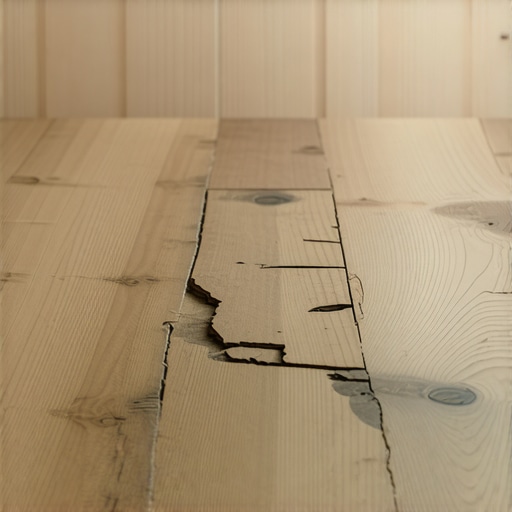
I once walked into a house where a $15,000 wide-plank walnut floor was cupping so bad it looked like a potato chip because the installer didn’t check the crawlspace humidity. The homeowner was devastated. The edges were splintering and the finish was literally shearing off the surface. This was not a product failure. It was a failure of physics and professional negligence. When you see your hardwood floor start to splinter at the edges, it is rarely a fluke. It is a symptom of a deeper structural or environmental conflict that was ignored during the installation process. My hands have the scars and sawdust to prove that these issues are preventable if you respect the material and the science of the subfloor.
The physics of moisture and microscopic wood expansion
Hardwood floor splintering at the edges occurs when the moisture content of the wood changes too rapidly or when the planks are forced against one another with excessive pressure. This mechanical stress causes the cell walls of the wood, known as the lignin and cellulose matrix, to fail at the weakest point, which is typically the tongue and groove joint or the top shoulder of the plank. When wood absorbs water from the air or the subfloor, it expands across the grain. If there is no room for this expansion, the wood fibers compress and eventually shatter, leading to visible splinters and rough edges. Most installers look at a plank and see a piece of wood. I see a bundle of straws that are constantly breathing, sucking in moisture from the concrete slab or the humid summer air. If that breathing is restricted or overwhelmed, the floor will destroy itself from the inside out.
Wood is a hygroscopic material. It lives and dies by its moisture content. When we talk about splintering at the edges, we are usually talking about a phenomenon called compression set. This happens when the planks expand so much that they crush each other. Once the wood dries out and shrinks back, the crushed fibers do not recover. They remain brittle and eventually break off as people walk over them. This creates those sharp, dangerous shards that ruin a high end finish and catch on your socks. If your installer didn’t use a moisture meter on every single room of your subfloor, they didn’t do their job. I have spent decades insisting that a concrete slab must be below 4 percent moisture or have a vapor barrier that is absolutely impenetrable. Anything less is a gamble with your investment.
“Wood is a hygroscopic material, meaning it constantly gains or loses moisture to stay in equilibrium with its environment.” – NWFA Technical Manual
The invisible failures of subfloor preparation
Subfloor flatness is the silent killer of hardwood joints and the primary reason for edge splintering in modern homes. If a subfloor has a dip or a high spot, the planks will deflect, or bend, every time someone steps on them. This constant vertical movement puts immense pressure on the tongue and groove connection. Over thousands of footfalls, the wood fibers at the edge of the plank fatigue and splinter. A floor is only as stable as the surface it rests upon. If you skip the grinding of high spots or the filling of low spots with a high compression strength leveling compound, you are essentially building a bridge out of glass. It might look good for a week, but the first sign of traffic will reveal the structural flaws underneath.
Many guys in the trade think they can hide a bad subfloor with a thick underlayment. They are wrong. Too much cushion actually makes the problem worse. If the underlayment is too soft, it allows the locking mechanisms or the nailed joints to move too much. In the flooring world, we measure flatness in 1/8 inch increments over a 10 foot radius. If the floor deviates more than that, the mechanical fasteners, whether they are cleats or staples, will begin to pull. This pulling action creates friction between the planks. Friction leads to heat and mechanical wear at the microscopic level, which eventually manifests as splintering. I spent three days grinding concrete on a job last month just so the floor wouldn’t click like a castanet. That is the difference between an installer and an architect of the floor.
The chemical reality of finish application and edge bonding
Edge glue and finish bonding can create a structural bridge that causes sidebonding and subsequent splintering as the floor moves. When a professional finish is applied too heavily, or if an inferior water based finish is used without the proper sealer, the liquid can seep into the joints between the planks. This acts as a glue, effectively turning a floor of individual planks into one giant sheet of wood. When the house naturally settles or the seasons change, the floor needs to move at every joint. If the planks are glued together by the finish, the floor will find the weakest point to break the bond. Usually, this is not the finish itself, but the wood grain at the edge of the plank. This results in long, jagged splinters that run the length of the board.
Using the right chemistry is just as important as using the right saw. High quality sealers are designed to prevent sidebonding by creating a non stick surface inside the tongue and groove. If your contractor used a cheap, builder grade polyurethane, they likely bypassed this safety measure. Furthermore, the mil thickness of the wear layer on engineered floors plays a massive role. A thin wear layer, anything under 2 millimeters, is prone to delamination. When the top layer of real wood is too thin, it cannot handle the internal stresses of expansion. It peels away from the plywood core, starting at the edges where the saw blade originally cut the material. This is why I always advocate for a 4 millimeter or 6 millimeter wear layer. It provides the structural integrity needed to resist splintering under pressure.
| Metric | Solid Hardwood | Engineered Hardwood | Laminate |
|---|---|---|---|
| Janka Hardness (Oak) | 1290 lbf | 1290 lbf (top layer) | Varies (AC4/AC5) |
| Acclimation Time | 7 to 14 days | 3 to 5 days | 48 hours |
| Moisture Tolerance | Very Low | Moderate | High (Surface only) |
| Expansion Gap Req | 3/4 inch | 1/2 inch | 3/8 inch |
The ghost in the expansion gap
Failure to leave an adequate expansion gap at the perimeter of a room is a fundamental error that leads to edge splintering. Every hardwood floor must have a space between the wood and the wall, usually hidden by baseboards or quarter round. This gap allows the entire floor to move as a single unit when humidity levels rise. If the floor is pinned against a wall, a kitchen island, or a heavy radiator, the pressure has nowhere to go but back into the planks. This pressure causes the wood to crush at the edges. I have seen entire floors lift off the subfloor, a phenomenon called buckling, because an installer forgot to leave a 1/2 inch gap near a door frame. When the wood has no room to breathe, it fights itself, and the edges are the first casualties.
This is especially true in regions with high seasonal humidity swings. In the swampy humidity of the south, a floor that was installed in the dry winter will expand significantly by July. If that floor was tight against the drywall in January, it will be splintering and cupping by the Fourth of July. I always tell homeowners that their floor is a living thing. It needs room to grow and shrink. Pinned floors also suffer from fastener fatigue. When the wood wants to move but the nails hold it tight, the wood eventually splits around the nail hole. This internal splitting often travels up to the surface and appears as a splinter at the edge of the board. It is a chain reaction of mechanical failure caused by a lack of space.
“A floor is only as good as the subfloor beneath it; deflection is the enemy of every joint.” – Master Flooring Axiom
The role of acclimation and environmental control
Proper acclimation is the process of allowing the wood to reach its equilibrium moisture content within the specific environment where it will be installed. Many people think that leaving the boxes of wood in the garage or the basement is enough. It is not. The wood must be stored in the actual room where it will live, with the HVAC system running at normal living conditions for at least a week. If you take wood from a dry warehouse and install it immediately into a humid home, the planks will swell so fast that the edges will crush against each other before the first coat of finish is even dry. This is the fastest way to ruin a premium oak or maple floor.
I use a thermo hygrometer to track the relative humidity and temperature of the air on every job site. If the humidity is above 50 percent or below 30 percent, I will not install the floor. It is that simple. Extreme dry heat will shrink the boards until the tongues are exposed, while extreme humidity will cause the splintering we are discussing. You have to maintain a stable environment. Homeowners who turn off their air conditioning when they go on vacation are often the ones who call me three months later wondering why their floors are falling apart. A floor requires a consistent climate to remain structurally sound. If you treat your house like a greenhouse or a desert, your hardwood will react accordingly.
Checklist for diagnosing and preventing edge splintering
- Verify the moisture content of the subfloor using a pinless meter before installation.
- Ensure the subfloor is flat within 1/8 inch over a 10 foot span to prevent vertical deflection.
- Confirm that an adequate expansion gap of at least 1/2 inch is present around the entire perimeter.
- Check that the wood was acclimated in the installation space for a minimum of 7 days with active climate control.
- Inspect the tongue and groove joints for manufacturing defects or over milling before the planks are laid.
- Use a high quality sealer to prevent sidebonding of the floor finish.
- Monitor the indoor relative humidity to keep it between 30 and 50 percent year round.
The impact of maintenance and improper cleaning
The use of wet mops or steam cleaners on hardwood floors is a primary cause of localized edge splintering and finish failure. Water is the enemy of wood. When you use a steam mop, you are forcing hot water vapor into the joints between the planks. This moisture bypasses the surface finish and goes straight into the raw wood of the tongue and groove. The wood swells rapidly, the finish cracks at the edges, and the fibers splinter. I have seen beautiful white oak floors ruined in less than a year because someone thought a steam mop was the most sanitary way to clean. It is a death sentence for hardwood.
Instead, you should use a microfiber mop and a pH neutral cleaner specifically formulated for hardwood. Never spray the cleaner directly on the floor. Spray it on the mop. This prevents liquid from pooling in the seams. Small amounts of water from a wet mop can sit in the bevels of the planks and cause the edges to stay wet longer than the rest of the board. This uneven drying cycle causes the edges to become brittle over time. Once the wood at the edge becomes brittle, it loses its elasticity and will splinter under the weight of even a small child. It is about preserving the cellular integrity of the wood for the long haul. If you treat your floor with respect, it will last a century. If you treat it like a tile floor in a commercial kitchen, it will fail you in five years.
The structural integrity of your home is reflected in your floors. Every splinter, every gap, and every creak is a message from the wood about the conditions it is enduring. By understanding the physics of moisture, the importance of subfloor preparation, and the necessity of proper maintenance, you can ensure that your hardwood remains a solid, beautiful surface for generations. It is not just about the wood you choose. It is about the science of how you put it down.