
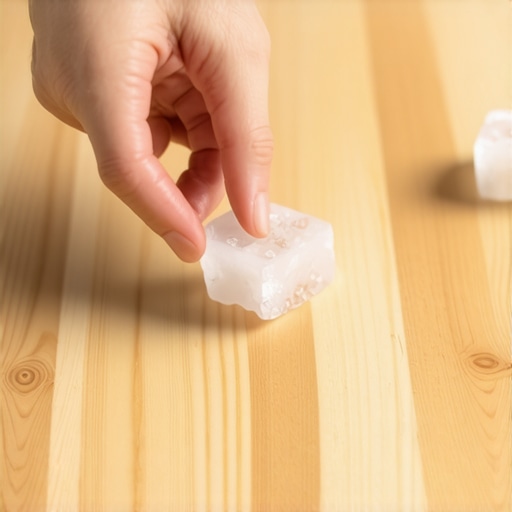
I once walked into a house where a $15,000 wide-plank walnut floor was cupping so bad it looked like a potato chip because the installer didn’t check the crawlspace humidity before the install. That job taught me that wood is not just a plank of dead organic matter. It is a biological structure that reacts to every change in its environment. When a heavy chair leg or a dropped cast iron skillet hits that floor, it does not just make a mark. It compresses the cellular architecture of the wood. Most people see a ruined surface and reach for the wood filler. They are wrong. Wood filler is a permanent scar that never takes stain correctly. If the wood fibers are merely crushed and not severed, you can use the physics of thermodynamics and hygroscopicity to bring those fibers back to their original state. This is where the ice cube trick comes into play. It is a slow, methodical process that relies on the wood’s natural memory. I have spent twenty five years with my knees on various subfloors and I can tell you that understanding the microscopic reality of your floor is the only way to maintain it. Hardwood floors are a structural engineering feat. They are designed to move and breathe. When you drop a heavy object, you are essentially creating a localized zone of high density. The ice cube trick allows you to reverse that density by introducing moisture and heat in a controlled manner.
The physics of wood fiber memory
The ice cube trick works by introducing moisture into the compressed wood cells, which causes the cellulose and lignin to expand back to their original shape. This process relies on the hygroscopic nature of wood, meaning it naturally absorbs water from its environment to reach a state of equilibrium. Wood is composed of millions of tiny tube like structures called tracheids and vessels. These tubes are primarily made of cellulose, hemicellulose, and lignin. When an object dents the floor, these tubes are flattened like a plastic straw that has been stepped on. Because wood is an elastic material to a certain point, those fibers want to return to their original orientation. However, they need a catalyst. Water acts as a plasticizer for the lignin. When you place an ice cube on a dent, the water slowly melts and penetrates the finish through microscopic cracks or pores. As the water enters the cell wall, it pushes the microfibrils apart. This is a molecular level event. The ice provides a slow release of moisture that prevents the wood from becoming oversaturated too quickly, which could lead to staining or finish delamination. If you understand the Janka scale, you know that different species have different levels of resistance to this compression. A soft wood like Black Walnut will dent more easily than a hard wood like Brazilian Cherry, but it also has a better memory for recovery. Softness in wood often equates to a more flexible cellular matrix.
“A floor is only as good as the subfloor beneath it; deflection is the enemy of every joint.” – Master Flooring Axiom
Why some dents are actually structural failures
Dents that have severed the wood fibers or cracked the protective polyurethane finish cannot be fully repaired with the ice cube trick alone. If the wood grain is physically broken, the cellular tubes are no longer intact and cannot hold the internal pressure required to expand back to their original position. You have to look at the dent under a raking light. If you see white lines or splintering, the fibers are shredded. In those cases, you are looking at a repair that requires sanding and refinishing. But if the dent is smooth, there is hope. The chemistry of the finish also matters. A modern water based polyurethane is quite flexible and will often stretch with the dent. An old school acid cured finish or a brittle oil based finish might crack. If the finish is cracked, the water from the ice cube will penetrate too deeply and could cause a dark mineral stain. This is common in White Oak because of the high tannin content. When tannins meet water, they turn black. This is why professional installers always test a small, inconspicuous area first. We are not just looking at a dent. We are looking at the moisture content (MC) of the plank. Most hardwood floors are kept at a stable MC of six to nine percent. Introducing a concentrated source of water like an ice cube temporarily spikes that MC to over twenty percent in a very small area. The surrounding dry wood will eventually pull that moisture back out, but you must be careful not to cause a permanent hump.
Comparing hardwood resilience to laminate and tile
Hardwood floors possess a cellular memory that allows for dent recovery, whereas laminate and tile are rigid systems that either shatter or remain permanently deformed upon impact. Laminate is essentially a photograph of wood glued to a high density fiberboard core, which lacks the elastic tracheids found in natural timber. When you dent laminate, you are crushing a resin impregnated paper layer. There is no biological structure to swell back up. If you try the ice cube trick on laminate, you will simply blow out the seams and cause the core to swell like a sponge, ruining the floor. Tile and grout are even less forgiving. If a heavy object hits a ceramic or porcelain tile, the energy is transferred until the material reaches its breaking point, resulting in a crack. Grout will simply crumble under localized pressure. This is why I always advocate for solid hardwood in living areas. It is a living material that can be healed. Even engineered hardwood has a thick enough wear layer, usually between three and six millimeters, to allow for these types of repairs. However, if the wear layer is too thin, the moisture might reach the glue line. If the adhesive is not moisture rated, the veneer could peel away. This is the structural engineering reality of flooring. You must know every layer from the joist to the finish.
| Wood Species | Janka Hardness Rating | Recovery Potential |
|---|---|---|
| Black Walnut | 1010 | High |
| Red Oak | 1290 | Moderate |
| White Oak | 1360 | Moderate |
| Hard Maple | 1450 | Low |
| Brazilian Cherry | 2350 | Very Low |
The hidden role of subfloor deflection
Subfloor deflection is the amount of vertical movement a floor system experiences under a load, and it significantly impacts how much a floor will dent upon impact. A bouncy subfloor acts like a trampoline, absorbing some of the energy, whereas a rock solid subfloor forces the wood fibers to take the full force of the blow. Many guys skip the leveling compound. They think the underlayment will hide the dip. It won’t. If there is a void under your hardwood, every footfall and every dropped object creates more stress on the tongue and groove joints. I spent three days grinding concrete on a job last month just so the floor wouldn’t click like a castanet. When the floor is perfectly supported, the wood can dissipate energy across a wider area. If you have a dent, it might be because the subfloor was uneven, allowing the plank to flex downward until it hit the high spot of the concrete or plywood underneath. This compression against a hard surface is what creates the permanent mark. Before you even think about the ice cube trick, you should walk the floor and listen for hollow sounds. If the floor is hollow, the dent is the least of your problems. You have a structural support issue that might require injecting resin or pulling up boards to fix the subfloor levelness. No amount of ice will fix a floor that is structurally unsupported.
“Wood is a hygroscopic material that constantly seeks equilibrium with its environment.” – NWFA Technical Manual
A professional protocol for fiber restoration
The most effective way to remove a dent is to combine the ice cube trick with a localized heat source, such as a soldering iron or a clothes iron, to create a steam injection effect. This accelerated process forces the water molecules into the cell walls much faster than simple melting would allow. I call this the steam recovery method. It is a precision operation. You start by placing a damp cotton cloth over the dent. You do not want the cloth dripping wet, just damp. Then, you apply the tip of a hot iron to the cloth directly over the dent. The heat turns the water into steam. Because steam molecules are smaller and more energetic than liquid water molecules, they penetrate the wood finish and the cellular structure of the timber almost instantly. You should only apply heat for ten to fifteen seconds at a time. Lift the cloth and check the progress. You will often see the dent rising before your eyes. It is a beautiful thing to see a piece of history restore itself. After the dent has leveled out, you must let the area dry naturally for twenty four hours. Do not use a hair dryer. Forced air can cause the finish to cloud or the wood to shrink too rapidly, leading to checks in the grain. This is a game of patience and physics.
- Identify if the wood fibers are crushed or severed using a magnifying glass.
- Clean the area with a pH neutral hardwood cleaner to remove any wax or oils.
- Place a single ice cube on the dent and let it melt completely over several hours.
- If the dent remains, use a damp cloth and a clothes iron to steam the fibers.
- Sand the area lightly with 400 grit sandpaper if the grain has raised too much.
- Apply a small amount of matching topcoat to reseal any microscopic cracks in the finish.
Humidity and the regional climate expert
In high humidity regions like Houston or New Orleans, the wood is already expanded near its limit, making the ice cube trick slightly less effective and more risky for the surrounding floor. Conversely, in dry climates like Phoenix, the wood is thirsty and will absorb the moisture rapidly, which can cause the grain to raise significantly. If you live in a swampy area, your hardwood is already fighting to stay flat. Adding more water to a specific spot can cause a localized hump that might not go away. You have to monitor the ambient humidity in the room. A professional will use a pinless moisture meter to check the surrounding planks before and after the repair. If the baseline MC is already twelve percent, you are asking for trouble by adding more water. In dry climates, the wood is more brittle. The fibers are more likely to snap than to bend. In those cases, the ice cube trick is essential because it adds the necessary elasticity back to the wood before you try any other repair methods. Always remember that the house is a closed system. The HVAC system is the lungs of your floor. If your humidity is swinging more than twenty percent between seasons, your floors will suffer from more than just dents. You will see gaps in the winter and cupping in the summer. A stable floor is a happy floor. Protecting your investment means controlling the air as much as the wood itself.