
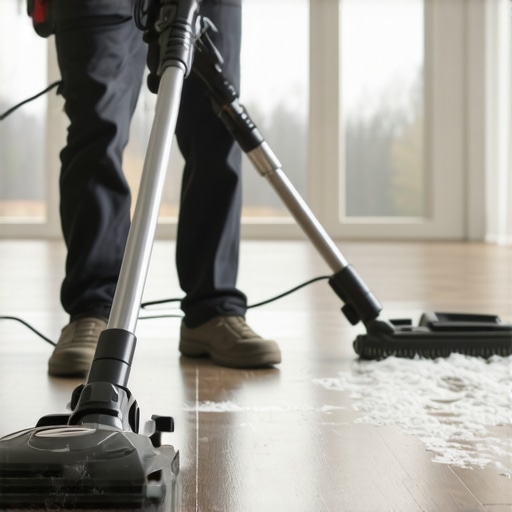
I once walked into a house where a $15,000 wide-plank walnut floor was cupping so bad it looked like a potato chip because the installer didn’t check the crawlspace humidity. The homeowner was frantic. They had spent a fortune on what they thought was the most stable flooring option on the market. They were told engineered hardwood was the solution to every moisture problem. But there is a massive difference between atmospheric humidity and the concentrated, high-pressure thermal assault of a steam mop. After three decades of kneeling on concrete slabs and testing the moisture content of oak and hickory, I can tell you that a steam cleaner is the fastest way to turn a high-end investment into a pile of peeling firewood. This is not about aesthetics. It is about the physics of vapor pressure and the chemical limits of the adhesives that hold your floor together.
The vapor pressure trap
Steam cleaners force pressurized water vapor into the microscopic pores of the wood surface at temperatures exceeding 200 degrees Fahrenheit. This process bypasses the protective finish and drives moisture deep into the cellular structure of the timber. Unlike a damp mop, steam acts as a gas that expands rapidly within the wood fibers, causing immediate internal stress that most residential finishes are not designed to withstand. This is a structural engineering failure waiting to happen. People think wood is a solid block, but it is a bundle of straws. When you hit those straws with pressurized gas, you are inviting disaster into your subfloor.
“A floor is only as good as the subfloor beneath it; deflection is the enemy of every joint.” – Master Flooring Axiom
Why heat and moisture destroy the cross-ply bond
Engineered hardwood relies on a series of thin wood veneers glued together in a cross-grain pattern using specific resins and adhesives. These bonds are engineered to be stable under normal household conditions, but they are not rated for the thermal shock provided by steam. The heat from a steam cleaner can actually liquefy or soften the urea-formaldehyde or phenol-formaldehyde glues used in the manufacturing process. Once those glues fail, the layers begin to separate. This is known as delamination. It is not something you can fix with a bit of wood glue and a prayer. Once the bond is broken at the molecular level, the structural integrity of the plank is gone forever.
| Factor | Standard Limit | Steam Cleaner Impact |
|---|---|---|
| Surface Temperature | 80-85 Degrees F | 212+ Degrees F |
| Moisture Content | 6-9 Percent | Saturation via Vapor |
| Adhesive Stability | High at Room Temp | Degrades at High Heat |
| Joint Integrity | Stable with Gaps | Swelling and Crushing |
The 1/8 inch that ruins everything
A standard expansion gap of 1/8 to 1/2 inch at the perimeter of a room is designed for seasonal movement, not the rapid swelling caused by steam. When you inject steam into the floor, the wood cells expand at a rate that the expansion gaps cannot accommodate. This leads to edge crushing and telegraphing, where the edges of the planks push against each other until they lift off the subfloor. I have seen floors that looked like a mountain range within six months because the owner thought they were being extra clean. Most people want the thickest underlayment possible, thinking it provides more protection, but too much cushion actually causes the locking mechanisms on engineered floors to snap under the pressure of foot traffic and moisture-induced movement.
The moisture meter never lies
Professional flooring installers use pin and pinless moisture meters to ensure the subfloor and the finish material are within a 2 percent to 4 percent range of each other. Steam cleaning throws this equilibrium out the window. Even if the surface feels dry to the touch ten minutes later, the vapor has already migrated into the core material. For those dealing with grout in bathrooms or showers near their hardwood transitions, the danger is doubled. Steam can easily pull minerals and dirt from grout lines and deposit them into the wood grain, creating permanent staining that no sander can reach. Hardwood floors and laminate are not porous in the way stone is, but they are susceptible to capillary action that pulls that hot vapor deep into the tongue and groove joints.
- Never use steam on any floor with a click-lock mechanism.
- Always check the manufacturer warranty for the term “steam cleaner prohibited.”
- Maintain a consistent relative humidity between 30 and 50 percent.
- Use a pH-neutral cleaner specifically designed for site-finished or pre-finished wood.
- Avoid any cleaning tool that uses heat as a primary mechanism.
A better path to clean surfaces
The secret to a long-lasting floor is a dry-microfiber dust mop and an occasional misting of a specialized hardwood cleaner. You want to avoid standing water at all costs. If you are worried about bacteria, remember that most modern wood finishes are formulated with antimicrobial properties that do not require high-heat sterilization. You are not cleaning a surgical suite; you are maintaining a natural organic material that reacts to its environment. If you insist on using steam, you are essentially performing a slow-motion demolition of your own home. I’ve seen it a hundred times. The homeowner thinks they are being hygienic, but they are actually just dissolving the glue that holds their house together.
“Wood flooring is a living product that reacts to its environment; moisture control is the only way to ensure its longevity.” – NWFA Technical Guidelines
Why your warranty is now a paperweight
Almost every major flooring manufacturer explicitly states that the use of a steam mop voids all structural and finish warranties. They know the physics of their product. They know that no finish, whether it is oil-based polyurethane or a UV-cured aluminum oxide coating, is completely vapor-proof. When the floor starts to peel or the boards start to buckle, the manufacturer will send an inspector with a moisture meter. They will find the high readings in the core of the wood and they will deny your claim. It is a heartbreaking conversation to have with a homeowner who just spent a year’s savings on a beautiful hickory floor. Do not let the marketing of appliance companies convince you that their machines are safe for your floors. They are not in the flooring business; they are in the steam mop business. Trust the guy who has to fix the mess they leave behind.