
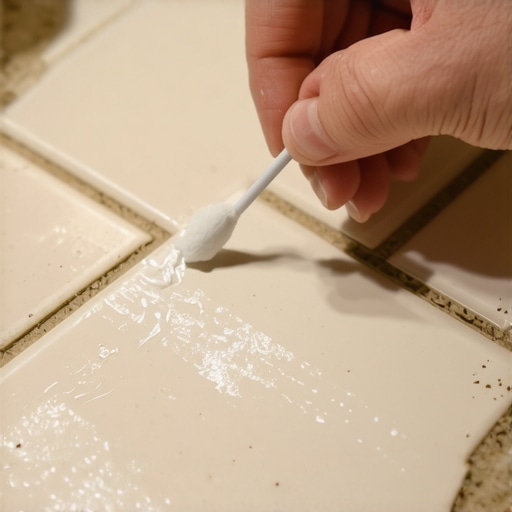
I spent three days grinding concrete on a job last month just so the floor wouldn’t click like a castanet. That is the level of precision required for a professional installation. Most guys skip the leveling compound and think the underlayment will hide the dip. It won’t. When a homeowner walks onto a fresh tile job and sees a permanent marker streak across the porcelain because a subcontractor got careless with a layout pen, the architectural integrity of the room feels compromised. This is not just a cosmetic smudge. It is a chemical bond on a technical surface. After 25 years of kneeling on subfloors, I have learned that cleaning a floor is as much about chemistry as it is about elbow grease. We are looking at a battle between the non porous nature of the tile and the solvent based resins in the ink. Permanent markers are designed to resist water, but they cannot stand up to high grade isopropyl alcohol when handled with precision.
The chemistry of ink on kiln fired surfaces
Isopropyl alcohol acts as a powerful solvent that breaks the molecular bonds of permanent marker resins on ceramic and porcelain tile. By dissolving the carrier agent in the ink, the alcohol allows the pigment to be lifted from the surface without scratching the protective glaze of the tile. This process must be controlled to prevent the dissolved ink from migrating into the porous grout lines nearby. When you apply a solvent like rubbing alcohol to a non porous surface, you are essentially re liquefying a solid. Porcelain tile is fired at temperatures exceeding 2000 degrees Fahrenheit, which creates a vitrified surface with extremely low water absorption, typically less than 0.5 percent. This density is your best friend. The ink cannot penetrate the tile itself. It sits on top, anchored by a thin film of plastic like resin. Rubbing alcohol, specifically 70 percent or 91 percent concentrations, attacks this resin immediately. You have to work in small circles to keep the solvent concentrated on the mark rather than spreading it across the floor.
The structural integrity of your grout lines
Grout is the most vulnerable part of any tile installation because it is a porous cementitious material that can permanently absorb dissolved ink. Unlike the tile, grout acts like a sponge for any liquid that comes into contact with it. If you use too much alcohol and the ink becomes a liquid slurry, it will find its way into the microscopic voids of the grout. This is why the technique matters more than the tool. If you saturate the area, you are inviting a permanent stain into the joints. I have seen beautiful white grout ruined because someone tried to scrub a marker line with a dripping wet rag. You need a controlled application. Use a cotton swab or a precision cloth. The goal is to keep the alcohol on the tile and away from the grout. If the marker is on the grout itself, the challenge changes entirely. You are no longer cleaning a surface; you are extracting a deep seated contaminant from a mineral matrix. In those cases, the alcohol might still work, but you risk driving the pigment deeper into the sub structure of the joint.
“A floor is only as good as the subfloor beneath it; deflection is the enemy of every joint.” – Master Flooring Axiom
When marker meets the laminate wear layer
Laminate flooring requires an even more delicate touch with rubbing alcohol because the wear layer is a melamine resin that can be clouded by aggressive solvents. While the top layer of laminate is tough, it is not as chemically inert as ceramic. If you leave alcohol sitting on a laminate seam for too long, you risk the liquid seeping into the HDF or MDF core. This causes the dreaded peaking or swelling that ruins the flat plane of the floor. When I am dealing with laminate, I always test a hidden spot under a baseboard first. The rubbing alcohol trick works here too, but the evaporation rate is critical. You want the alcohol to do its job and then disappear before it can penetrate the tongue and groove locking mechanism. If moisture gets into that core, the wood fibers expand and the floor will never be flat again. It is a one way trip to replacement. Always wipe the area dry with a clean microfiber cloth immediately after the ink is lifted to ensure no residual solvent remains to dwell on the joints.
| Surface Type | Porosity Level | Solvent Recommendation | Risk Factor |
|---|---|---|---|
| Porcelain Tile | Very Low (<0.5%) | 91% Isopropyl | Low |
| Ceramic Tile | Low to Medium | 70% Isopropyl | Moderate |
| Cement Grout | High | Precision Application Only | Very High |
| Laminate | Impermeable Surface | 70% Isopropyl (Light) | Moderate (Seams) |
| Solid Hardwood | High (Grain Dependent) | Diluted Alcohol Only | High |
The physics of capillary action in floor cleaning
Capillary action describes how liquids move through the tiny pores of a material, and it is the primary reason why cleaning solutions can fail on floors. When you apply a solvent to a floor, the liquid wants to travel. On a micro level, the surface tension of the alcohol pulls it into any available crack or pore. This is why I preach the gospel of dry subfloors and tight joints. If your subfloor is damp, the moisture from below can push upward, creating a vapor drive that interferes with how cleaners sit on the surface. If you are cleaning a mark off a tile in a shower, you also have to consider the waterproofing membrane behind the wall. While rubbing alcohol is fine for the surface, you never want to use bulk chemicals that could degrade the thin set or the topical waterproofing. Everything in a floor is connected. A chemical reaction on the surface can have repercussions through the entire assembly if the installation was not done to TCNA standards.
“The longevity of a tile installation is directly proportional to the rigidity of the substrate and the quality of the bond.” – Master Flooring Axiom
Step by step removal protocol
Following a systematic approach ensures that you remove the marker without causing secondary damage to the finish or the subfloor. Most people rush the process and end up with a bigger mess than they started with. You have to be patient and let the chemistry work. Here is how a pro handles it.
- Identify the tile type to determine the appropriate alcohol concentration.
- Vacuum the area to remove any grit or sawdust that could scratch the surface during scrubbing.
- Apply a small amount of isopropyl alcohol to a clean white cloth or cotton swab.
- Blot the mark first rather than rubbing to see how the ink responds.
- Work from the outside of the mark toward the center to prevent spreading.
- Rinse the area with a damp cloth using distilled water to neutralize any residue.
- Dry the surface immediately to prevent any liquid from entering the grout or seams.
Subfloor protection during aggressive spot cleaning
Excessive use of liquid cleaners can compromise the bond between the tile and the subfloor if the liquid seeps through unsealed grout. When I am installing, I am always thinking about the moisture vapor emission rate of the slab. If you dump a bunch of alcohol or water onto a floor to clean a mark, you are adding to the moisture load of the system. In a perfect world, your grout is sealed and your tile is impervious. But we do not live in a perfect world. We live in a world where houses settle and grout develops hairline cracks. Those cracks are highways for liquids to reach the thin set and eventually the plywood or concrete below. If you are working on a hardwood floor, this is even more critical. Alcohol can strip the finish off a site finished oak floor in seconds, reaching the raw wood and causing a permanent chemical burn. You have to be surgical. The floor is a structural system, and every chemical you introduce to it must be accounted for in your maintenance plan.
Safety protocols for solvent use in showers
In enclosed spaces like showers, the volatility of rubbing alcohol requires proper ventilation to avoid the accumulation of flammable vapors. When you are down on your knees in a 3 by 3 foot shower stall, those fumes get thick fast. I always keep a fan running and the door open. You also have to be careful about the type of tile. Natural stone like marble or travertine in a shower is acid sensitive and porous. Rubbing alcohol is pH neutral, which is good, but it can still leach the natural oils out of certain stones, leaving them looking chalky or dull. This is why understanding the material science of your floor is the most important tool in your kit. If you treat every floor like it is just a piece of plastic, you are going to ruin a lot of expensive installations. Respect the material, respect the chemistry, and always keep your subfloor dry. That is how you make a floor last for fifty years instead of five.