
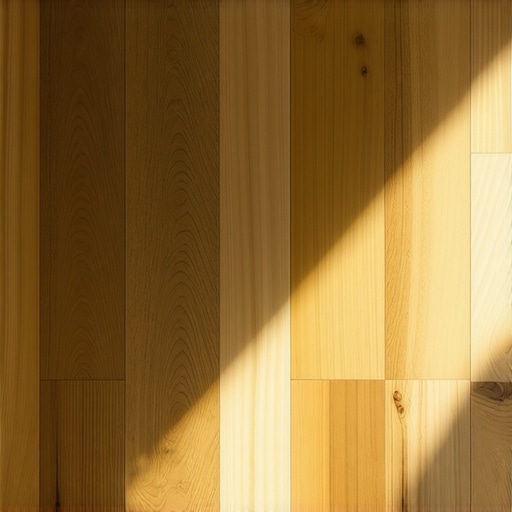
I once walked into a house where a $15,000 wide-plank walnut floor was cupping so bad it looked like a potato chip because the installer didn’t check the crawlspace humidity. The homeowner was devastated, but what made it worse was the high-gloss finish they insisted on. Every single ripple, every 1/64 of an inch of movement, was magnified by the overhead lights like a spotlight on a crime scene. If they had gone with a matte finish, we might have been able to save their sanity while we addressed the subfloor moisture. Instead, the floor looked like a hall of mirrors at a carnival. I spent three decades on my knees with a moisture meter and a level to tell you this. Hardwood floors are alive. They breathe, they move, and they definitely do not like being forced to look like a sheet of glass.
The physics of light on wood surfaces
Matte finish hardwood floors use a lower sheen level to diffuse light rather than reflecting it in a direct path. This light scattering masks minor surface imperfections, scratches, and dust. High-gloss finishes create a mirror effect that highlights every dent and piece of debris on the planks. When we talk about sheen, we are talking about the percentage of light reflected back at a 60 degree angle. High gloss sits up there at 70 percent or higher. Matte is usually down in the 10 to 20 percent range. Think about a car hood. A brand new shiny black paint job shows every swirl mark from a car wash. A matte wrap hides the dirt. Wood is the same way. The cellular structure of the wood is not perfectly flat. Even after sanding with 120 grit paper, there are microscopic valleys. A thick, shiny polyurethane fill those valleys and creates a flat plane. That plane acts as a lens. Every scratch in that lens is visible because the light refraction is interrupted. In a matte finish, the finish itself has flattening agents, often tiny particles of zinc or silica, that break up the light. You are not seeing the scratch because the light is already going in ten different directions.
The ghost in the expansion gap
Expansion gaps are required around the perimeter of every hardwood installation to allow for natural wood movement during seasonal humidity changes. Without these gaps, the floor will buckle or crown, a phenomenon exacerbated by high-gloss finishes. Matte finishes are more forgiving during these inevitable structural shifts. I see it every summer. The humidity hits 80 percent, the wood cells soak up water, and the boards grow. If you do not have that 1/2 inch gap under your baseboard, the floor has nowhere to go but up. On a high-gloss floor, a rise of just 1/32 of an inch creates a shadow line that screams. You do not see that as easily on a matte floor. The lower sheen blends the transition between boards. Most people forget that hardwood floors are not like laminate or tile. Laminate is a photograph glued to a fiberboard core. Tile is kiln-fired clay. Wood is an organic polymer of cellulose and lignin. It is hydraulic. It moves. You cannot stop it. You can only manage it. High gloss makes managing it a nightmare because it demands perfection from a material that is naturally imperfect.
“A floor is only as good as the subfloor beneath it; deflection is the enemy of every joint.” – Master Flooring Axiom
Why your subfloor is lying to you
Subfloor flatness is the most ignored variable in flooring installation yet it dictates the longevity of the finish. High-gloss options require a subfloor that is flat to within 1/8 inch over a 10-foot radius to prevent visual distortions. Matte finishes provide a buffer for minor subfloor variations. I have spent days grinding concrete on a job just so the floor wouldn’t click like a castanet. If your subfloor has a dip, a high-gloss floor will show a pool of light in that dip. It looks like the floor is wet. If you have a hump, the light will break over it. It is about the geometry of the surface. When I am installing engineered hardwood, I am looking at the ply-core stability. If the subfloor is not dead flat, those locking mechanisms or tongue-and-groove joints will flex. Flexing leads to finish cracking. On a high-gloss floor, a micro-crack in the finish turns white. It is called crazing. On a matte floor, you will likely never see it. This is why I tell people to avoid high gloss in high-traffic areas. The mechanical stress on the finish is too high. You are better off with a finish that can hide the battle scars of daily life.
| Feature | Matte Finish (10-20% Sheen) | High-Gloss (70%+ Sheen) |
|---|---|---|
| Scratch Visibility | Very Low | Extremely High |
| Dust & Pet Hair | Hidden | Magnified |
| Maintenance Frequency | Low | Daily |
| Subfloor Requirement | Standard NWFA | Extreme Precision |
| Refraction Type | Diffuse | Specular |
The chemistry of the topcoat
The chemical composition of modern floor finishes often includes aluminum oxide for durability and silica for sheen control. Matte finishes contain more flattening agents which provide a textured surface at the molecular level. High-gloss finishes are pure resins that create a smooth, vulnerable film. When we talk about durability, people often confuse sheen with hardness. They are not the same. A matte finish can be just as hard as a gloss finish. The difference is in how they wear. Every floor wears out. You walk on it, you drag grit across it, and you are basically sanding it with your shoes. A gloss floor wears unevenly. The paths you walk every day will turn matte over time, while the edges of the room stay shiny. This creates a hideous traffic lane. A matte floor is already matte. The wear pattern is much harder to spot because there is no contrast between the worn areas and the original finish. This is the secret to a floor that looks good ten years later. You are not fighting the physics of friction. You are working with it.
- Check subfloor moisture levels with a pin-type meter before installation.
- Acclimate wood for at least 72 hours in the room where it will be installed.
- Always use a felt pad under furniture legs to prevent deep gouges.
- Avoid using steam mops on any hardwood surface regardless of finish.
- Vacuum with the beater bar turned off to prevent scratching the resin layer.
The 1/8 inch that ruins everything
Precision in flooring is measured in fractions of an inch, and high-gloss finishes have zero tolerance for error. Matte finishes allow for the natural character of the wood grain to take center stage, hiding minor installation variances. I have seen guys try to install high-gloss solid oak over a subfloor that was bouncing like a trampoline. Within two months, the finish was flaking off at the seams. Wood floors need to be part of a system. That system includes the joists, the subfloor, the underlayment, and the wood itself. If you are putting hardwood floors in a kitchen where there might be spills, you need to think about the grout lines in your tile elsewhere. You do not want a high-gloss floor next to a matte tile or a textured laminate. It creates a visual jarring that ruins the flow of the house. Matte hardwood has a more natural, organic feel. It looks like wood, not plastic. People pay a lot of money for wood. Why cover it in a layer of plastic that makes it look like a basketball court? It makes no sense to me.
“Wood flooring is a hygroscopic material, meaning it gains or loses moisture to reach equilibrium with its environment.” – NWFA Technical Standards
Refraction patterns on a molecular level
The way light waves hit a surface determines our perception of its cleanliness and quality. Matte surfaces create a chaotic bounce of photons that masks the presence of oils and skin cells. High-gloss surfaces reflect light in parallel waves, making every fingerprint a visible smudge. If you have kids or dogs, high-gloss is a death sentence for your free time. You will be cleaning it every hour. I have seen homeowners get so frustrated they tried to use showers of cleaning chemicals on their floors. That is a mistake. Chemical buildup will ruin the bond of the finish. You need to understand that the finish is a sacrificial layer. It is there to be destroyed so the wood underneath stays safe. Matte finishes are the masters of being destroyed gracefully. They take the hits, they hide the scratches, and they keep the room looking warm and inviting. High gloss is cold. It is clinical. And it is unforgiving. If you want a floor you can actually live on, you go matte. If you want a floor you can only look at from the doorway, go gloss. But don’t call me when the first scratch appears, because it will, and it will be all you see for the next twenty years.