
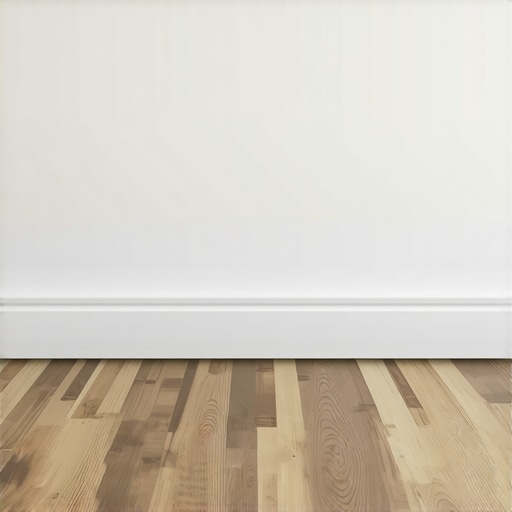
I once walked into a house where a $15,000 wide-plank walnut floor was cupping so bad it looked like a potato chip because the installer didn’t check the crawlspace humidity. The homeowner was in tears. The contractor was long gone. The real tragedy was that it was preventable. I have spent 25 years on my knees with a moisture meter and a level. I have seen every way a floor can fail. Most people think flooring is a cosmetic choice. They are wrong. It is a structural engineering challenge. When you lay hardwood, you are installing a living, breathing material that reacts to the physics of its environment. If your planks are hitting the wall, it is because you ignored the laws of thermodynamics.
The invisible force pushing your baseboards
Hardwood expansion occurs when wood fibers absorb water molecules from the air or subfloor, causing the cellular structure to swell in width. This process, known as hygroscopy, is relentless. When the relative humidity in a room increases, the moisture content of the wood follows. Each individual plank can grow by a fraction of an inch. Across a twenty-foot room, that cumulative growth equals several inches of pressure. If you did not leave a sufficient expansion gap at the perimeter, the wood has nowhere to go but up or out. It will crush your baseboards or create a tented peak in the center of the room. It will buckle. It will ruin your investment.
How moisture moves through a cellular structure
The chemical bond between water and cellulose fibers dictates the dimensional stability of every hardwood installation. Wood is composed of hollow cells. When water enters these cells, it first fills the cell walls. This is called the fiber saturation point. As the walls thicken, the entire plank expands. This expansion is not uniform. Wood expands much more across the grain than it does along the length. This is why wide-plank floors are significantly more dangerous than narrow strips. A five-inch plank has more surface area to absorb moisture and more mass to exert force. If the subfloor is damp, the bottom of the plank swells while the top remains dry. This imbalance causes cupping. The edges of the board lift higher than the center. It creates a washboard effect that is a nightmare to sand flat. You cannot simply sand away the problem. If you sand a cupped floor before it reaches equilibrium, the boards will crown once they eventually dry out. You must address the moisture source first. I smell the oak dust every day, and I can tell you that moisture is the primary enemy of every craftsman.
“A floor is only as good as the subfloor beneath it; deflection is the enemy of every joint.” – Master Flooring Axiom
The 48 hour acclimation myth
Proper wood acclimation is a process of reaching Equilibrium Moisture Content (EMC) rather than a fixed period of time. Most installers tell you to let the wood sit for two days. That is nonsense. If the wood comes from a cold warehouse and goes into a humid house, forty-eight hours is not enough. You need a pin-type moisture meter. You must test the subfloor and the flooring. The NWFA states that for solid strip flooring, the moisture content between the subfloor and the hardwood should be within 4 percent. For wide-plank flooring, that margin drops to 2 percent. If you ignore these numbers, the floor will fail. I have seen guys dump wood in a room with a running humidifier and wonder why the planks look like a roller coaster a month later. You have to wait until the wood stops moving. That might take three days, or it might take two weeks. The wood dictates the schedule, not the contractor.
Why your subfloor is lying to you
Subfloor moisture levels often hide beneath the surface of concrete or plywood, waiting to migrate into your hardwood planks. A concrete slab might look dry on top, but it can be a reservoir of water. Vapor drive is a real phenomenon. Moisture moves from high-pressure areas to low-pressure areas. If your crawlspace is damp, that moisture will push through the subfloor and into the bottom of your hardwood. This is why a 6-mil poly film is not a suggestion, it is a requirement. I have seen homeowners try to save money by skipping the vapor barrier. They end up spending ten times as much on a tear-out. Even in bathrooms where people worry about showers and grout, the real danger is usually the hidden moisture in the air or the slab. Hardwood floors and showers generally do not mix, but if you must do it, your subfloor prep has to be surgical. Any dip in the subfloor will allow the planks to flex. This flex creates a pump action that draws even more moisture into the joints.
| Material Type | Expansion Risk | Moisture Tolerance | Stability Rating |
|---|---|---|---|
| Solid White Oak | High | Low | Moderate |
| Engineered Oak | Medium | Moderate | High |
| Laminate | Medium | Low | Moderate |
| Luxury Vinyl Plank | Low | High | Extreme |
| Porcelain Tile | Zero | Extreme | Maximum |
The math of expansion gaps
Calculating the required expansion gap involves measuring the total width of the installation and the expected seasonal moisture variance. A general rule of thumb is a 1/2 inch to 3/4 inch gap around the entire perimeter. This includes doorways, fireplaces, and cabinets. Do not undercut your baseboards and jam the wood tight against the drywall. The wood needs to breathe. I hate seeing T-moldings in the middle of a floor, but on long spans, they are a necessary evil. If your room is wider than thirty feet, you are asking for trouble without an intermediate expansion break. The physics do not care about your aesthetic. If the wood expands and hits a heavy kitchen island, it is locked in place. The pressure will build until the weakest point gives way. Usually, that is a tongue snapping off a groove or a plank lifting off the glue. It is a structural failure caused by a lack of math.
“Wood is a hygroscopic material, meaning it constantly gains or loses moisture to reach equilibrium with its environment.” – NWFA Technical Manual
Correcting the buckle before it ruins the room
Fixing a buckled floor requires immediate reduction of ambient humidity and, in extreme cases, the removal of perimeter boards to restore expansion space. If you catch it early, you can sometimes save the floor. Put a dehumidifier in the room. Bring the relative humidity down to 35 percent. If the planks have already hit the wall, you must remove the baseboards. You might need to use a toe-kick saw to trim the edges of the floor back. This gives the wood room to lay back down. Do not walk on a buckled floor. You will break the locking mechanisms or the tongues. If the wood has been wet for too long, the lignin in the cells is permanently damaged. At that point, you are looking at a full replacement. It is a bitter pill to swallow. I have seen it happen in the dry heat of Phoenix and the swampy humidity of Houston. The climate changes, but the physics of wood remains the same.
The Pre-Installation Checklist
- Test the subfloor moisture content at twenty different locations per thousand square feet.
- Verify that the HVAC system has been running for at least seven days at normal living conditions.
- Inspect every plank for milling defects before nailing it down.
- Ensure the expansion gap is equal to the thickness of the flooring material.
- Use a high-quality moisture barrier even if the subfloor seems dry.
- Check the crawlspace for standing water or lack of ventilation.
Most installers want to get in and out as fast as possible. They want the check. They do not care about the floor two years from now. But a master knows that the job starts weeks before the first nail is driven. You have to respect the material. You have to understand the chemistry of the adhesives and the physics of the expansion. If you treat flooring like a decoration, it will fail. If you treat it like an engineering project, it will last a century. Laminate and LVP have their place, but nothing beats a real wood floor that was installed with precision. Just keep it away from the showers and keep the moisture in check. Your subfloor is the foundation of your home’s comfort. Treat it with the respect it deserves, or the wood will remind you of your mistakes every time it hits the wall.